Cynefin Framework
The Cynefin Framework is a decision-making tool that categorizes problems into five domains: Clear, Complicated, Complex, Chaotic, and Confused. It helps identify the appropriate approach—best practices, good practices, sense-making, or rapid response—based on the level of uncertainty and cause-effect relationships.
THE IDEA
Relief through insight
When I first shared this reality with Riva, I watched decades of guilt, perfectionism, and self-criticism fall from her shoulders. Her negative self-talk now had a mighty combatant: the truth. Using a notebook I drew the Cynefin Framework for her and explained:
“If you were a machine you would always be able to more or less predict your next blood sugar. You’d make a cause-and-effect analysis and calculate your way to a number. You control the outcome by standardizing and manipulating the variables, like food, exercise and the effect of a unit of insulin.
But as a living biological organism, most of the time managing your blood sugar relies on unknown, invisible and constantly changing and interacting variables. Then you take an action and that causes the variables and your blood sugar to fluctuate again. This, in complexity theory, is called a recursive process. You co-create a result to which you respond, which in turn changes the outcome. And this is the very nature of a complex system: the outcome is uncertain and unpredictable, and what you do may have unintended effects. There are too many unknown unknowns.
The good news is that while you can’t predict your blood sugar numbers, they are not random, and from the Complex domain you can see patterns, or dispositions. Discovering these, you can influence your numbers in the right direction. Still, there is no certainty, so you cannot be held accountable for the results. Your effort becomes monitoring and knowing what to do when a blood sugar number appears on your meter. That’s the criterion for success.”
Riva’s response was immediate: a new perspective and profound relief. Boudewijn’s explanation that she lives in the Complex domain of the Framework confirmed what she had always felt but had no language for. Together they had even photographed a subway poster that read “control is an illusion,” intuiting its truth. Understanding that managing blood sugar is a constant sense-making activity knocked the last vestige of guilt, shame, and perfectionism off her shoulders. It buoyed her energy and confidence and helped define a path toward ‘blood sugar mastery’—knowing how to recognize patterns, influence blood sugar, and respond to any number to move it in the right direction.
This transformation illustrates the power of the Cynefin Framework: a sense-making model that helps people see the type of system they are dealing with so they can choose the right action. But what exactly is Cynefin, and how did it come to hold such power?
The origin and meaning of Cynefin
Cynefin (pronounced kun-ev-in) is a Welsh word with no direct equivalent in English. As a noun it translates to habitat; as an adjective, familiar or acquainted. Yet dictionary definitions fail to do it justice. A more poetic, richer meaning comes from the introduction to a collection of paintings by Kyffin Williams: “It describes that relationship: the place of your birth and of your upbringing, the environment in which you live and to which you are naturally acclimatised.” Dave Snowden, the framework’s creator, often describes it as “the place of your multiple belongings.” The word speaks of flow through time and space, a multiplicity of tangled connections, of community. It differs from the Japanese concept of Ba (a shared space for emerging relationships) in that it links a community into its shared history—or histories—in a way that paradoxically both limits perception and enables an intuitive ability to adapt to profound uncertainty.
Cynefin began in the late 1990s during Snowden’s work on knowledge management at IBM. He was critiquing the Data-Information-Knowledge-Wisdom pyramid and arguing that knowledge exists on a spectrum between tacit and explicit. Inspired by Max Boisot’s I-Space model, he initially mapped knowledge along axes of abstraction and codification, showing that high abstraction creates notes that remind us of what we know, while low abstraction aims for codification that makes knowledge independent of people. The framework first appeared as a 2x2 matrix in 1999 and was published in the 2000 book Knowledge Horizons. Over more than two decades it evolved through continuous iteration between theory and practice, shaped extensively by teaching on flip charts, conversations with thinkers like Boisot and J.C. Spender, and the 2007 Harvard Business Review cover article “A Leader’s Framework for Decision Making” co-authored with Mary Boone. It won awards and spread into fields ranging from government and healthcare to software development and disaster response.
At its heart, Cynefin is a sense-making framework—more specifically, a naturalized sense-making framework. Sense-making asks: How do we make sense of the world so that we can act in it? Cynefin provides a practical answer by distinguishing five domains of decision-making, each with its own relationship between cause and effect, and each demanding a different mode of action.
The five domains of the Cynefin Framework
The framework uses a curved, liminal diagram to represent five domains, often remembered as four Cs and a central area of confusion.
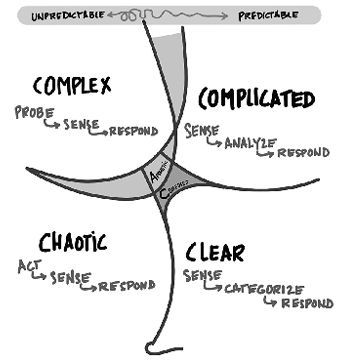
Clear (originally called Simple or Known) – The domain of obvious cause and effect. Here, best practices exist and can be applied with little expertise. Standard operating procedures, recipes, and rules work reliably. In T1D, this domain covers extreme emergencies: severe hypoglycemia calls for an emergency glucagon injection and dialing emergency services. But as soon as the situation stabilizes, the Clear domain alone is insufficient.
Complicated – The domain of multiple right answers, where cause and effect require analysis or expert knowledge. Good practices (rather than a single best practice) apply. For diabetes, carrying glucose tablets at all times, checking blood sugar at regular intervals, and using a CGM to track trends are good practices. In organizations, this is the realm of specialists: engineers, doctors, lawyers. The instruction “organize yourselves by height, birth date, and shoe size” creates a Complicated problem; groups devise various strategies, and those who solve it become temporary experts who can teach others.
Complex – The domain of entangled, dynamic cause and effect that can only be understood in hindsight. There are too many unknown unknowns for analysis to work. The appropriate approach is probe-sense-respond: run safe-to-fail experiments, see what patterns emerge, and amplify what works. This is where most of T1D management lives—daily blood sugar fluctuates due to hundreds of interacting variables. No calculation can guarantee a number; instead, one must learn to recognize dispositions and nudge the system. In workshops, the “eclipse game” (each person simultaneously trying to keep their Moon between themselves and their Sun) creates a Complex system: frustration, emergent clusters, and heuristics like “move slowly” arise naturally without any central plan.
Chaotic – The domain where cause and effect are completely unclear and turbulence reigns. Immediate stabilizing action is required: act-sense-respond. A patient rushed to hospital in a severe hypoglycemic crisis enters chaos; emergency workers may not know the person has T1D and may make mistakes. The boundary between order and chaos is a cliff, not a smooth transition.
Confused (or Disorder) – The central domain where it is not clear which of the other domains applies. This is a legitimate state of not-yet-knowing. In T1D, confusion arises when a blood sugar number appears and the person has no idea why. The framework encourages leaning into confusion as a portal to sense-making, rather than forcing a premature categorization. In the liminal version of Cynefin, the Confused domain includes an aporia zone—deliberate puzzlement through paradox and questioning that can unlock fresh insight.
Cynefin adds four liminal subdomains that lie between the main domains, representing transitions. For example, the liminal space between Complex and Complicated is where we move from emergent insight to codified good practice. The liminal aspect acknowledges that movement and boundary-crossing are where much of the practical work happens.
Dynamics and key principles
Cynefin is not a static classification tool; it is about movement. The framework recognizes that situations shift across domains—a stable Complicated process can slide into Chaos if critical expertise is lost, and a Chaotic crisis can be stabilized into Clear routines. Understanding these dynamics helps leaders avoid catastrophic domain-crossings (such as the “Masada Gambit”—throwing things into chaos for its own sake when ordered approaches fail) and instead navigate transitions mindfully.
Two foundational principles underpin all use of Cynefin:
-
Bounded applicability: Most things have value within certain boundaries. Nothing works universally; everything is context-specific. Ordered approaches are valuable in ordered domains but become destructive when forced onto Complex systems. The goal is not to discard past methods but to understand where they fit.
-
Coherent heterogeneity: Embrace as much diversity as possible without becoming incoherent. This allows multiple perspectives to coexist and enrich sense-making, rather than imposing a single “one size fits all” narrative.
A third principle, from Alicia Juarrero’s work, is the critical role of constraints. In ordered systems, we impose rigid constraints (rules, procedures). In complex systems, we use enabling constraints—boundaries that create a field of possibility without dictating exact paths. Safe-to-fail experiments are a form of enabling constraint: they limit the downside while allowing novel patterns to emerge.
How Cynefin shows up in practice
Healthcare and type 1 diabetes. The diabetes story that opened this chapter is not an isolated example; it reflects a broader reimagining of chronic disease management. When T1D was diagnosed in 1972, management was squarely in the Clear domain: a prescribed diet, urine testing, and the same insulin dose every morning. Today, with continuous glucose monitors, varied insulins, and countless influencing factors, it is a constant sense-making activity. Studies show people with T1D make about 180 decisions daily. Yet the myth of control persists, fed by devices that promise precision but often lead to self-blame when numbers are not perfect. Clinicians who embrace Cynefin can meet patients in the Complex domain—listening to their stories, exploring patterns, co-designing safe-to-fail experiments, and replacing judgmental labels like “non-compliant” with curiosity. Success becomes the ability to recognize patterns and respond effectively, not to hit a fixed number.
Safety and risk. Safety culture is a Complex phenomenon. Traditional Safety-I focuses on identifying known risks and preventing things from going wrong; it excels in ordered domains. But in complex socio-technical systems, the unimaginable can happen. Safety-II, inspired by complexity thinking, focuses on what makes things go right and builds capacity for adaptive response. Cynefin bridges the gap between workers at the sharp end—who navigate complexity daily—and regulators who often rely on linear models. It helps organizations acknowledge that incidents often emerge from system complexity rather than simple cause-effect chains, and that cultivating resilience requires both best practices for the known and flexible heuristics for the unknown.
Strategy and leadership. Strategy is no longer a static document but a dynamic movement through the domains. A printed strategic plan is often obsolete on arrival. Cynefin reframes strategy as a verb: a continually evolving process that guides attention, decision-making, and action in a way that remains coherent with purpose. Leaders allocate resources across tactical, strategic, and horizon time-frames—much like a barbell approach, balancing high-probability incremental improvements with asymmetric investments in emergent possibility. In law enforcement, a supervisor might shift from Command & Control in a Clear situation to Mission Command in a Complex one, matching leadership style to domain.
Public service and the small country effect. Wales has been a living laboratory for Cynefin in public services. The 2015 Wellbeing of Future Generations Act—requiring public bodies to act sustainably and consider long-term impact—aligns deeply with Cynefin’s principles of emergence, local context, and safe-to-fail learning. Early adopters in Welsh health services ran SenseMaker® projects to collect micro-narratives and understand complex community needs, moving away from “one size fits all” policies developed in Cardiff headquarters. Small countries (defined loosely as groups under 5 million with strong local identity) seem particularly receptive; Cynefin has spread through Wales, New Zealand, Nova Scotia, and other pockets, often through a band of excited activists who, as one participant put it, “can’t unsee it.”
Complex facilitation. The shift to complexity changes facilitation itself. Traditional facilitation aims to support groups in reaching a defined outcome through structured processes, with the facilitator often acting as expert or guide. Complex facilitation, in contrast, designs conditions for a shared understanding to emerge without the facilitator engaging in content. Instructions may be deliberately ambiguous, outcomes are not predetermined, and the responsibility for making sense shifts to the group. This can be uncomfortable—for participants used to being led, and for facilitators who must embrace uncertainty—but it unlocks novel insights and responses that ordered facilitation cannot reach.
Using micro-narratives and SenseMaker®. In ordered domains, measurement and statistics suffice. In the Complex domain, people make sense through experiences and stories. Political campaigns have used SenseMaker®—a tool that collects micro-narratives and allows respondents to self-interpret them—to detect authentic support beneath misleading polls. During Colombia’s 2018 presidential election, the winning campaign used SenseMaker to reveal that a heavily hyped opponent had little true popular backing, allowing them to allocate scarce resources correctly. This approach exemplifies how narrative-based sense-making can decode complexity.
Exercises that bring the domains alive. Teaching Cynefin often involves three experiential exercises:
- “Organize yourselves by height in 30 seconds.” Groups invariably succeed with a single best practice—a Clear domain task.
- “Organize by height, birth date, and shoe size in 5 minutes.” This Complicated problem yields multiple good practices, and some participants become temporary experts who can teach others.
- The eclipse game: each person secretly chooses a Sun and a Moon and tries to keep the Moon between them and the Sun. The room immediately moves into a Complex adaptive system—frustration, emergent clusters, heuristics, infinite play, and no single solution. Debriefing the differences opens a deep conversation about leadership, constraints, and the dominance of linear problem-solving habits.
A tool for embracing the unknown
Cynefin is not merely a classification grid; it is a way of being in complexity. It helps us navigate intentional and emergent change, surprise, and possibility. In disaster response, for instance, a command center holds both Clear protocols for generator start-up and Complex real-time coordination, moving fluidly between domains under extreme stress. The framework enables a kind of preparedness that extends beyond planning for the imaginable to nurturing the capacity to adapt to the unimaginable.
It also reshapes risk practice. Risk management in traditional form tends to obsess over threats and controls; Cynefin invites a parallel focus on possibility and nurturing the system. Instead of engineering defenses against every imaginable threat, practitioners run safe-to-fail experiments, amplify emergent solutions, and cultivate conditions from which new capabilities can arise. As Rebecca Solnit writes, “Hope is an embrace of the unknown and the unknowable, an alternative to the certainty of both optimists and pessimists.”
Mastery as an infinite game
Just as complexity is not a higher order of complicatedness, mastery is not the meticulous codifying of good practices. The pursuit of mastery in any field that touches complexity—whether blood sugar management, leadership, safety, or strategy—is emergent and ongoing. It is an infinite game played in a dynamic, messy, fragmented world. The Cynefin Framework serves as a navigation tool that entices us to think differently about risk, control, and our role as stewards of the systems we inhabit.
Cynefin’s own journey is instructive. It has come home to Wales not as a rigid doctrine but as a living framework that evolves with its users. In the words of one practitioner, “I’ve seen it. I can’t now unsee it.” Once you learn to recognize the different domains, the world looks different. You stop blaming yourself for failing to control the uncontrollable. You stop imposing ordered solutions on complex problems. Instead, you probe, sense, and respond. You cross the river by feeling the stones—setting a direction, taking a step into the adjacent possible, and trusting that the next stone will become visible when you need it.
A Mulla Nasrudin story serves as a cautionary parable for Cynefin practitioners: Nasrudin found a weary falcon on his windowsill. He had never seen such a bird. “You poor thing,” he said, “how ever were you allowed to get into this state?” He clipped the falcon’s talons, cut its beak straight, and trimmed its feathers. “Now you look more like a bird,” said Nasrudin. The framework warns us: don’t trim the falcon. Don’t force the complex into the ordered. Instead, leave the door open for the unknown—that’s where the important things come from.
When to use it
Strategic planning: Use Cynefin to classify business challenges and choose appropriate methodologies (e.g., Lean for ordered, Agile for complex).
Crisis management: In an emergency, first stabilize the chaotic system, then move to probe for patterns in the complex domain.
Innovation: For complex problems, run experiments (probe) to discover emergent solutions rather than imposing a predetermined plan.
Personal growth: Apply Cynefin to life decisions—different approaches for routine tasks (ordered), learning new skills (complex), and unexpected life events (chaotic).
Determining the appropriate leadership and decision-making approach in different organizational contexts.
Analyzing crises to decide whether to stabilize first (chaotic) or probe (complex).
Evaluating community resilience and collaboration potential based on shared history and environment.
Designing knowledge management systems that account for the tacit, contextual nature of understanding.
Using Cynefin to categorize strategic problems in a company off-site.
Applying Cynefin to choose between analytical, experimental, or action-oriented methods in a project.
Classifying customer service issues to determine whether to standardize or adapt responses.
Navigating ambiguous situations in product development by first identifying the domain.
Project management: selecting project methodology based on task uncertainty.
Strategic planning: assessing the environment to decide between analysis and emergence.
Crisis management: quickly diagnosing the nature of a crisis to activate the right response.
Innovation: knowing when to use experiments (complex) vs. expert analysis (complicated).
Organizational change: identify whether the change is complicated (requires expert guidance) or complex (requires iterative experimentation and feedback).
Crisis management: determine if the situation is chaotic (act quickly to stabilize) or complex (probe and adapt over time).
Product development: use Cynefin to decide when to follow best practices (simple), seek expert advice (complicated), or run agile experiments (complex).
Assessing whether to codify tacit knowledge in an organization, such as capturing expert knowledge from retiring employees.
Deciding on the appropriate level of formalization for processes in a project management context.
Evaluating the effectiveness of knowledge sharing practices in a team or department.
Designing training programs that balance explicit instruction with tacit skill development.
Strategic planning in an organization with high uncertainty, using the complex domain for probing and sensing.
Risk assessment and horizon scanning for government agencies, leveraging narrative to detect weak signals.
Leadership development programs that train managers to differentiate between simple, complicated, complex, and chaotic contexts.
Post-crisis sense-making to understand emergent patterns and adapt responses in chaotic situations.
Software development teams choose appropriate methodologies (e.g., Scrum, XP) based on the domain of the problem.
Managers avoid applying a one-size-fits-all approach by assessing whether a situation is simple, complicated, complex, or chaotic.
Organizations use Cynefin to determine when to run safe-to-fail experiments (complex domain) versus when to follow best practices (simple domain).
Change management initiatives adopt different strategies depending on the complexity of the environment.
Categorizing the nature of a project's problem to choose the appropriate management approach (e.g., Agile for complex, traditional for complicated).
In innovation processes, leveraging the Complex domain for experimentation and the Complicated domain for expert analysis.
During organizational change, using the Chaotic domain to quickly stabilize and then moving to Complex or Complicated for structured improvement.
Managing organizational change in a volatile market where the path forward is unclear; use Cynefin to sense which domain the situation falls into and adapt accordingly.
Designing product development cycles for innovative projects, allowing for iterative exploration of 'adjacent possibles' rather than fixed milestones.
Deciding on a public health response during an emerging pandemic, where the situation is complex and requires continuous probing and pattern recognition.
Resolving a team conflict by first understanding whether the disagreement is simple (facts & procedures), complicated (needs expert analysis), or complex (requires experimentation and shared sense-making).
When developing policy for diverse communities, use Cynefin to assess whether the context is simple, complicated, complex, or chaotic.
When a business problem resists standard solutions, apply Cynefin to shift from a prescriptive approach to an adaptive one.
During organizational change, use Cynefin to categorize challenges and choose appropriate management techniques.
Classifying urgent vs. complex problems in healthcare management to decide whether to use standard protocols or adaptive approaches.
Using SenseMaker to gather and interpret stories from citizens to inform public policy in a local government.
Applying Cynefin to a project management scenario to determine whether the environment is complicated (requiring expert analysis) or complex (requiring experimentation).
Training teams in Cynefin to improve collective sense-making and decision-making under uncertainty.
Public policy planning in uncertain environments where cause and effect are unclear.
Organizational change management when outcomes are unpredictable and require adaptive approaches.
Crisis management in chaotic situations that demand immediate action to restore order.
Strategic decision-making in business with multiple interacting factors and emergent patterns.
Public policy development: Designing long-term sustainability laws that require multi-stakeholder collaboration and localized implementation.
Business strategy: Navigating uncertain markets by using safe-to-fail probes to test new products or services before full commitment.
Community initiatives: Empowering local groups to solve grassroots problems with context-specific solutions rather than top-down mandates.
Crisis management: During emergencies like pandemics, using Cynefin to decide when to apply simple rules versus when to allow adaptive, decentralized responses.
A project manager uses the Cynefin framework to assess whether a project is clear (standard operating procedures), complicated (needs expert analysis), or complex (requires experimentation and adaptation).
A teacher designs learning activities that shift between domains: direct instruction (clear), problem-solving with expert guidance (complicated), and open-ended projects (complex).
A leader in a crisis uses the framework to decide whether to apply established protocols or allow emergent strategies to unfold.
Training teams to better understand and navigate complexity in decision-making.
Organizational development work to diagnose and shift culture away from confusion toward appropriate domain responses.
Designing workshops or learning experiences that move from conceptual to embodied understanding of frameworks.
Leadership coaching to help leaders recognize when they are misapplying simple or complicated approaches to complex challenges.
Leading a team through an ambiguous project with no clear path forward.
Deciding on a strategy in a rapidly changing market where data is incomplete.
Facilitating a workshop to help an organization embrace uncertainty.
Personal development for leaders seeking to be more authentic and adaptive.
Managing a chronic condition like Type 1 diabetes, where numerous variables interact unpredictably.
Making strategic decisions in a business environment with high uncertainty and unknown unknowns.
Responding to an emergency situation where rapid action is needed and cause-effect relationships are unclear.
Evaluating healthcare policies to move away from a control mindset and towards sense-making and adaptation.
Managing diabetes treatment plans by recognizing that each patient's response is context-dependent and not fully controllable.
Transitioning from a prescriptive, protocol-driven approach to a collaborative, adaptive one in chronic disease management.
Facilitating conversations with patients about uncertainty and the need for flexibility in daily management.
Healthcare professionals working with patients who have chronic conditions like type 1 diabetes, to move from a prescriptive approach to a collaborative, sense-making one.
Managers leading teams in complex, dynamic environments where emergent solutions are needed rather than rigid plans.
Educators helping students understand the difference between complicated and complex problems in subjects like biology or social systems.
Individuals managing their own health or personal projects that involve many interacting variables, to avoid oversimplifying and to experiment safely.
Healthcare: Designing patient interactions and treatment plans that accommodate complex, emergent dynamics like diabetes management.
Law enforcement: Structuring training, investigations, and supervision to match the complexity of situations, from routine patrol to tactical operations.
Business: Comparing and integrating Cynefin with other management philosophies like Theory of Constraints to improve decision-making.
General decision-making: Categorizing problems and environments to select appropriate strategies, tools, and mindsets.
Organizational change initiatives where the path forward is unclear
Software development projects with evolving requirements
Military or emergency response command and control
Innovation management in product development
Use Cynefin to decide whether to implement a new software development methodology based on the complexity of the project.
When designing an employee wellness program, use story collection and sense-making to uncover emergent issues rather than relying only on surveys.
In a crisis situation, use the Chaotic domain to act immediately to stabilize, then move to Complex to learn.
When faced with a novel problem, use the Probe-Sense-Respond approach to run safe-to-fail experiments.
Categorizing strategic decisions in an organization to avoid applying simple solutions to complex problems.
Informing crisis management by quickly identifying whether the situation is chaotic or complex.
Guiding product development in environments where experimentation and feedback loops are essential.
Enhancing risk management by acknowledging unknown unknowns and using the framework to navigate uncertainty.
When planning a product launch in a rapidly changing market, use Cynefin to assess if the environment is complex or chaotic to decide on an agile versus structured approach.
During organizational change, apply Cynefin to understand whether the change is simple, complicated, complex, or chaotic to select appropriate management strategies.
When analyzing a crisis, use Cynefin to quickly categorize the situation and prioritize actions (e.g., stabilize in chaotic, analyze in complicated, probe in complex).
In strategic planning, use Cynefin to map different business units into domains and tailor decision-making processes accordingly.
Disaster response coordination during a natural disaster
Business strategy in uncertain markets or disruptive innovation
Emergency room triage where conditions evolve rapidly
Project management in complex environments with unpredictable outcomes
Strategic planning in volatile markets where traditional forecasting fails
Organizational change initiatives in complex social systems
Prioritizing innovation projects with unknown outcomes and interdependencies
Crisis response and adaptation to emergent challenges
A business leader uses Cynefin to decide whether to apply standard operating procedures (simple) or run experiments (complex) when entering a new market.
A policy maker applies Cynefin to distinguish between complicated regulatory design (requiring expert analysis) and complex social systems (requiring iterative probing).
A teacher uses Cynefin to design lesson plans: simple drills for foundational knowledge, complex projects for ambiguous problems.
Innovation portfolio management using the barbell approach (safe bets vs asymmetric bets)
Crisis management and emergency response when situations are chaotic or complex
Organizational change initiatives requiring different strategies for different parts of the system
A product development team uses Cynefin to decide when to use agile vs. plan-driven approaches based on the domain of their work.
A policy maker tackling a wicked social issue (e.g., poverty) uses complex facilitation to bring together citizens, experts, and stakeholders to probe for insights and allow shared solutions to emerge.
An organization in crisis (e.g., sudden market disruption) applies complex facilitation to navigate uncertainty, avoiding the trap of imposing old solutions on a new complex context.
A research group exploring innovative technologies uses Cynefin to identify that their domain is complex, thus adopting a probe-sense-respond approach rather than a linear R&D process.
A product development team uses Cynefin to categorize their project challenges and choose appropriate methodologies.
A crisis management team uses the Chaotic domain to stabilize a situation before moving to other domains.
An executive team uses the framework to prioritize initiatives based on their complexity and required decision style.
Leaders can use Cynefin to classify problems in product development, choosing between iterative prototyping (complex) or standard procedures (complicated).
In crisis management, quickly assess if the situation is chaotic (act first) or simple (follow protocols).
When designing organizational change, use Cynefin to decide whether to mandate change (simple) or allow emergent strategies (complex).
Political campaigns: to gauge true public sentiment beyond media narratives and traditional polls.
Organizational change: to understand underlying dynamics and resistance to change through employee stories.
Public policy: to assess the impact of interventions in highly interconnected social systems.
Business strategy: to navigate market complexity by sensing emerging patterns through decentralized feedback.
Classifying safety issues into Cynefin domains to determine appropriate management strategies (e.g., probe-sense-respond for complex problems).
Using the framework to communicate with regulators about the complexity of front-line operations and the limitations of linear cause-effect models.
Applying Cynefin to incident investigation to avoid oversimplification and recognize emergent phenomena.
Evaluating an unexpected equipment failure in a factory—determining whether it is complicated (requiring expert diagnosis) or complex (requiring experimental probes).
Designing a pandemic response plan for a hospital that acknowledges the complex nature of viral spread and the need for flexible protocols.
Improving incident reporting systems to capture both known risks (Safety-I) and emergent weak signals (Safety-II).
Training safety leaders to shift from command-and-control to probe-sense-respond when facing novel, high-stakes situations.
FROM THEORY TO EVERYDAY LIFE
In practice
Categorizing a Business Problem
A company facing declining sales: if the causes are known (e.g., price increase), it's an ordered problem; if interactions in the market are unclear, it's complex; if a sudden crisis like a PR disaster, it's chaotic. Use Cynefin to decide the appropriate response: analyze for ordered, probe for complex, act for chaotic.
Policy-Making During a Pandemic
Governments used Cynefin to understand the pandemic: early on, it was chaotic (unknown unknowns); later, as data emerged, it became complex; some aspects (like vaccine distribution) became ordered. The framework helped shift strategies as understanding evolved.
Classifying a Business Problem
A manager faces a sudden drop in sales. Using Cynefin, they assess whether the cause is obvious (simple), requires expert analysis (complicated), has many interacting factors (complex), or is a complete surprise (chaotic). This informs whether to follow best practices, seek expertise, run experiments, or act decisively to stabilize.
Community Adaptation to Crisis
During a natural disaster, a community with strong Cynefin (rootedness in place and history) may intuitively coordinate and adapt, while a community without such ties may struggle with survival and fail to collaborate effectively.
Crisis Management
In a chaotic situation like a product recall, leaders must first act to contain damage (chaotic domain), then diagnose the cause (complex domain) and eventually standardize corrective procedures (simple domain).
Software Development
A new software feature may involve unknown unknowns (complex domain) requiring experimentation and iterative feedback, whereas routine maintenance tasks (simple domain) can follow established protocols.
Classifying a business problem
A manager facing declining sales uses Cynefin to determine if the problem is simple (best practice), complicated (expertise needed), complex (probe-sense-respond), or chaotic (act-sense-respond).
Healthcare decision
A medical team uses Cynefin to choose the appropriate approach: simple for routine surgeries, complicated for diagnosing rare diseases, complex for managing patient reactions, and chaotic for emergency trauma.
Categorizing a problem in a project team
A project manager notices that a recurring quality issue cannot be fixed by standard procedures (simple) nor by expert analysis (complicated). The team instead experiments with different workflow adjustments, observes the outcomes, and adapts – a classic complex (probe-sense-respond) approach enabled by Cynefin.
Knowledge Codification Decision
An organization considering whether to document a senior engineer's expertise (tacit knowledge) into a manual (explicit knowledge) uses Cynefin to assess the cost of codification. The framework suggests that only in a limited zone—where abstraction and codification balance—is formal knowledge management worthwhile. For highly tacit knowledge, the cost exceeds benefits, so mentoring or storytelling may be preferred.
Drucker's Insight on Human Judgment
Peter Drucker helped Snowden realize that Scientific Management and Complexity Thinking both preserve a role for human judgment, unlike cybernetic systems thinking. This insight shaped Cynefin's emphasis on narrative and context.
Singapore Government Risk Assessment
Snowden became an advisor to Singapore's Ministry of Defense and later won a tender for complexity aspects of risk assessment and horizon scanning, leading to strong ties with the Civil Service College and making Singapore home for Cognitive Edge.
Applying Cynefin to Agile Methodology
In software development, teams use Cynefin to classify problems: standard best practices for simple issues, expert judgment for complicated problems, and safe-to-fail experiments for complex ones. This helped avoid a one-size-fits-all approach and integrated Cynefin with Agile practices.
Critique of Universal Management Fads
Cynefin was developed to counter management fads that claim universal applicability. The principle of bounded applicability shows that each method has value only within its appropriate domain, avoiding tokenization and ensuring legacy practices are respected.
Using Liminal Subdomains in Strategy
A company facing a complex market shift uses the liminal space between complex and complicated to apply a mix of probe-sense-respond and sense-analyze-respond methods, transitioning smoothly as understanding grows.
Renaming Domains for Clarity
In a workshop, participants found it easier to use the terms Clear, Complicated, Complex, Chaotic, and Confused instead of the older terms Obvious, Known, Simple, and Disorder, leading to better communication and application.
Crossing a river by feeling the stones
The framework is likened to crossing a river by feeling for stones underfoot: you have a general direction (cross the river) but do not aim for a specific point. Each step reveals new stepping stones (adjacent possibles), and sometimes you must take a risk without seeing the next stone. Progress is emergent and evolutionary rather than engineered and certain.
The falcon parable (Mulla Nasrudin)
Nasrudin finds a weary falcon and, not recognizing its true nature, clips its talons, cuts its beak straight, and trims its feathers to make it 'look more like a bird.' This story warns practitioners not to force the Cynefin Framework into a mechanical, linear mold, but instead to honor its organic, sense-making spirit.
Gorilla playing basketball eye test
A video demonstrating selective attention, used by Dave Snowden to illustrate how people miss unexpected events when focused on a specific task.
How to organize a party for teenagers
A story used to show that complex problems require adaptive, emergent approaches rather than rigid plans.
Cynefin in Welsh Public Services
Over the next few years, Dave’s ideas, from the ‘Gorilla Eye Test’ to specific courses to teach the principles of Complex Adaptive Systems, the Cynefin Framework, and SenseMaker, surfaced in many spots within Welsh Public Services.
SenseMaker in Health Promotion (Australia-Wales Connection)
A representative from the Australian State of Victoria, John Wyn Owen of the Welsh Learned Society, came to speak at a major health conference in Wales about their use of SenseMaker in health promotion. This exemplified how Small Countries around the world were connecting through Cynefin.
MBTI Practitioners' Reaction
During the keynote, Dave Snowden critically evaluated the Myers-Briggs Type Indicator, causing some MBTI practitioners in the audience to feel their deeply held views were shattered. Cynefin challenges simplistic classification systems.
Public Service Leaders' Adoption
In 2016, Welsh public service leaders had greater awareness of complexity and the Cynefin Framework compared to 2008, showing how the framework's application evolved in real-world policy contexts.
Wales Wellbeing of Future Generations Act
Wales became the first country to legally require public services to act sustainably and consider future generations. The Act's Five Ways of Working (collaboration, long-term thinking, integration, citizen involvement, prevention) align directly with the Cynefin Framework, shifting from rigid 'one size fits all' approaches to context-sensitive 'safe-to-fail probes' and community-led actions.
Pandemic Response and Local Context
The Coronavirus pandemic highlighted the need for locally adapted responses rather than uniform solutions. Using Cynefin, leaders moved from a 'failure is not an option' mindset to experimenting with safe-to-fail probes, allowing communities to develop sustainable solutions tailored to their unique circumstances.
Exercise 1: Organize by Height
Groups are asked to organize themselves by height within 30 seconds. This is a Clear domain problem: tight constraints and a clear outcome make a best practice effective.
Exercise 2: Organize by Height, Birth Date, and Shoe Size
Groups must simultaneously organize by three variables in 5 minutes. This is a Complicated problem requiring expertise, interpretation, and analysis; solutions vary and are not directly transferable.
Exercise 3: The Systems Game (Sun and Moon)
Each person must keep their Moon between themselves and their Sun in silence and without touching. This complex exercise causes emergent behavior, frustration, and adaptive strategies, highlighting the nature of complex adaptive systems.
Embodied Teaching with Ropes
Keith used ropes to physically represent the Cynefin domains in a workshop, allowing participants to step through and feel the different contexts, making the framework more tangible and impactful.
Internal Application of Cynefin
The growing organization applied Cynefin to recognize its own tendencies toward confusion and to intentionally shape its culture and responses, exemplifying 'eating your own dog food.'
Leaning into confusion
When faced with a complex problem, instead of seeking a quick answer, a leader might pause and explore the confusion, asking questions and seeking diverse perspectives rather than imposing a predetermined solution.
Safe-to-fail experiment in Complex domain
Taking one glucose tablet instead of three to raise blood sugar, then monitoring the change to avoid overshooting.
Clear domain best practice for hypoglycemia
When blood sugar is severely low, follow established best practices to restore equilibrium, such as administering glucagon.
Riva's realization and liberation
Understanding that living with T1D is primarily in the Complex domain, Riva let go of guilt, perfectionism, and self-blame, recognizing that outcomes are unpredictable and success is based on monitoring and responding.
The Engineering Frame vs. Complex Domain in Diabetes Care
A doctor with T1D observes that clinicians learn to apply an engineering frame to humans, which may work in acute care but fails for chronic conditions. Treating diabetes management as a problem in the Clear or Complicated domains (engineering frame) sets impossible goals and leads to clinician-patient dissatisfaction. Shifting to the Complex domain opens new insights and improves outcomes.
Clear domain: Severe hypoglycemia
In a situation of extremely low blood sugar, best practices apply: have an emergency rescue product available and call the national emergency number.
Complicated domain: Preparing for unpredictable highs/lows
Help patients think through how they can prepare for when blood sugar is too high or too low, and what they will do. Also, organize supplies so they know when to reorder.
Complex domain: Safe-to-fail experiments
Explore small, safe-to-fail experiments patients can undertake to make improvements, such as adjusting insulin timing or trying new meal routines.
Applying Cynefin to Diabetes Care
In managing type 1 diabetes, the Cynefin framework helps health professionals and patients recognize that navigating blood sugar is complex. This insight leads to a more open, emergent, and constructive interaction, moving from a coping mindset to flourishing. The Flourishing Approach, based on complexity science and neurobiology, was designed using Cynefin to foster mastery.
Applying Cynefin to Law Enforcement
In policing, Cynefin was used to redesign training programs, shifting from rigid procedures to adaptive strategies. It helped detectives differentiate between simple, complicated, and complex investigations, guiding appropriate interview techniques and intelligence approaches. For supervisors, it clarified when to use Command & Control versus Mission Command based on the situation.
U.S. Navy Combat Information Center (CIC)
During World War II, Admiral Nimitz used Cynefin principles to develop the CIC. He avoided imposing a solution, instead using parallel safe-to-fail experiments and enabling constraints to allow innovative solutions to emerge from subordinates. This led to a new system that merged command functions and improved responsiveness.
Applying Agile in a Nuclear Power Plant
A person asked how to apply Agile techniques to dismantling nuclear power stations. The author responded that software development has inherent safety through rollback, but physical environments like nuclear plants require more careful change. Cynefin helps identify whether a context is simple, complicated, or complex, guiding whether to adopt Agile or a more controlled approach.
Improving Well-being through Stories
An organization seeking to improve employee well-being initially used standard surveys and mindfulness programs. By applying the Cynefin framework, they realized well-being is a complex emergent property. They then collected employee stories using SenseMaker to identify patterns of conditions and interactions that matter, leading to more effective, context-specific policies.
Product Development in a Complex Context
A product development team uses the Cynefin Framework to categorize their project as complex, requiring an experimental probe-sense-respond approach rather than traditional predictive planning.
Crisis Response
During a sudden market disruption, a management team applies the Cynefin Framework to identify the situation as chaotic, prompting immediate action to stabilize before moving to a more ordered domain.
Product Development in a Complex Market
When launching a new product in a rapidly changing market, use the Cynefin Framework to determine whether the environment is complex (unknown unknowns) or complicated (known unknowns). In a complex domain, adopt an experimental, probe-sense-respond approach; in a complicated domain, use expert analysis and best practices.
Organizational Crisis Response
During a sudden crisis, quickly assess the situation using Cynefin. If it's chaotic (e.g., a natural disaster), act immediately to stabilize (act-sense-respond). If it's simple (e.g., a routine technical glitch), apply standard operating procedures. This categorization prevents applying the wrong strategy.
Power system blackout disaster response
During a wide-scale power system blackout, a disaster response command center must act rapidly using clear protocols for generator start-up and multi-agency coordination. Experienced responders exhibit calmness amidst chaos, grounded in understanding what can be specified upfront and what depends on nurtured patterns of thinking.
Product Development in Unpredictable Markets
A startup facing high uncertainty about customer needs runs several small, parallel experiments—each designed to test a different value proposition at low cost. They treat each experiment as a safe-to-fail probe, learning quickly which direction to pursue further.
Using Cynefin to Classify a Problem
A manager facing a product launch might use Cynefin: if the cause-effect relationships are clear, it's simple; if expertise is needed, it's complicated; if unknown unknowns exist, it's complex; if a crisis hits, it's chaotic. This classification informs whether to follow best practices, seek expert analysis, probe and experiment, or act decisively.
Applying Cynefin to Product Development
A tech company uses the Cynefin framework to classify its product development challenges. For clear, predictable features (obvious domain), they use standard project management. For moderately complex integrations (complicated domain), they bring in experts. For uncertain market demands (complex domain), they run experiments and iterate. This prevents over-analysis in simple situations and encourages exploration in complex ones.
Using Cynefin in Crisis Response
During a sudden supply chain disruption, a logistics manager uses Cynefin to determine the situation is complex due to multiple interacting factors. Instead of trying to predict the outcome, they run multiple small-scale interventions (probe-sense-respond) to see what works, then scale up successful approaches.
Startup Market Strategy
A startup trying to enter an unpredictable market uses the Cynefin Framework to recognize the situation as complex. Instead of a rigid plan, they run small experiments (probe) to test assumptions, observe outcomes (sense), and adapt their strategy (respond), allowing for emergent opportunities rather than forcing a predetermined outcome.
Community Conflict Resolution
A community organization dealing with a long-standing conflict over land use realizes the problem is complex, involving many stakeholders with diverse values. They employ complex facilitation by gathering affected parties, using ambiguous and open-ended exercises to allow shared understanding to emerge, rather than a facilitator imposing a structured agenda toward a predefined solution.
Large-Scale Workshop Using Cynefin
In a two-day workshop, 350 people from multiple perspectives used the Cynefin domains to generate and refine 70 actionable recommendations. The executive team prioritized them using colored dots for 'now', 'not now', and 'needs further consideration'.
Categorizing Business Problems
A project team uses Cynefin to distinguish between a complicated technical issue (requiring expert analysis) and a complex market trend (requiring experimentation and iterative response).
Tame Problem Example: Elephant
A tame problem, like an elephant, is one that can be addressed with known solutions. The Toyota Production System provides tools for such problems in closed systems.
Wild Problem Example: Hippopotamus
A wild problem, like a hippopotamus, requires a different approach focusing on relationships and communication. The Flow System supports navigating these in open, complex systems.
Failure of Polls in the 2016 Elections
In 2016, public opinion surveys failed catastrophically in predicting Brexit, the US presidential election (Trump victory), and the Colombian Peace Plebiscite. The Cynefin Framework explains that increased connectivity turned these systems into complex adaptive systems, where traditional linear measurement tools are inadequate.
Ivan Duque’s 2018 Presidential Campaign
The Duque campaign used SenseMaker, a tool based on the Cynefin Framework, to collect micro-narratives instead of relying on traditional polls. This revealed that a media-hyped opponent had little true support, allowing the campaign to focus resources on the real challenger. The result saw Duque winning with 39.4% in the first round, outperforming expectations.
Three Mile Island Accident (1979)
Before this accident, the human role in safe operation of civilian nuclear power plants received little attention. The subsequent Kemeny Report identified all aspects of safety culture, but the term 'safety culture' did not come into widespread use until after the Chernobyl accident in 1986.
Safety Spear (Todd Conklin)
Todd Conklin's 'Safety Spear' highlights the disconnect between workers at the sharp end (high risk) and regulators. The Cynefin Framework can bridge this awareness gap by acknowledging the complexity of front-line safety realities.
Hospital emergency response
A hospital safety team uses Cynefin to classify a sudden outbreak of a rare infection. It is complex because cause-and-effect are only understood in hindsight, so they rely on probe-sense-respond rather than predefined protocols, allowing adaptive measures to contain the spread.
Aircraft maintenance
In aerospace, a recurring mechanical issue is complicated but not complex. Engineers can diagnose root causes using expertise, applying sense-analyze-respond. This differs from a novel system failure that may require a complex approach.
A MOMENT TO REFLECT
Put it to work.
Identify a problem you're currently facing. Which of the three system types (ordered, complex, chaotic) does it most resemble, and how should that guide your first step?
Think of a time you applied a solution that worked in one context but failed in another. How could the principle of bounded applicability have helped you avoid that failure?
How can you incorporate coherent heterogeneity into a team decision-making process to avoid groupthink while maintaining alignment?
How does your own community's history and environment shape your perception of uncertainty and adaptability?
In what ways might a lack of physical or temporal rootedness limit a team's creative problem-solving?
Can you identify a situation where the Cynefin framework would change how you approach a decision?
When facing a problem, how do you determine whether it belongs to a simple, complicated, complex, or chaotic domain?
How can the Cynefin framework help you avoid applying a one-size-fits-all decision-making approach?
Reflect on a recent decision: which domain did it fall into, and what approach did you take?
How does the Cynefin framework help avoid the trap of applying a one-size-fits-all solution to all problems?
Describe a time when you misdiagnosed a problem's nature. How would Cynefin have helped?
In what ways does your background, like the author's trans-disciplinary upbringing, influence how you approach problem-solving?
Think of a recent challenging decision you faced. Which Cynefin domain (simple, complicated, complex, or chaotic) did it belong to, and how did that influence your approach?
How does the concept of sufficiency – knowing enough to act – apply to your own sense-making processes in uncertain situations?
What is the key difference between a complicated problem (requiring expertise) and a complex problem (requiring experimentation) in the context of Cynefin?
How does the cost of codification affect your organization's knowledge management strategy?
In what situations might you choose not to codify tacit knowledge, and what alternatives would you use?
How does the Cynefin framework help you distinguish between different decision-making contexts?
How can you distinguish between a complicated problem (requiring expert analysis) and a complex problem (requiring probing and sensing) in your work?
In what situations might an over-reliance on metrics and targets (systems thinking) lead to poor outcomes, and how could Cynefin help reframe the approach?
Reflect on a decision you made recently: which Cynefin domain did it fall into, and did your response match the recommended approach for that domain?
How can you apply the principle of bounded applicability to a recent decision you made?
Think of a management fad that claimed universal applicability; how would Cynefin critique it?
What is the difference between Cynefin and the Stacey Matrix in terms of their focus on perception versus reality?
Can you identify a situation where you are in the Confused (Disorder) domain? How can you create Aporia to move to a more productive domain?
How does the liminal space between Complex and Complicated change the way you categorize problems?
Why is it important to distinguish between legitimate liminality and mere confusion when applying Cynefin?
Think of a recent complex decision you faced. How could you have applied the Cynefin heuristic of 'feeling the stones' rather than forcing a linear plan?
In what areas of your life or work do you tend to treat complex problems as simple or complicated, and how might that lead to unintended consequences?
Recall a time when you intervened in a system and it backfired. How does the falcon parable illustrate the risk of imposing a template on a unique situation?
Why might the Cynefin framework cause cognitive dissonance in organizations accustomed to linear management?
How can the Cynefin framework help leaders decide whether to simplify or embrace complexity?
What are the risks of applying a 'one size fits all' solution to complex problems?
How can you apply Cynefin's five domains to a problem you are currently facing in your work or personal life?
What narratives or stories in your organization might reveal the complex nature of a situation that requires a different approach?
How might the 'small countries' model of spreading innovative ideas apply to your professional network or community?
How can the Cynefin framework help you distinguish between complicated and complex problems in your own work?
In what ways might rigid classification systems like MBTI limit understanding of human behavior?
Think of a recent decision you made. Which Cynefin domain would it fit into and why?
How might you apply the Cynefin framework to categorize a current problem in your organization? Which domain does it fall into, and what does that imply for your decision-making approach?
In what ways does the Wellbeing of Future Generations Act's emphasis on prevention and long-term thinking challenge traditional 'one size fits all' approaches? How can you incorporate similar principles into your work?
Think of a recent situation where a 'safe-to-fail probe' could have been used instead of a large-scale, irreversible decision. What small experiments might you try to learn and adapt?
Think of a recent problem you faced. Which Cynefin domain did it belong to, and how did your approach match or mismatch that domain?
In the Systems Game, what strategies did you observe emerging? How does this reflect real-world challenges where no single solution exists?
Why do people often feel like failures in complex situations, and how can understanding the Cynefin framework change that perception?
How could you use physical or embodied methods to teach an abstract framework like Cynefin?
In what ways might your organization be operating in the 'Confused' domain, and how can Cynefin help you realign?
What are the dangers of applying predictable, control-based responses to complex or chaotic situations?
How can you shift from trying to be the 'knower' to being a 'wonderer' in your daily decisions?
What would it mean to 'lean into confusion' in a current challenge you are facing?
In what ways can you cultivate more coherence between your values and your actions in leadership?
In which domain of the Cynefin Framework does your current primary challenge reside?
What safe-to-fail experiments can you design to probe a complex situation and discover patterns?
How can you become comfortable with being uncomfortable in the liminal space between the Complicated and Complex domains?
How might treating a chronic condition as a complex problem change the way you interact with patients?
What are the risks of solely using an engineering frame in healthcare?
How can clinicians balance providing expert guidance with acknowledging the inherent unpredictability of chronic diseases?
How can you embrace the notion that 'control as we know it' is not possible for type 1 diabetes, and instead shift to a mastery mindset?
In what ways can you explore the systems your patient lives in to understand their context and behavior?
What safe-to-fail experiments could you propose to a patient to help them make small, incremental improvements?
How can the Cynefin framework change the way you approach a complex problem in your field?
In what ways does the Cynefin framework help distinguish between different types of investigations in law enforcement?
How might the Cynefin framework influence the leadership style you choose for a team?
How can you apply safe-to-fail experiments to a complex problem you are currently facing?
What enabling constraints might help your team focus on desired outcomes without stifling creativity?
How can you use feedback loops to amplify effective approaches and dampen less useful ones in your organization?
Think of a current challenge you face. How would you categorize it using the Cynefin domains? What action mode (act-sense-respond, sense-analyze-respond, probe-sense-respond, act) is appropriate?
In your workplace, are well-being initiatives based on simple assumptions? How might shifting to a complex lens change your approach?
Recall a time when a 'best practice' failed. Could the Cynefin framework have predicted that outcome?
How can the Cynefin Framework help you differentiate between simple, complicated, complex, and chaotic situations in your work?
In what ways might embracing uncertainty, as described by Solnit, improve your decision-making process?
Think of a current challenge: which domain of the Cynefin Framework does it belong to, and what actions would be appropriate?
What domain of the Cynefin Framework is most relevant to a current challenge you face? How does that inform your approach?
How might you adjust your decision-making when moving from a complicated to a complex situation?
How does the Cynefin Framework help you 'dance' with change rather than trying to control it?
How can you use the Cynefin framework to categorize a situation as simple, complicated, complex, or chaotic?
In what ways can you prepare for surprises that you cannot yet imagine?
How do you balance clear protocols with adaptive decision-making in your own work?
How can you shift your current approach from controlling risks to cultivating possibilities in a complex project?
What safe-to-fail experiments could you design this week to probe an area of uncertainty in your work or life?
Identify a scenario where you or your team focus excessively on threats. How might Cynefin help reframe that situation toward discovery and learning?
In your current work, how often do you consciously categorize problems using a framework like Cynefin?
What would it take to shift from a reactive to an intentional practice of using decision frameworks?
How might developing a shared vocabulary around Cynefin improve collaboration in your team or organization?
Think of a current strategic challenge. Which Cynefin domain does it most likely fall into?
How might you shift your decision-making approach if you classified a situation as complex rather than complicated?
In your organization, is strategy treated as a noun or a verb? How could you make it more dynamic?
How can you distinguish between a complex problem and a merely complicated one using the Cynefin Framework?
Think of a recent situation where traditional facilitation or ordered methods were applied but failed. Could complex facilitation have led to a better outcome?
What personal biases or expectations might you need to set aside to effectively practice complex facilitation?
How can you categorize a current problem using the Cynefin domains?
What decision-making approach is appropriate for a complex problem?
How does the Cynefin framework help avoid a one-size-fits-all approach?
How can you identify whether a current challenge is a tame or wild problem using the Cynefin Framework?
What communication strategies would you employ when dealing with a wild problem in a complex system?
How does understanding the Cynefin domains help in selecting appropriate leadership approaches?
In what areas of your work or life do you rely on linear measurements that might be failing in complex situations?
How can you use micro-narratives or stories to gain insights that numbers alone cannot provide?
What signs indicate that you are operating in a complex adaptive system rather than an ordered one?
How can the Cynefin Framework help bridge the gap between workers at the sharp end and regulators in safety management?
In which domain of the Cynefin Framework would you classify a recurring safety issue in your organization?
How does understanding that safety culture resides in the Complex domain change the way we investigate incidents and assign blame?
Think of a recent safety incident in your organization. Which Cynefin domain does it fall into, and how might that change your response?
How does the distinction between Safety-I and Safety-II help you identify blind spots in your current risk management approach?
In what ways could you build more adaptive capacity in your team to handle complex safety challenges?
Often confused with
References
- The Social Ecology of Knowledge Management — Despres & Chauvel (2000)
- Sinclair 1998 (introduction to Kyffin Williams paintings) — Sinclair (1998)
- Ba concept — Nonaka & Konno (1998)
- Structural stability and morphogenesis — René Thom (1972)
- Knowledge Assets — Max Boisot (1998)
- Complex Acts of Knowing: Paradox and Descriptive Self-Awareness — Dave Snowden (2002)
- The New Dynamics of Strategy: Sense-Making in a Complex and Complicated World — Dave Snowden and Cynthia Kurtz (2003)
- A Leader's Framework for Decision Making — David J. Snowden and Mary E. Boone (2007)
- Dynamics in Action — Alicia Juarrero (1999)
- A Short History of Nearly Everything — Bill Bryson (2014)
- On the importance of a certain slowness — F. P. Cilliers (2006)
- Flowing through time: the need for a certain slowness — Sonja Blignaut
- The Exploits of the Incomparable Mulla Nasrudin & The Subtleties of the Inimitable Mulla Nasrudin — Idries Shah (1985)
- History of the United States Naval Operations in World War II — Samuel Eliot Morison (1984)
- Learning War: The Evolution of Fighting Doctrine in the U.S. Navy, 1898-1945 — Trent Hone (2018)
- Information at Sea: Shipboard Command and Control in the U.S. Navy, from Mobile Bay to Okinawa — Timothy S. Wolters (2013)
- Network Centric Warfare: How Navies Learned to Fight Smarter Through Three World Wars — Norman Friedman (2009)
- Hope in the Dark — Rebecca Solnit (2004)
- Natural-Born Cyborgs: Minds, Technologies, and the Future of Human Intelligence — Andy Clark (2003)
- A leader’s framework for decision making — Snowden, David J. and Mary E. Boone (2007)
- A Field Guide to Getting Lost — Solnit, Rebecca (2006)
- Finite and infinite games — Carse, James (2011)
- Strategy Safari: Your Complete Guide through the Wilds of Strategic Management — Henry Mintzberg et al. (2009)
- Working with Wicked Problems in Socio-Ecological Systems: Awareness, Acceptance, and Adaptation — Wei-Ning Xiang (2013)
- Wicked Problems and Network Approaches to Resolution — Nancy Roberts (2000)
- Wicked Problems [Editorial] — West C. Churchman (1967)
- General System Theory: Applications for Organization and Management — Fremont E. Kast, James E. Rosenzweig (1972)
- Complexity Theory: An Overview with Potential Applications for the Social Sciences — J.R. Turner, R. Baker (2019)
- Toyota Culture: The Heart and Soul of the Toyota Way — Jeffrey K. Liker, Michael Hoseus (2008)
- The Toyota Way: 14 Management Principles from the World’s Greatest Manufacturer — Jeffrey K. Liker (2004)
- Flow: The Psychology of Optimal Experience — Mihaly Csikszentmihalyi (1990)
- Constructal Theory: From Engineering to Physics, and How Flow Systems Develop Shape and Structure — Heitor A. Reis (2006)
- Coping with Uncertainty: Insights from the New Sciences of Chaos, Self-Organization, and Complexity — Uri Merry (1995)
- Erik Hollnagel on Safety-I and safety culture — Erik Hollnagel (2014)
- Richter & Koch on safety culture definition — Richter & Koch (2004)
CONTINUE THE CONVERSATION
Source texts
- Cynefin - Weaving Sense-Making into the Fabric of Our World ED02 (Dave Snowden Sonja Blignaut Zhen Goh)
- Cynefin - Weaving Sense-Making into the Fabric of Our World ED02 (Dave Snowden Sonja Blignaut Zhen Goh)
- Cynefin - Weaving Sense-Making into the Fabric of Our World ED02 (Dave Snowden Sonja Blignaut Zhen Goh)
- Cynefin - Weaving Sense-Making into the Fabric of Our World ED02 (Dave Snowden Sonja Blignaut Zhen Goh)
- Cynefin - Weaving Sense-Making into the Fabric of Our World ED02 (Dave Snowden Sonja Blignaut Zhen Goh)
- Cynefin - Weaving Sense-Making into the Fabric of Our World ED02 (Dave Snowden Sonja Blignaut Zhen Goh)
- Cynefin - Weaving Sense-Making into the Fabric of Our World ED02 (Dave Snowden Sonja Blignaut Zhen Goh)
- Cynefin - Weaving Sense-Making into the Fabric of Our World ED02 (Dave Snowden Sonja Blignaut Zhen Goh)
- Cynefin - Weaving Sense-Making into the Fabric of Our World ED02 (Dave Snowden Sonja Blignaut Zhen Goh)
- Cynefin - Weaving Sense-Making into the Fabric of Our World ED02 (Dave Snowden Sonja Blignaut Zhen Goh)
- Cynefin - Weaving Sense-Making into the Fabric of Our World ED02 (Dave Snowden Sonja Blignaut Zhen Goh)
- Cynefin - Weaving Sense-Making into the Fabric of Our World ED02 (Dave Snowden Sonja Blignaut Zhen Goh)
- Cynefin - Weaving Sense-Making into the Fabric of Our World ED02 (Dave Snowden Sonja Blignaut Zhen Goh)
- Cynefin - Weaving Sense-Making into the Fabric of Our World ED02 (Dave Snowden Sonja Blignaut Zhen Goh)
- Cynefin - Weaving Sense-Making into the Fabric of Our World ED02 (Dave Snowden Sonja Blignaut Zhen Goh)
- Cynefin - Weaving Sense-Making into the Fabric of Our World ED02 (Dave Snowden Sonja Blignaut Zhen Goh)
- Cynefin - Weaving Sense-Making into the Fabric of Our World ED02 (Dave Snowden Sonja Blignaut Zhen Goh)
- Cynefin - Weaving Sense-Making into the Fabric of Our World ED02 (Dave Snowden Sonja Blignaut Zhen Goh)
- Cynefin - Weaving Sense-Making into the Fabric of Our World ED02 (Dave Snowden Sonja Blignaut Zhen Goh)
- Cynefin - Weaving Sense-Making into the Fabric of Our World ED02 (Dave Snowden Sonja Blignaut Zhen Goh)
- Cynefin - Weaving Sense-Making into the Fabric of Our World ED02 (Dave Snowden Sonja Blignaut Zhen Goh)
- Cynefin - Weaving Sense-Making into the Fabric of Our World ED02 (Dave Snowden Sonja Blignaut Zhen Goh)
- Cynefin - Weaving Sense-Making into the Fabric of Our World ED02 (Dave Snowden Sonja Blignaut Zhen Goh)
- Cynefin - Weaving Sense-Making into the Fabric of Our World ED02 (Dave Snowden Sonja Blignaut Zhen Goh)
- Cynefin - Weaving Sense-Making into the Fabric of Our World ED02 (Dave Snowden Sonja Blignaut Zhen Goh)
- Cynefin - Weaving Sense-Making into the Fabric of Our World ED02 (Dave Snowden Sonja Blignaut Zhen Goh)
- Cynefin - Weaving Sense-Making into the Fabric of Our World ED02 (Dave Snowden Sonja Blignaut Zhen Goh)
- Cynefin - Weaving Sense-Making into the Fabric of Our World ED02 (Dave Snowden Sonja Blignaut Zhen Goh)
- Cynefin - Weaving Sense-Making into the Fabric of Our World ED02 (Dave Snowden Sonja Blignaut Zhen Goh)
- Cynefin - Weaving Sense-Making into the Fabric of Our World ED02 (Dave Snowden Sonja Blignaut Zhen Goh)
- Cynefin - Weaving Sense-Making into the Fabric of Our World ED02 (Dave Snowden Sonja Blignaut Zhen Goh)
- Cynefin - Weaving Sense-Making into the Fabric of Our World ED02 (Dave Snowden Sonja Blignaut Zhen Goh)
- Cynefin - Weaving Sense-Making into the Fabric of Our World ED02 (Dave Snowden Sonja Blignaut Zhen Goh)
- Cynefin - Weaving Sense-Making into the Fabric of Our World ED02 (Dave Snowden Sonja Blignaut Zhen Goh)
- Cynefin - Weaving Sense-Making into the Fabric of Our World ED02 (Dave Snowden Sonja Blignaut Zhen Goh)