Toyota Production System (TPS)
The Toyota Production System (TPS), developed by Eiji Toyoda and Taiichi Ohno, is a manufacturing methodology focused on eliminating waste through Jidoka (automation with human touch) and Just-in-Time production, forming the foundation of lean production.
THE IDEA
The Toyota Production System
The Toyota Production System (TPS) originated from Eiji Toyoda and Taiichi Ohno from 1948 to 1975 as they developed and refined Toyota’s manufacturing processes, which greatly contributed to Toyota’s success. The Toyota Production System influenced lean production, which provides methods and tools (see Figure 4) designed to eliminate waste. The TPS consists of two pillars, Jidoka and Just-in-Time. Jidoka combines automation with the ability to detect an abnormality, stop the process, and address its cause. Just-in-time, underpinned by Kanban, operates on the philosophy of making only “what is needed when it is needed, and in the amount needed.” Together, these two pillars make up the TPS house with a foundation in standardized processes with people (customers and employees) at the center (or inside the TPS house). This foundation emphasizes “stability through standardized processes and preventative maintenance.” The foundational principles of the Toyota Production System are: Customer 1st, Respect for Humanity, and the total Elimination of Waste (MUDA).
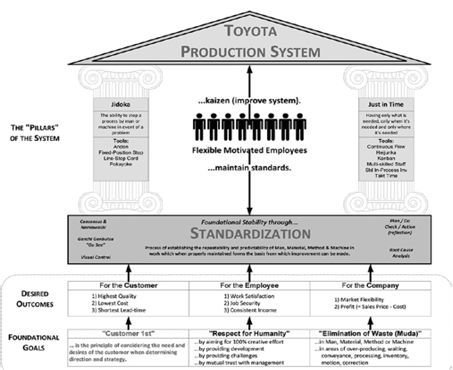
Figure 4. The Toyota Production System
When to use it
Optimizing assembly line efficiency in automotive manufacturing
Managing inventory in retail to minimize waste
Implementing continuous improvement (Kaizen) in software development
Designing hospital processes to reduce patient wait times
FROM THEORY TO EVERYDAY LIFE
In practice
Just-in-Time in Automotive Manufacturing
A car manufacturer orders parts from suppliers only when needed for production, reducing inventory costs and warehouse space. This requires precise coordination and reliable suppliers.
Jidoka in Assembly Line
A factory uses sensors to stop a conveyor when a defect is detected. A worker investigates the problem before restarting, helping prevent the process from continuing to produce the same defect.
A MOMENT TO REFLECT
Put it to work.
How could the principles of TPS be adapted to service industries like healthcare or education?
What are the potential downsides of a Just-in-Time system in the face of supply chain disruptions?
How does the principle of 'Respect for Humanity' manifest in modern workplaces?
CONTINUE THE CONVERSATION
Source texts
- Cynefin - Weaving Sense-Making into the Fabric of Our World ED02 (Dave Snowden Sonja Blignaut Zhen Goh)