The Swiss Cheese Model
The Swiss Cheese Model, proposed by James Reason, illustrates how mistakes occur when holes in different layers of defense align, allowing errors to pass through and cause catastrophic failures. It is used in high-stakes fields like medicine and aviation.
THE IDEA
THE SWISS CHEESE MODEL
HOW MISTAKES HAPPEN
There are different types of mistake:
• real mistakes – occur when the wrong process is carried out
• black-outs – occur when part of a process is forgotten
• slip-ups – occur when the right process is carried out incorrectly
There are several levels on which mistakes occur:
• skill-based level
• rule-based level
• knowledge-based level
And there are various factors that contribute to mistakes occurring:
• people involved – boss, team, colleagues, friends
• technical provisions – equipment, workplace
• organizational elements – task to be fulfilled, timing
• outside influences – time, economic climate, mood, weather
James Reason’s human error or Swiss cheese model (1990) illustrates how weaknesses in several defenses can combine. The model compares the different levels on which mistakes occur with slices of Emmental cheese. In a mistake-free world, the cheese would have no holes. But in the real world, the cheese is cut into thin slices, and every slice has many holes, which are in different places in different slices. Imagine the holes as conduits for mistakes. A mistake remains unnoticed or irrelevant if it penetrates only one hole in one of the slices. But it can lead to catastrophe if the holes in the different slices align and the mistake passes through all the holes in all of the defenses. The model is used in the fields of medicine and air traffic, for example – and anywhere where mistakes can have fatal consequences.
Experience is the name everyone gives to his mistakes. Oscar Wilde
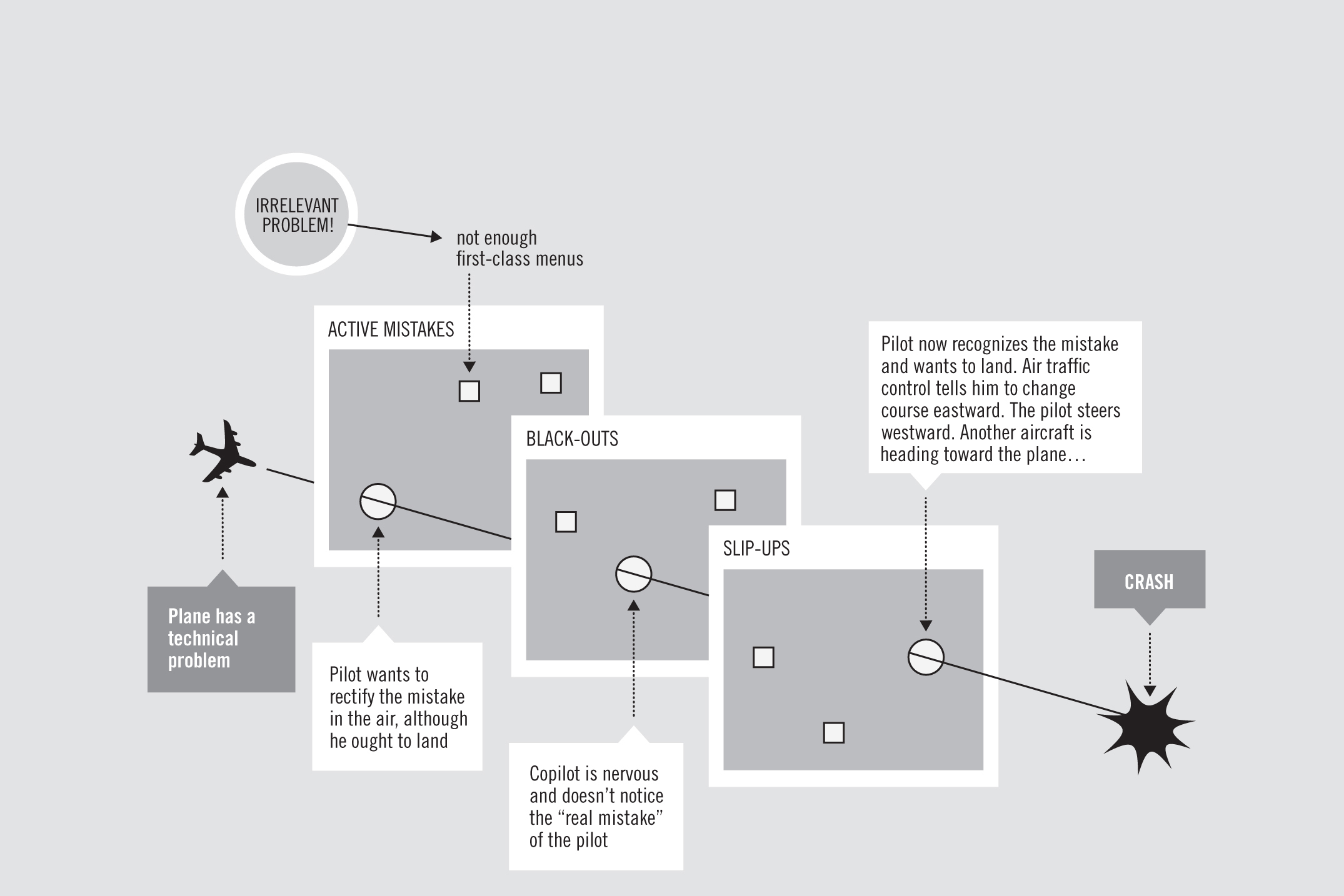
The illustration shows what happens when mistakes are made on three different levels, and three “holes in the cheese” align:
- The pilot makes a mistake. 2. The copilot reacts incorrectly.
- While attempting to rectify the mistake, another is made.
When to use it
Aviation safety: Analyze incidents by identifying holes in pilot training, cockpit design, and air traffic control.
Healthcare: Use the model to prevent medication errors by examining layers from prescription to administration.
Project management: Apply to risk analysis by mapping organizational, technical, and human factors that could combine to cause project failure.
Software development: Use for incident post-mortems to understand how multiple small errors in code, testing, and deployment aligned to produce a bug.
FROM THEORY TO EVERYDAY LIFE
In practice
Aviation incident scenario
A pilot makes a mistake during landing. The copilot, unaware of the initial error, reacts incorrectly. While trying to fix the situation, the crew makes another error. These three errors align across different defense layers, leading to a near-accident.
A MOMENT TO REFLECT
Put it to work.
Think of a recent mistake you made or observed. Which layers of defense did it penetrate? How could adding another 'slice' have prevented it?
In your professional field, what are the common 'holes' that could align to cause a catastrophic error?
How does the Swiss Cheese Model differ from other models of error causation, like the 'Domino Theory'?
References
- Human Error — James Reason (1990)
CONTINUE THE CONVERSATION
Source texts
- The Decision Book Fifty Models for Strategic Thinking