The Dunning-Kruger Effect
The Dunning–Kruger effect describes inflated self-assessments among low performers on particular tasks. Someone may lack both a skill and the knowledge needed to judge that skill accurately. It is a finding about calibration, not a rule that every beginner is arrogant or every expert underestimates their ability.
THE IDEA
THE IGNORANCE OF ARROGANCE
One of my favorite accolades is a satirical award for research that’s as entertaining as it is enlightening. It’s called the Ig™ Nobel Prize, and it’s handed out by actual Nobel laureates. One autumn in college, I raced to the campus theater to watch the ceremony along with over a thousand fellow nerds. The winners included a pair of physicists who created a magnetic field to levitate a live frog, a trio of chemists who discovered that the biochemistry of romantic love has something in common with obsessive-compulsive disorder, and a computer scientist who invented PawSense—software that detects cat paws on a keyboard and makes an annoying noise to deter them. Unclear whether it also worked with dogs.
Several of the awards made me laugh, but the honorees who made me think the most were two psychologists, David Dunning and Justin Kruger. They had just published a “modest report” on skill and confidence that would soon become famous. They found that in many situations, those who can’t . . . don’t know they can’t. According to what’s now known as the Dunning-Kruger effect, it’s when we lack competence that we’re most likely to be brimming with overconfidence.
In the original Dunning-Kruger studies, people who scored the lowest on tests of logical reasoning, grammar, and sense of humor had the most inflated opinions of their skills. On average, they believed they did better than 62 percent of their peers, but in reality outperformed only 12 percent of them. In those tasks, lower performance was associated with greater overestimation of relative performance. In a group of football fans, the one who knows the least is the most likely to be the armchair quarterback, prosecuting the coach for calling the wrong play and preaching about a better playbook.
This tendency matters because it compromises self-awareness, and it trips us up across all kinds of settings. Look what happened when economists evaluated the operations and management practices of thousands of companies across a wide range of industries and countries, and compared their assessments with managers’ self-ratings:
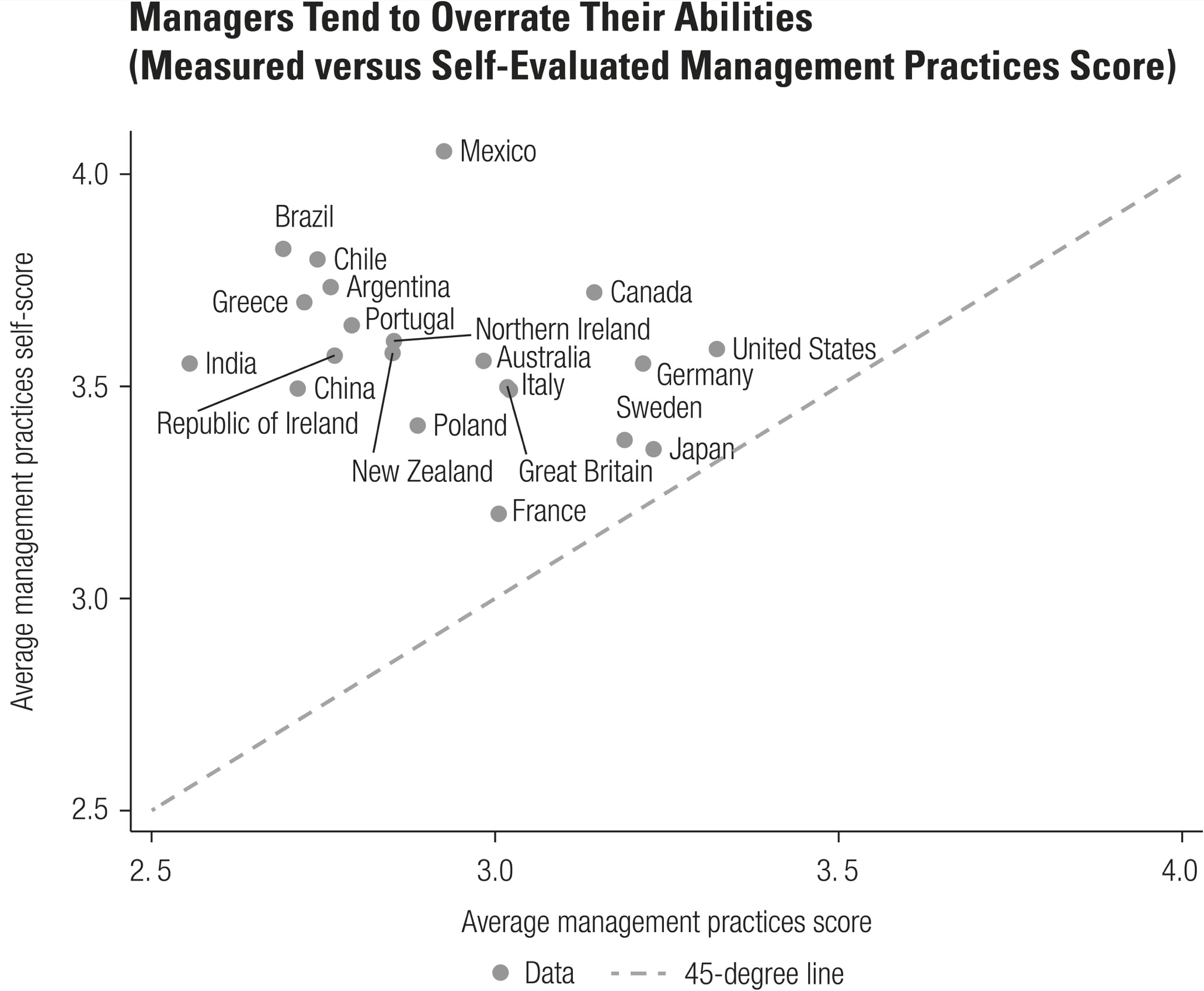
Sources: World Management Survey; Bloom and Van Reenen 2007; and Maloney 2017b.
In this graph, if self-assessments of performance matched actual performance, every country would be on the dotted line. Average self-assessments exceeded assessed performance across the surveyed countries, with the largest gaps where assessed management quality was lowest.*
Of course, management skills can be hard to judge objectively. Knowledge should be easier—you were tested on yours throughout school. Compared to most people, how much do you think you know about each of the following topics—more, less, or the same?
- Why English became the official language of the United States
- Why women were burned at the stake in Salem
- What job Walt Disney had before he drew Mickey Mouse
- On which spaceflight humans first laid eyes on the Great Wall of China
- Why eating candy affects how kids behave
One of my biggest pet peeves is feigned knowledge, where people pretend to know things they don’t. It bothers me so much that at this very moment I’m writing an entire book about it. In a series of studies, people rated whether they knew more or less than most people about a range of topics like these, and then took a quiz to test their actual knowledge. The more superior participants thought their knowledge was, the more they overestimated themselves—and the less interested they were in learning and updating. If you think you know more about history or science than most people, chances are you know less than you think. As Dunning quips, "The first rule of the Dunning-Kruger club is you don’t know you’re a member of the Dunning-Kruger club."*
These questions also show why a quiz’s own answers need scrutiny. Suspected witches were hanged in Salem, not burned. The official-language question depends on the policy in effect at the time; Disney’s role differs from Iwerks’s animation work; and visibility from space depends on altitude and conditions. A surprising answer can invite verification, but surprise alone does not establish that an answer is correct.
Although the Dunning-Kruger effect is often amusing in everyday life, it was no laughing matter in Iceland. Despite serving as governor of the central bank, Davíð Oddsson had no training in finance or economics. Before entering politics, he had created a radio comedy show, written plays and short stories, gone to law school, and worked as a journalist. During his reign as Iceland’s prime minister, Oddsson was so dismissive of experts that he disbanded the National Economic Institute. To force him out of his post at the central bank, Parliament had to pass an unconventional law: any governor would have to have at least a master’s degree in economics. That didn’t stop Oddsson from running for president a few years later. He seemed utterly blind to his blindness: he didn’t know what he didn’t know.
When to use it
When evaluating your own performance in a new job or skill, seek objective data and external feedback rather than relying solely on self-perception.
In team discussions, compare claims with evidence and invite contributions from people who have relevant experience, including those who speak less often.
When making important decisions (e.g., financial investments, medical choices), consult domain experts rather than assuming you have sufficient knowledge.
In education, help students develop metacognition by teaching them about the Dunning-Kruger effect and encouraging self-testing.
FROM THEORY TO EVERYDAY LIFE
In practice
Original Dunning-Kruger studies
In the reported tests of logical reasoning, grammar and sense of humor, the lowest-performing participants believed they outperformed 62% of peers but actually outperformed only 12%. Their self-assessments were poorly calibrated to their measured performance.
Management self-assessment across countries
A survey of thousands of companies found that managers in countries with the poorest management practices rated themselves as highly as those in top-performing countries, illustrating widespread overconfidence.
Feigned knowledge quiz
Participants who rated their knowledge as superior were more overconfident and less interested in updating in the studies Grant describes. His quiz uses questions with misleading premises to invite self-testing; its individual claims still need precise wording and verification.
Davíð Oddsson in Iceland
Grant presents Davíð Oddsson’s dismissal of economic expertise as a warning about unwarranted confidence. His lack of formal finance training and the later change in qualification requirements are parts of that account, rather than a direct measurement of his self-assessment.
A MOMENT TO REFLECT
Put it to work.
In which areas of your life do you feel most confident, and how could you test whether that confidence is justified?
Think of a time you dismissed an expert or avoided learning about a topic. Could the Dunning-Kruger effect have played a role?
How might you solicit honest feedback from others to calibrate your self-assessment of a skill?
Often confused with
References
- Unskilled and unaware of it: How difficulties in recognizing one's own incompetence lead to inflated self-assessments — Justin Kruger and David Dunning (1999)
- World Management Survey — Bloom and Van Reenen (2007)
- Maloney 2017b (unpublished data or paper) — Maloney (2017)
CONTINUE THE CONVERSATION
Source texts
- Think Again The Power of Knowing What You Dont Know (Adam Grant)