Stressors Are Information
In complex systems, stressors convey vital information to components; depriving systems of stressors induces fragility, while acute stress with recovery is beneficial and chronic stress is harmful.
THE IDEA
STRESSORS ARE INFORMATION
Now the crux of complex systems, those with interacting parts, is that they convey information to these component parts through stressors, or thanks to these stressors: your body gets information about the environment not through your logical apparatus, your intelligence and ability to reason, compute, and calculate, but through stress, via hormones or other messengers we haven't discovered yet. As we saw, your bones will get stronger when subjected to gravity, say, after your (short) employment with a piano moving company. They will become weaker after you spend the next Christmas vacation in a space station with zero gravity or (as few people realize) if you spend a lot of time riding a bicycle. The skin on the palms of your hands will get calloused if you spend a summer on a Soviet-style cooperative farm. Your skin lightens in the winter and tans in the summer (especially if you have Mediterranean origins, less so if you are of Irish or African descent or from other places with more uniform weather throughout the year).
Further, errors and their consequences are information; for small children, pain is the only risk management information, as their logical faculties are not very developed. For complex systems are, well, all about information. And there are many more conveyors of information around us than meet the eye. This is what we will call causal opacity: it is hard to see the arrow from cause to consequence, making much of conventional methods of analysis, in addition to standard logic, inapplicable. As I said, the predictability of specific events is low, and it is such opacity that makes it low. Not only that, but because of nonlinearities, one needs higher visibility than with regular systems—instead what we have is opacity.

FIGURE 2. This illustrates why I have a thing for bones. You see identical situations of head-loading water or grain in traditional societies in India, Africa, and the Americas. There is even a Levantine love song about an attractive woman with an amphora on her head. The health benefits could beat bone density medication—but such forms of therapy would not benefit pharma's bottom line. Credit: Creative Commons
Let us consider bones again. I have a thing for bones, and the idea I will discuss next made me focus on lifting heavy objects rather than using gym machines. This obsession with the skeleton got started when I found a paper published in the journal Nature in 2003 by Gerard Karsenty and colleagues. The tradition has been to think that aging causes bone weakness (bones lose density, become more brittle), as if there was a one-way relationship possibly brought about by hormones (females start experiencing osteoporosis after menopause). It turns out, as shown by Karsenty and others who have since embarked on the line of research, that the reverse is also largely true: loss of bone density and degradation of the health of the bones also causes aging, diabetes, and, for males, loss of fertility and sexual function. We just cannot isolate any causal relationship in a complex system. Further, the story of the bones and the associated misunderstanding of interconnectedness illustrates how lack of stress (here, bones under a weight-bearing load) can cause aging, and how depriving stress-hungry antifragile systems of stressors brings a great deal of fragility which we will transport to political systems in Book II. Lenny's exercise method, the one I watched and tried to imitate in the last chapter, seemed to be as much about stressing and strengthening the bones as it was about strengthening the muscles—he didn't know much about the mechanism but had discovered, heuristically, that weight bearing did something to his system. The lady in Figure 2, thanks to a lifetime of head-loading water jugs, has outstanding health and excellent posture.
Our antifragilities have conditions. The frequency of stressors matters a bit. Humans tend to do better with acute than with chronic stressors, particularly when the former are followed by ample time for recovery, which allows the stressors to do their jobs as messengers. For instance, having an intense emotional shock from seeing a snake coming out of my keyboard or a vampire entering my room, followed by a period of soothing safety (with chamomile tea and baroque music) long enough for me to regain control of my emotions, would be beneficial for my health, provided of course that I manage to overcome the snake or vampire after an arduous, hopefully heroic fight and have a picture taken next to the dead predator. Such a stressor would be certainly better than the mild but continuous stress of a boss, mortgage, tax problems, guilt over procrastinating with one's tax return, exam pressures, chores, emails to answer, forms to complete, daily commutes—things that make you feel trapped in life. In other words, the pressures brought about by civilization. In fact, neurobiologists show that the former type of stressor is necessary, the second harmful, for one's health. For an idea of how harmful a low-level stressor without recovery can be, consider the so-called Chinese water torture: a drop continuously hitting the same spot on your head, never letting you recover.
Indeed, the way Heracles managed to control Hydra was by cauterizing the wounds on the stumps of the heads that he had just severed. He thus prevented the regrowth of the heads and the exercise of antifragility. In other words, he disrupted the recovery.
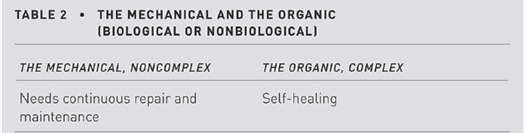
Table 2 shows the difference between the two types. Note that there may be intermediate steps between engineered and organic, though things tend to cluster in one bucket or the other.
The reader can get a hint of the central problem we face with top-down tampering with political systems (or similar complex systems), the subject of Book II. The fragilista mistakes the economy for a washing machine that needs monthly maintenance, or misconstrues the properties of your body for those of a compact disc player. Adam Smith himself made the analogy of the economy as a watch or a clock that once set in motion continues on its own. But I am certain that he did not quite think of matters in these terms, that he looked at the economy in terms of organisms but lacked a framework to express it. For Smith understood the opacity of complex systems as well as the interdependencies, since he developed the notion of the “invisible hand.”
Click here for a larger image of this table.








But alas, unlike Adam Smith, Plato did not quite get it. Promoting the well-known metaphor of the ship of state, he likens a state to a naval vessel, which, of course, requires the monitoring of a captain. He ultimately argues that the only men fit to be captain of this ship are philosopher kings, benevolent men with absolute power who have access to the Form of the Good. And once in a while one hears shouts of “who is governing us?” as if the world needs someone to govern it.
When to use it
Fitness training: Use periodic high-intensity exercise followed by rest to build strength, rather than continuous moderate activity.
Workplace management: Avoid constant low-level stressors like excessive emails and meetings; instead, use focused sprints with breaks.
Public policy: Recognize that complex systems (economies, ecosystems) are information-rich and that interventions should be minimal and targeted, allowing natural feedback.
Personal health: Incorporate intermittent fasting, cold exposure, or other hormetic stressors to improve resilience.
FROM THEORY TO EVERYDAY LIFE
In practice
Bones Strengthen Under Stress
Your bones get stronger when subjected to weight-bearing stress, such as from lifting heavy objects or carrying loads on your head. Depriving bones of such stress (e.g., by riding a bicycle or living in zero gravity) causes them to weaken. Stressors convey information to the body.
Acute Shock vs Chronic Pressure
An intense stressor like encountering a snake, followed by recovery, is beneficial, whereas continuous low-level stress from a boss, mortgage, or daily commutes is harmful. This differentiates necessary from harmful stressors.
A MOMENT TO REFLECT
Put it to work.
Think of a situation where you have been avoiding stressors. Could that be making you more fragile?
How can you distinguish between beneficial acute stress and harmful chronic stress in your own life?
In what domains might be misapplying a top-down control approach based on a mistaken assumption of linear causality?
References
- Nature paper on bones and aging — Gerard Karsenty et al. (2003)
CONTINUE THE CONVERSATION
Source texts
- Antifragile (Nassim Nicholas Taleb)