Strategy as Movement Through Cynefin Domains
Strategy involves leading the movement through and between Cynefin domains, using safe-to-fail experiments to navigate from complex to complicated while avoiding over-constraining in the clear domain. It emphasizes vigilance, testing assumptions, and adapting to prevent strategic drift.
THE IDEA
Boundaries and Dynamics
It may be useful for executives to think of strategy as leading the movement through and between the Cynefin domains. In the core business, we generally have processes, procedures and projects that we can treat as complicated. These are repeatable and we have enough historical information to be reasonably sure of our future. Staff have the skills and experiences needed to guide decision-making and resource allocation. We can reliably forecast and model the system.
Moving between the Complicated and Complex domains can help expose strategic drift, in which a company gradually loses its competitive edge. For instance, the people in the organization become extremely good and efficient at delivering one product or service at the expense of anything else. Hit by a market shock or significant disruption, they are left vulnerable. Enabling some parts of the business to challenge the status quo by conducting multiple safe-to-fail experiments, we can test the assumptions behind a core business. If some of these experiments produce positive results, we should look to amplify them and build an evidence base. We may even take a shallow dive into the liminal complex/chaos domain to stimulate innovation and creativity.
These new emergent ways of doing things, new methods or practices, then replace the old systems once we have confidence in their repeatability. We will then wrap in more defined processes and procedures and provide additional resources. This is the movement from complex to complicated. Be careful not to do this too soon as interventions in the complex will almost certainly have unintended consequences.
We may need to hold and allow sufficient time in the liminal complex/complicated domain to allow for more understanding and refinement. If we push something that’s not fit for purpose into the complicated domain too soon, we may drop straight into the Chaotic domain. The advantage of trialing multiple activities at the same time is that we don’t expect them to all work, and we only need one or two to do so to be able to keep moving forward. The key to vigilance is using evidence to track success and failure, and continually feed forward into future actions.
We continually test the assumptions behind our strategic plan. We establish real-time feedback loops and bring safe-to-fail experiments into ‘business as usual.’ We notice the temptation to constrain the system in the Clear domain. That may be useful for processes where we need to control for variation but can cause us to tip into chaos if we overconstrain things. Be aware too that people who are good at leading and managing in one domain may not be suited in another.
Business issues such as culture, engagement, and stakeholder relationships involve continuing complexity. A good rule of thumb is to assume that almost all human-to-human interactions start in the Complex domain. Rigidly standardizing these interactions, as in a tightly scripted call centre, can make them feel inauthentic and prevent employees from responding to the person in front of them. We must remain vigilant in such instances, manage in the moment, amplify things we like, and disrupt things we don’t.
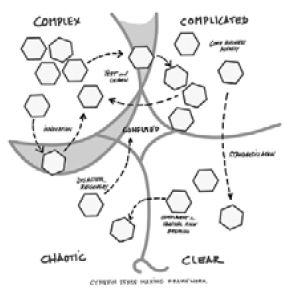
Figure 7. Strategy as leading the movement through and between the Cynefin domains.
When to use it
A company facing market disruption uses safe-to-fail experiments to explore new products and services, moving from complex to complicated as they validate successful ones.
A leader manages team culture by recognizing it as a complex domain, avoiding overly rigid policies and instead amplifying positive behaviors.
An organization tests strategic assumptions by establishing real-time feedback loops and integrating experiments into daily operations.
When scaling a new process, the team holds it in the liminal space between complex and complicated to gather more understanding before standardizing.
FROM THEORY TO EVERYDAY LIFE
In practice
Core Business Vulnerability to Disruption
A company becomes extremely efficient at delivering a single product. When a market shock occurs, it is vulnerable because it lacks adaptability. By running multiple safe-to-fail experiments in other areas, it can test its assumptions and explore alternatives before committing to a new direction.
Standardizing Human Interactions
A call centre uses a script for every conversation. When a customer’s problem falls outside the script, the agent cannot respond usefully. The team keeps procedures for routine tasks but gives agents room to interpret unusual requests and learn from the results.
A MOMENT TO REFLECT
Put it to work.
What is a core process in your organization that could benefit from safe-to-fail experiments to test its underlying assumptions?
How might you identify when you are over-constraining a system in the clear domain and risking a slide into chaos?
Think of a recent human interaction at work that felt inauthentic due to standardization. How could you approach it differently using the complex domain?
Often confused with
CONTINUE THE CONVERSATION
Source texts
- Cynefin - Weaving Sense-Making into the Fabric of Our World ED02 (Dave Snowden Sonja Blignaut Zhen Goh)