Recognition of a Regression Effect in Sports and Acting
In a study of sports and acting, participants with relevant experience were more likely to favor a statistical explanation for exceptional tryout or audition performances followed by less exceptional results. The study found an association with experience, while leaving several explanations for it open.
THE IDEA
Recognition of a Regression Effect in Sports and Acting
People may reason statistically when they recognize that events vary and that their evidence is only a sample. If people are capable of learning from experience that events of a given kind are heterogeneous and are produced in part by chance, then it should be possible to show that greater expertise in a domain is associated with a greater tendency to reason statistically in that domain. The two domains we selected to test this proposition were sports and acting. We anticipated that experience with sports would facilitate recognition of a regression effect in sports and that experience with acting would facilitate recognition of a regression effect in acting. Subjects were told about a small sample of extreme behavior followed by a larger sample of less extreme behavior. It was anticipated that inexpert subjects would generalize from the small sample and then would be obligated to give a causal explanation for the discrepancy between the small sample and the large sample. Expert subjects were expected to generalize less and to recognize that the discrepancy could be due to chance factors making the small sample appear extreme.
Method. Subjects had also participated in Study 3 of the source account. The problem presented to them was one of several in a study described as being aimed at finding out “how people go about explaining and predicting events under conditions of very limited information about the events.” Subjects were given one of two nearly identically worded problems. One concerned a football coach who usually found that the most brilliant performers at tryout were not necessarily the best players during the football season, and the other concerned a repertory company director who usually found that the most brilliant performers at audition were not necessarily the best actors during the drama season. The full text of the football version was as follows:
Football. Harold is the coach for a high school football team. One of his jobs is selecting new members of the varsity team. He says the following of his experience: “Every year, we add 10 to 20 younger boys to the team on the basis of their performance at the try-out practice. Usually, the staff and I are extremely excited about the potential of two or three of these kids – one who throws several brilliant passes or another who kicks several field goals from a remarkable distance. Unfortunately, most of these kids turn out to be only somewhat better than the rest.” Why do you suppose that the coach usually has to revise downward his opinion of players that he originally thought were brilliant?
The acting version of the problem was almost identical except that it was about Susan, the director of a student repertory company, who gets excited about “a young woman with great stage presence or a young man who gives a brilliant reading.”
Subjects were asked which of the following explanations they preferred for the fact that the coach/director usually had to revise downward his or her opinion of the brilliant performers. The second alternative is the statistical one, suggesting that the explanation is simply that the tryout performances were uncharacteristically good for the “brilliant” performers.
1. Harold was probably mistaken in his initial opinion. In his eagerness to find new talent, he exaggerates the brilliance of the performances he sees at the try-out.
2. The brilliant performances at try-out are not typical of those boys’ general abilities. They probably just made some plays at the try-out that were much better than usual for them.
3. The boys who did so well at try-out probably could coast through the season on their talent alone and don’t put out the effort necessary to transform talent into consistently excellent performance.
4. The boys who did so well at try-out may find that their teammates are jealous. They may slack off so as not to arouse envy.
5. The boys who did so well at try-out are likely to be students with other interests. These interests would deflect them from putting all their energies into football.
Wording was altered very slightly for the acting version: “Boys” became “actors” and “try-out” became “audition.”
Experience in sports was assessed by asking subjects whether they had played any organized team sports in high school or college. Those who had were defined as experienced. Experience in acting was defined as having had “more than a bit part” in a play in high school or college.
Results. It may be seen in Table 28.2 that experience affects the likelihood of preferring a statistical explanation for both the football version of the problem and the acting version. Most of the subjects with athletic team experience (a majority) preferred the statistical explanation for the football problem, whereas most of the subjects without team experience preferred one of the other, deterministic explanations. Most of the subjects with acting experience (a small minority) preferred the statistical explanation for the acting problem, whereas most of the subjects without acting experience preferred one of the deterministic explanations.
Table 28.2. Percentage of Experienced and Inexperienced Subjects Who Preferred the Statistical Explanation for the Football and the Acting Problems
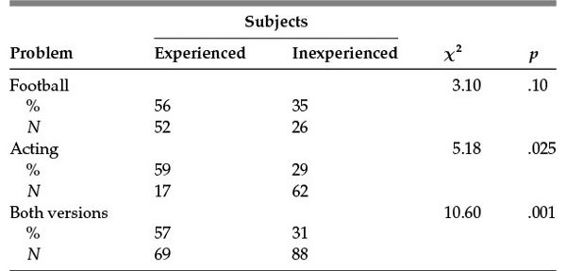
We do not wish to infer from these results that experience in a domain will make statistical explanations more salient for every kind of problem. Expertise brings a recognition of the causal factors at work in a domain as well as a recognition of the remaining uncertainty. When the problem can be approached with this expert causal knowledge, the expert may give answers that are less statistical, at least in form, than those of the novice. We may speculate that expertise reduces reliance on the representativeness heuristic, which encourages unreflective assumptions that the future will resemble the past and that populations will resemble samples, and substitutes either statistical reasoning or reasoning in accordance with well-justified causal rules.
We should note also that it is possible that the tendency of experts to reason statistically may have less to do with knowledge of variability and uncertainty than with a subcultural norm for them to do so. The statistical answer may simply look more like a familiar, standard answer to the experts than to the nonexperts. For a correlational study such as Study 4, it is not easy to disentangle the undoubtedly related factors influencing statistical reasoning.
When to use it
Evaluating talent in sports tryouts: Coaches should be aware that exceptional performances may be due to chance and not indicative of consistent ability.
Auditioning for acting roles: Directors should recognize that a brilliant audition may not predict sustained performance.
Interpreting job interviews: A single outstanding interview might not reflect a candidate's typical work performance.
Assessing student test scores: An unusually high score on a test may be followed by a more average score due to regression to the mean.
FROM THEORY TO EVERYDAY LIFE
In practice
Football Tryout Scenario
Harold the coach observes brilliant passes and kicks at tryouts but finds those players are only somewhat better during the season. The statistical explanation (option 2) attributes this to the tryout performances being uncharacteristically good, while deterministic explanations blame mistaken judgment, lack of effort, jealousy, or other interests.
Acting Audition Scenario
Susan the director sees brilliant readings at auditions but later finds the actors are not as outstanding during the season. The same pattern of explanations applies, with acting experience associated with a greater preference for the statistical explanation.
A MOMENT TO REFLECT
Put it to work.
Can you recall a situation where an initial outstanding performance turned out to be a fluke? How did you explain that outcome?
Why might expertise in a domain lead people to prefer statistical explanations over causal ones? Does this always hold?
How does the representativeness heuristic lead people to overlook regression effects in everyday judgments?
Often confused with
CONTINUE THE CONVERSATION
Source texts
- Heuristics and Biases The Psychology of Intuitive Judgment (Thomas Gilovich, Dale Griffin, Daniel Kahneman)