PO (Provocative Operation)
Edward de Bono uses PO to mark an idea for exploration before judgment. It can challenge an assumption, introduce a deliberately unusual proposal, or connect unrelated words. The listener’s task is to seek another way of seeing the problem; any resulting idea still needs evaluation.
THE IDEA
Grammatical use of PO
PO can be used in any way that seems natural. The most important point is that anything covered by PO should be clearly seen to be covered by PO. The two main functions of PO are: first, to protect an arrangement of information from judgement and to indicate that it is being used provocatively; second, to challenge a particular arrangement of information such as an idea, a concept, or a way of putting things. In the second case the material being challenged would be repeated and PO would be added to it. In the other case PO would cover new material.
1. PO as interjection
Here PO would be used by itself as a reply or even as an interruption, much as ‘no’ is used. It would imply that a particular way of looking at things was being challenged.
e.g. ‘The purpose of sport is to encourage the competitive spirit and the will to win.’ ‘Po!’
2. PO as preface
Here PO is used before a sentence or a phrase or a word that it is meant to qualify. The qualification may take the form of a challenge or it may take the form of introducing provocative material.
e.g. ‘An organization can only function efficiently if all its members show absolute obedience.’ ‘Po function efficiently.’ or ‘Po clockwork with the cogwheels made of rubber.’
3. PO as a juxtaposition
When two words are going to be juxtaposed for no reason at all, PO is used to indicate this relationship between them. This same use of PO is involved in the introduction of a random word into a discussion.
e.g. ‘Travel po ink.’ or ‘Po kangaroos.’
4. PO in the same positions as NO or NOT
PO can be used in any position in which ‘no’ or ‘not’ could be used. In such a position PO would qualify exactly the same things as ‘no’ or ‘not’ would qualify.
e.g. ‘Wednesday is po a holiday.’
In practice it is probably best to try to use PO always at the beginning of a sentence or phrase or right in front of the word to be qualified. PO does not have to be written in capital letters but until one is well used to it capital letters are preferable. If one is using PO and the other person does not understand its use, then this can be most simply explained as follows:
- Challenge function: PO means ‘you may very well be right but let’s try and look at it in another way.’
- Provocative function: PO means ‘I am just saying that to see what it sets off in your mind, to see whether that way of putting things can stimulate any new ideas.’
- Anti-arrogance function: PO means ‘don’t be so arrogant, so dogmatic. Don’t have such a closed mind.’
- Overreaction: PO simply means, ‘let’s cool it. There is no point in getting upset about this.’
The mechanism of PO
De Bono explains PO through a model of memory in which information forms patterns that can become hard to change. In this model, the order of arrival matters: A followed by B, C, and D may produce a different pattern from B followed by D, A, and C. Presenting A, B, C, and D together might produce another arrangement. Adding to an existing pattern is easier than restructuring it, and some patterns are inherited from other people. This is his rationale for provocation; the contrast with a programmed computer does not establish how all minds or computers work.
PO is intended to interrupt a familiar pattern long enough to explore another arrangement of the information. De Bono proposes that dislocating an old pattern can allow a new one to form. The practical test is whether the provocation helps people generate alternatives they can then examine.
A provocation may deliberately depart from a reasonable proposal because its immediate purpose is to prompt a different line of thought. A bigger departure does not guarantee a useful insight. Once an alternative emerges, it must be judged in the usual way.
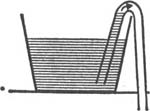
In emptying a bucket by siphon the water must first be sucked upwards in the tube—an unnatural direction for water to travel. Once the water has reached a certain position the siphon forms and the water will continue to flow naturally out of the bucket until it is empty. In the same way an unnatural use of information may be necessary to provoke a rearrangement that is itself perfectly natural.
Three broad classes of use
For convenience the many uses of PO may be divided into three broad classes:
-
The generation of alternatives. Anti-arrogance. Relaxation. Reexamination of a concept. Rethinking. Restructuring. Indicating an awareness of the possibility of clichés or a rigid point of view.
-
Provocation. The use of arrangements of information as stimuli. Juxtapositions. Introduction of random words. Abolition of concept divisions. The use of fantasy and nonsense.
-
Protection and rescue. Holding off judgement. Temporarily reversing judgement. Removal of the NO label.
Practice and application
The appropriate reaction to PO is more important to emphasize than the correct use of it. Someone who knows how to react appropriately to PO will also know how to use it appropriately. After initial practice sessions in which the use of PO is obviously excessive and artificial, one moves on to a more natural use in ordinary discussion.
Classroom exercises
-
Teacher interrupts student. A student is asked to talk on a subject (e.g., “What is the use of space travel?”, “Should all medical aid be free?”, “Are straight roads better than winding ones?”). In the course of the talk the teacher interrupts with PO, repeating part of what the student has said and prefacing it with PO. The student is not expected to respond to PO at this stage; he simply pauses and then carries on.
-
Students interrupt teacher. The teacher talks about a subject (e.g., “The usefulness of different languages”, “Whether large organizations work better than small ones”, “Was it easier to work alone or in a group?”) and the students are invited to interrupt with PO. Each time a student interrupts with PO, the teacher (and eventually students) generates alternative ways of putting things. For example:
TEACHER: Different languages are useful because they allow the development of different cultures and so provide more interest. STUDENT: PO provide more interest. TEACHER: Different cultures mean different ways of looking at life, different habits and ways of behaving, different art etc. All these are things one can learn about and find out about and compare to one’s own. New patterns to be explored. Something to be done. STUDENT: Different ways of expressing the same thing — they could be useful, they could be a waste of time. TEACHER: Because of the different language communication is poor and so distinctness emerges instead of a general uniformity. STUDENT: PO communication is poor. TEACHER: People cannot talk easily to people with another language or read their books. People cannot influence each other so much. STUDENT: People cannot influence each other. That may be a bad thing because from such interaction might come better understanding. TEACHER: PO understanding. STUDENT: They would know what the other person meant, what he was up to, what he wanted, what his values were.
- Debate. A two-way debate between two students can be arranged. Each is allowed to use PO, and the teacher may interrupt with PO but not otherwise take part.
Avoiding a common trap
During these discussions PO may seem to function mainly as a focusing device: “explain what you mean by…”, “define that…”, “elaborate that point…”. The teacher should point out that the true function of PO is to ask for a restructuring—to ask for alternative ways of putting things. When PO is used, the class can pause and list different ways of putting whatever has been qualified by PO. For example, ‘PO understanding’ might generate:
- Supposing that the other person reacts in the same way as you.
- Things mean the same to the other person as to you.
- Lessen the possibility of misunderstanding.
- Full sympathy.
- Communication without interpreters or intermediaries.
- Ability to listen and respond.
None of these are complete definitions but they are different ways of putting things. The best might be ‘lessen the possibility of misunderstanding’—a statement that says a great deal from an information point of view.
Picture interpretation
The caption is removed from a photograph and a student is asked to interpret it. When an interpretation is offered, the teacher replies, ‘Po.’ This simply means: “Very well. Go on. Generate another alternative. What else could it mean?” This use of PO is very simple but helpful to practise, as it indicates the use of PO in a much clearer manner than the other situations.
When to use it
In product design, temporarily reverse an assumed feature requirement and explore what changes.
In a meeting, name an assumption that everyone has accepted without discussion and mark it with PO.
For a personal problem, imagine an unreasonable option and identify which constraint it exposes.
In campaign planning, connect the product with a random word and inspect the associations.
Before a brainstorm, agree that a PO statement is an invitation to explore rather than a proposal to approve.
In strategy review, consider what would happen if a familiar customer segment disappeared.
In class, ask students for another interpretation after accepting their first answer as possible.
In personal reflection, revisit a conclusion you rejected before considering its implications.
During a brainstorm, write down objections for later so an unusual suggestion can be explored briefly.
When a team stalls, qualify a precise word in its problem statement with PO and seek alternative meanings.
Before choosing a solution, use PO to produce alternatives and then evaluate them against the same criteria.
When reviewing a belief, separate willingness to examine it from agreement that it is false.
In an exercise, juxtapose unrelated words and develop a possible connection.
When teaching creativity, contrast asking for a definition with asking for another way of putting an idea.
In a disagreement, invite each party to restate the issue from another perspective.
In design review, explore how a product would work without its most familiar component.
In class, use the language dialogue to practise responding to PO with alternatives.
In a meeting, let participants challenge the facilitator’s assumptions as well as each other’s.
After a disagreement, examine the different meanings people attached to a key phrase.
In user research, generate several interpretations of an observation before choosing one to test.
In a workshop, practise PO in exaggerated form before trying it in ordinary discussion.
In a classroom debate, allow a PO interruption to prompt a pause for alternative formulations.
When evaluating a provocation, ask which part generated a useful question even if the literal proposal fails.
For a creativity exercise, remove a photograph’s caption and offer several possible accounts of the scene.
FROM THEORY TO EVERYDAY LIFE
In practice
Siphon Analogy for PO
Just as a siphon requires water to be initially sucked upward (an unnatural direction) to start the flow, PO uses an unnatural arrangement of information to provoke a natural restructuring of a mental pattern.
Restructuring in a Team Brainstorm
When a team is stuck on a problem, a PO statement like 'What if our product was free?' can disrupt established assumptions and lead to novel business models or pricing strategies.
Challenging a common belief about sport
A person states: 'The purpose of sport is to encourage the competitive spirit and the will to win.' Another responds: 'Po!' to challenge that assumption and open up alternative views.
Provocative preface in organizational context
Someone says: 'An organization can only function efficiently if all its members show absolute obedience.' The response: 'Po function efficiently.' This provokes thinking about whether obedience is truly necessary for efficiency.
Separating the Provocation from the Proposal
A team asks, 'PO: What if we gave our product away for free?' Members explore who else might pay, what costs would remain, and whether a limited free version would help. The provocation generates questions; it is not yet a pricing decision.
Education: Rethinking homework
A teacher asks, 'PO: What if homework were banned entirely?' Colleagues examine what homework is intended to achieve and which activities could serve that purpose. They can explore the question without agreeing that homework should be banned.
Classroom discussion on different languages
A teacher discusses the usefulness of different languages. A student interrupts with 'PO provide more interest'. The teacher then generates alternative perspectives: different cultures, ways of looking at life, habits, art, etc. Another student adds 'PO communication is poor', prompting the teacher to consider poor communication and lack of influence, which leads to further exploration.
Rethinking 'Understanding'
When a student says 'PO understanding', the class generates alternative phrasings such as 'lessen the possibility of misunderstanding', 'full sympathy', or 'ability to listen and respond'. Each offers a different angle on the concept.
Picture Interpretation Exercise
A teacher shows a photograph without its caption. After a student gives one interpretation, the teacher says 'Po' to prompt the student to generate additional alternative interpretations, encouraging flexible thinking.
Brainstorming with PO
A team committed to a free product hears, 'PO: We should charge customers for using our product.' Members explore what would have to change for customers to pay. The statement challenges this team's assumption; charging for a product is not inherently illogical.
Reactions That Keep Exploration Open
After a homework provocation, a teacher immediately lists reasons a ban would fail. Another participant reminds the group that PO asks them to generate alternatives first. They note the objections for later evaluation and continue exploring what schoolwork is for.
A MOMENT TO REFLECT
Put it to work.
What is a deeply ingrained pattern in your thinking that might benefit from deliberate disruption?
How can you apply PO to a current problem that seems stuck?
Think of a recent situation where an 'unnatural' idea led to a creative breakthrough. What made it work?
Think of a belief you hold strongly. How could you apply PO to challenge it?
How might using PO in a meeting change the discussion and lead to more creative solutions?
In what situations could the anti-arrogance function of PO be most useful?
Which assumption in your current problem would be hardest to question aloud? How could you mark it as a temporary provocation?
Describe a situation where you quickly rejected an unusual idea. How might using PO's 'protection and rescue' class have allowed you to explore that idea further?
What useful question could you extract from an idea you would never implement literally?
How would you explain PO to someone who hears it as a rejection of their view?
When you hear someone make a statement, consider responding with 'PO [key phrase]'. What new possibilities emerge?
When should your team move from generating alternatives to evaluating them?
Which part of a familiar proposal would you repeat after PO to make the challenge precise?
Could asking for alternative meanings clarify a recent misunderstanding? What would still require agreement about facts?
What other thinking tools complement the use of PO to generate alternatives?
How could you keep an unusual idea open for discussion without treating it as a commitment?
Choose a random word and connect it to a current problem. Which association is worth exploring further?
When someone uses PO in a discussion, what is an appropriate reaction that shows understanding?
Often confused with
CONTINUE THE CONVERSATION
Source texts
- Lateral Thinking A Textbook of Creativity (Edward de Bono)
- Lateral Thinking A Textbook of Creativity (Edward de Bono)
- Lateral Thinking A Textbook of Creativity (Edward de Bono)
- Lateral Thinking A Textbook of Creativity (Edward de Bono)
- Lateral Thinking A Textbook of Creativity (Edward de Bono)
- Lateral Thinking A Textbook of Creativity (Edward de Bono)