Playing in the Tension
Cynefin values the tension between coherence and difference, using it generatively to create space for novelty. It embraces and-and rather than either-or, avoiding premature convergence and playing in ambiguity.
THE IDEA
Playing in the tension
Cynefin values coherence and difference, even though they are in tension. Too much difference and things become incoherent. Too much coherence and things become too homogeneous.
For example, in large organizations there is often a drive to align the entire workforce behind a particular goal and create a singular culture. This singular alignment, one could argue, is an extreme form of coherence. It strips away the diversity of a system to a point where its resilience is compromised. On the other hand, too many subcultures and conflicting goals in an organization will become incoherent and lead to fragmentation. Applying the principle of coherent heterogeneity, we can accept and value the diversity of localized sub-cultures, as long as they are coherent with the identity of the whole. The key here is that the difference is bounded or contained in such a way that it does not become incoherent or fragmented. (Jennifer Garvey-Berger and team’s chapter explores how they applied this approach in their company.)
Cynefin uses this inherent tension as generative, creating a space for the novelty to emerge. Most of our methods work to generate this space by embracing and sometimes intentionally creating ambiguity, paradox, and aporia. (For more on Aporia, read Zhen Goh’s chapter.)
“Conflict and paradox are critical to the advancement of understanding. Aside from verbal paradox, Cynefin methods often deliberately introduce conflict and ambiguity into group interactions to gain this higher level of understanding. Introducing a state of Aporia, or deliberate puzzlement, allows us to present seemingly contradictory and competing understandings as valid and useful pieces of the bigger picture.” – Dave Snowden
The world abounds with false dichotomies: management vs. leadership; agile vs. waterfall; purpose vs. profit; theory vs. practice... The list goes on and on. We embrace – And-And rather than Either-Or – which means we seek out, or play in tension, rather than creating binary options or false dichotomies. Cynefin values ambiguity, dialectic, and even paradox. We attempt to avoid prematurely converging to one particular idea or solution, and we try to play in ambiguity and a broad option field for as long as we can. Keeping our options open as long as possible creates a liminal space. Liminality is a key concept that was introduced into the Framework a few years ago. Liminality is about transitions, about being in the ‘in-between.’ When we find ourselves in the in-between spaces, the liminal space, our task is to be mindful of suspending judgment, keeping our options open and enabling action that allows novelty to emerge and patterns to stabilize.
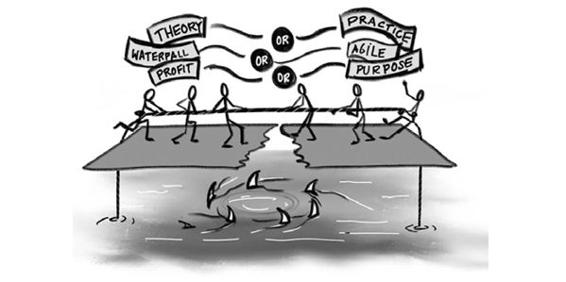
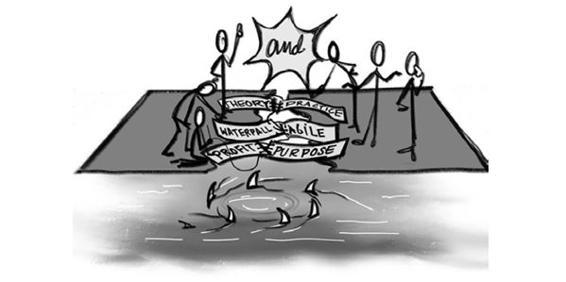
“The issue is not to swing to either extreme but to increase diversity (and thereby conflict, discontinuity, and paradox) when it is necessary and reduce it through alignment when the situation demands. The attempt to remove (or require) conflict, in many idealistic approaches that value stability or turbulence but ignore context, is the worst of all possible worlds. By always choosing one option or another, we can get the worst of both.” – Dave Snowden
When to use it
Navigating organizational culture change by balancing unity with diversity.
Facilitating team decision-making that avoids premature convergence and explores ambiguity.
Applying the principle of coherent heterogeneity to manage conflicting goals in a project.
Using liminality as a creative space for innovation and pattern stabilization.
FROM THEORY TO EVERYDAY LIFE
In practice
Organizational Culture Alignment
In a large organization, there is often pressure to create a single, unified culture. This extreme coherence can reduce resilience by eliminating diversity. Conversely, too many conflicting subcultures lead to fragmentation. The Cynefin approach suggests valuing localized sub-cultures as long as they remain coherent with the overall identity, thus maintaining a healthy tension.
False Dichotomies in Management
Common management debates pit agile vs. waterfall, leadership vs. management, purpose vs. profit. Cynefin refuses these binary choices and instead looks for ways to embrace both, playing in the tension between them to find novel solutions.
A MOMENT TO REFLECT
Put it to work.
How can you create a space that holds both coherence and difference in your organization or team?
What false dichotomies do you encounter in your work, and how might you reframe them as 'and-and' instead of 'either-or'?
When is it beneficial to increase diversity or alignment? How do you know which is needed in a given situation?
Often confused with
CONTINUE THE CONVERSATION
Source texts
- Cynefin - Weaving Sense-Making into the Fabric of Our World ED02 (Dave Snowden Sonja Blignaut Zhen Goh)