Pascal's Wager
Pascal's Wager applies expected value to the question of belief in God, arguing that even a tiny non-zero probability of infinite reward makes belief rational, despite serious philosophical flaws such as the 'Cat in the Hat' problem of ignoring alternative deities.
THE IDEA
Pascal’s Wager
One of the first people to think clearly about expected value was Blaise Pascal; puzzled by some questions posed to him by the gambler Antoine Gombaud (self-styled the Chevalier de Méré), Pascal spent half of 1654 exchanging letters with Pierre de Fermat, trying to understand which bets, repeated over and over, would tend to be profitable in the long run, and which would lead to ruin. In modern terminology, he wished to understand which kinds of bets had positive expected value and which kinds were negative. The Pascal-Fermat correspondence is generally thought of as marking the beginning of probability theory.
On the evening of November 23, 1654, Pascal, already a pious man, experienced an intense mystical experience, which he documented in words as best he could:
FIRE.
God of Abraham, God of Isaac, God of Jacob
Not of the philosophers and the scholars . . .
I have cut myself off from him, shunned him, denied him, crucified him.
Let me never be cut off from him!
He can only be kept by the ways taught in the Gospel.
Sweet and total renunciation.
Total submission to Jesus Christ and my director.
Everlasting joy in return for one day’s effort on earth.
Pascal sewed this page of notes into the lining of his coat and kept it there the rest of his life. After his “night of fire,” Pascal largely withdrew from mathematics, devoting his intellectual effort to religious topics. By 1660, when his old friend Fermat wrote to propose a meeting, he replied:
For, to talk frankly with you about Geometry, is to me the very best intellectual exercise: but at the same time I recognize it to be so useless that I can find little difference between a man who is nothing else but a geometrician and a clever craftsman . . . my studies have taken me so far from this way of thinking, that I can scarcely remember that there is such a thing as geometry.
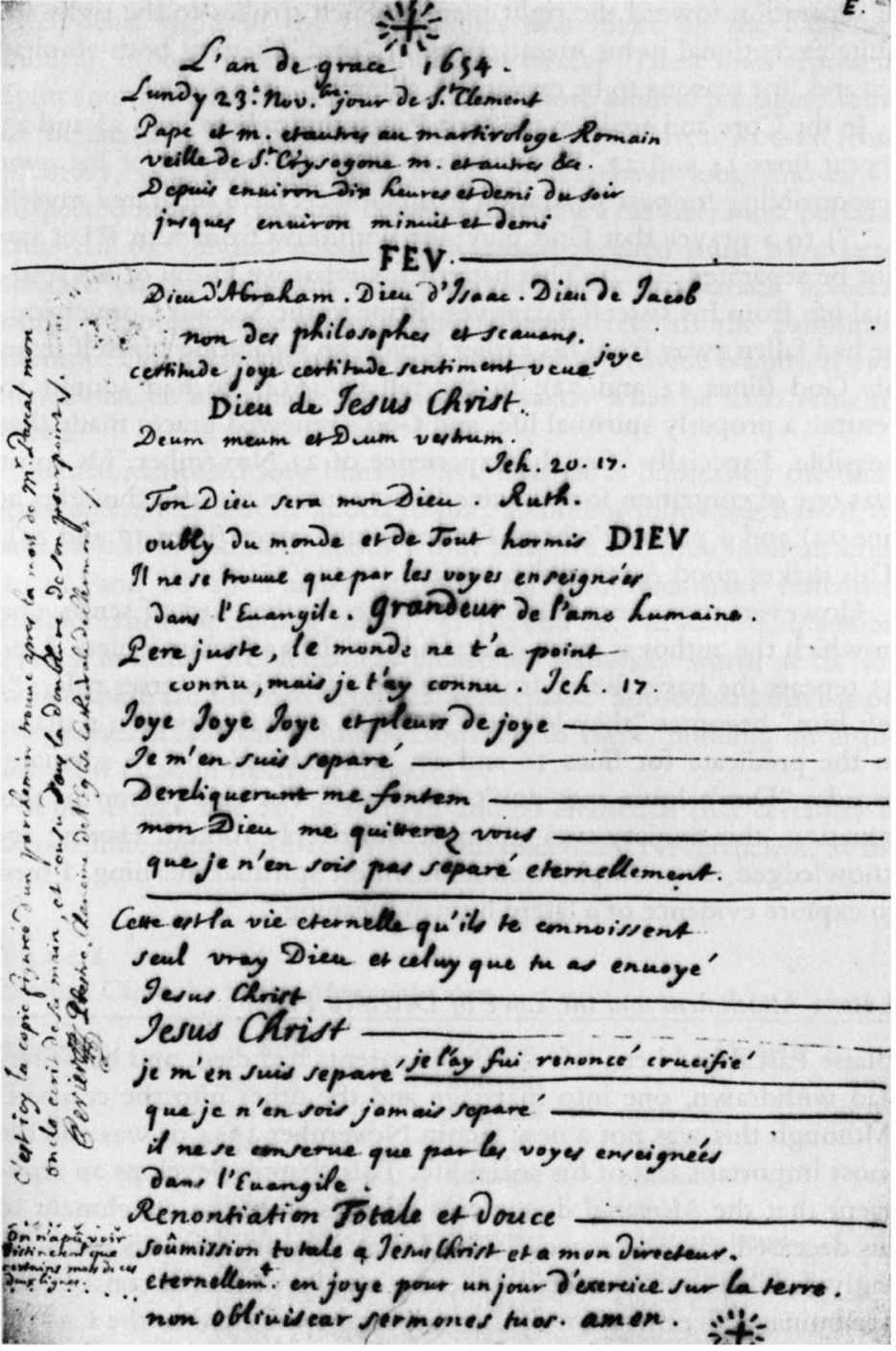
The Mémorial, Parchment Copy. Photograph © Bibliothèque Nationale de France, Paris.
Pascal died two years later, at thirty-nine, leaving behind a collection of notes and short essays meant for a book defending Christianity. These were later collected as the Pensées (“Thoughts”) which appeared eight years after his death. It’s a remarkable work, aphoristic, endlessly quotable, in many ways despairing, in many ways inscrutable. Much of it comes in short, numbered bursts:
-
Let us imagine a number of men in chains, and all condemned to death, where some are killed each day in the sight of the others, and those who remain see their own fate in that of their fellows, and wait their turn, looking at each other sorrowfully and without hope. It is an image of the condition of men.
-
Art thou less a slave by being loved and favored by thy master? Thou art indeed well off, slave. Thy master favors thee; he will soon beat thee.
But what the Pensées are most famous for is thought 233, which Pascal titled “Infinite-rien” (“Infinity-nothing”) but which is universally known as “Pascal’s wager.”
Pascal held the question of God’s existence to be one that logic couldn’t touch: “‘God is, or He is not.’ But to which side shall we incline? Reason can decide nothing here.” But Pascal doesn’t stop there. What is the question of belief, he asks, if not a kind of gamble, a game with the highest possible stakes, a game you have no choice but to play? And the analysis of wagers, the distinction between the smart play and the foolish one, was a subject Pascal understood better than almost anyone on earth. He had not quite left his mathematical work behind him after all.
How does Pascal compute the expected value of the game of faith? The key is already present in his mystic revelation:
Everlasting joy in return for one day’s effort on earth.
What is this, but a reckoning of the costs and benefits of adopting faith? Even in the middle of ecstatic communion with his savior, Pascal was still doing math! I love this about him.
To compute Pascal’s expected value, we still need the probability that God exists; say for a moment we are pretty fervent doubters and assign this hypothesis a probability of only 5%. If we believe in God, and we turn out to be right, then our reward is “everlasting joy,” or, in the economists’ terms, infinitely many utils.* If we believe in God and we turn out to be wrong —an outcome we are 95% sure will be the case—then we pay a price; maybe more than the “one day’s effort” that Pascal suggests, since we have to count not only the time spent in worship but the opportunity cost of all the libertine pleasures we forwent in our quest for salvation. Still, it’s a certain fixed sum, let’s say a hundred utils.
Then the expected value of belief is
(5%) × infinity + (95%)(−100).
Now, 5% is a small number. But infinite joy is a lot of joy; 5% of it is still infinite. So it swamps whatever finite cost is imposed on us by adopting religion.
Consider the proposition “God exists.” It is not clear that assigning it a numerical probability makes sense. But Pascal doesn’t make any such dodgy numerical move. He doesn’t need to. Because it doesn’t matter whether that number is 5% or something else. One percent of infinite bliss is still infinite bliss, and outweighs whatever finite costs attach to a life of piety. The same goes for 0.1% or 0.000001%. All that matters is that the probability God exists is not zero . Don’t you have to concede that point? That the existence of the Deity is at least possible ? If so, then the expected value computation seems unequivocal: it is worth it to believe. The expected value of that choice is not only positive, but infinitely positive.
Pascal’s argument has serious flaws. The gravest is that it fails to consider alternative hypotheses—the Cat in the Hat problem discussed in Ellenberg’s chapter 10. In Pascal’s setup, there are only two options: that the God of Christianity is real and will reward that particular sector of the faithful, or that God doesn’t exist. But what if there’s a God who damns Christians eternally? Such a God is surely possible too, and this possibility alone suffices to kill the argument: now, by adopting Christianity, we are wagering on a chance of infinite joy but also taking on the risk of infinite torment, with no principled way to weight the relative odds of the two options. We’re back to our starting point, where reason can decide nothing.
Voltaire, writing decades later, raised a different objection. You might have expected him to be sympathetic to Pascal’s wager; he had no objection to gambling. And he admired mathematics; his attitude toward Newton approached worship (he once called him “the god to whom I sacrifice”) and he was romantically entangled for many years with the mathematician Émilie du Châtelet. But Pascal was not quite Voltaire’s sort of thinker. The two men stood at odds across a gulf as much temperamental as philosophical. Voltaire’s generally chipper outlook had no room for Pascal’s dark, introspective, mystical emissions. Voltaire dubbed Pascal “the sublime misanthrope” and devoted a long essay to knocking down the gloomy Pensées piece by piece. His attitude toward Pascal is that of the popular smart kid toward the bitter and nonconforming nerd.
As for the wager, Voltaire said it was “a little indecent and puerile: the idea of a game, and of loss and gain, does not befit the gravity of the subject.” More substantively: “The interest I have to believe a thing is no proof that such a thing exists.” Voltaire himself, typically sunny, leans toward an informal argument by design: look at the world, look how amazing it is, God is real, QED!
Voltaire has missed the point. Pascal’s wager is curiously modern, so much so that Voltaire has not caught up to it. Voltaire is right that, unlike Witztum and the Bible coders, or Arbuthnot, or the contemporary advocates of intelligent design, Pascal is not offering evidence for God’s existence at all. He is indeed proposing a reason to believe, but the reason has to do with the utility of believing, not the justifiability of believing. In a way, he anticipates the austere stance of Neyman and Pearson that Ellenberg discusses in chapter 9. Just like them, he was skeptical that the evidence we encounter will provide a reliable means of determining what is true. Nonetheless, we have no choice but to decide what to do. Pascal is not trying to convince you God exists; he is trying to convince you that it would be to your benefit to believe so, and thus that your best course of action is to hang out with Christians and obey the forms of piety, until, just by force of propinquity, you start to truly believe. Can I put Pascal’s argument in modern terms better than David Foster Wallace did in Infinite Jest ? I cannot.
The desperate, newly sober White Flaggers are always encouraged to invoke and pay empty lip-service to slogans they don’t yet understand or believe—e.g. “Easy Does It!” and “Turn It Over!” and “One Day at a Time!” It’s called “Fake It Till You Make It,” itself an oft-invoked slogan. Everyone on a Commitment who gets up publicly to speak starts out saying he’s an alcoholic, says it whether he believes he is yet or not; then everybody up there says how Grateful he is to be sober today and how great it is to be Active and out on a Commitment with his Group, even if he’s not grateful or pleased about it at all. You’re encouraged to keep saying stuff like this until you start to believe it, just like if you ask somebody with serious sober time how long you’ll have to keep schlepping to all these goddamn meetings he’ll smile that infuriating smile and tell you just until you start to want to go to all these goddamn meetings.
When to use it
Deciding whether to follow a religious path based on potential infinite reward rather than evidence.
Evaluating a business investment that has a small chance of enormous returns, using expected value logic.
Examining when a 'fake it till you make it' approach might help establish a habit and when it might merely reinforce an unsupported belief.
FROM THEORY TO EVERYDAY LIFE
In practice
Pascal's Expected Value Calculation
Within the wager’s assumptions, assign a 5% probability to the God who rewards belief. Belief yields infinite joy if correct, and a finite cost (e.g., -100 utils) if wrong. Expected value = 0.05 * ∞ + 0.95 * (-100) = ∞, which outweighs any finite cost.
Fake It Till You Make It (from Infinite Jest)
In the recovery-group scene from Infinite Jest, newcomers repeat slogans like 'Easy Does It' before fully believing them. Ellenberg uses the scene to illustrate Pascal’s advice to practice religious rites in the hope of cultivating belief.
A MOMENT TO REFLECT
Put it to work.
What are the key flaws in Pascal's wager, particularly the 'Cat in the Hat' problem?
How does Pascal's wager differ from evidence-based arguments for belief?
Can you think of a modern decision where expected value with infinite stakes is argued, and what pitfalls should be considered?
Often confused with
References
- Pensées — Blaise Pascal (1670)
- Mémorial — Blaise Pascal (1654)
- Infinite Jest — David Foster Wallace (1996)
CONTINUE THE CONVERSATION
Source texts
- How Not to Be Wrong The Power of Mathematical Thinking (Ellenberg, Jordan)