Nonlinearity and Less is More (& Procrustean Bed)
A nonlinear dose-response curve can rise, level off, and reverse, so more input need not produce more benefit. Taleb uses this pattern to argue for practical limits and simplicity.
THE IDEA
NONLINEARITY AND LESS IS MORE (& PROCRUSTEAN BED)
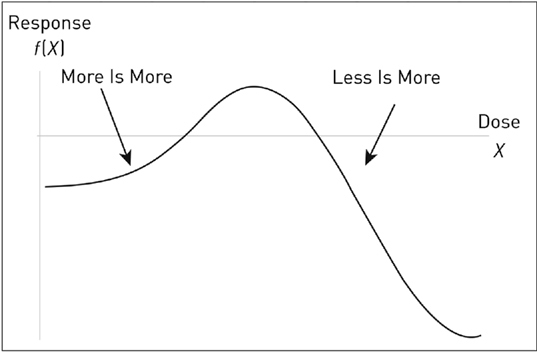
FIGURE 19. This graph explains both the nonlinear response and the “less is more” idea. As the dose increases beyond a certain point, benefits reverse. We saw that everything nonlinear is either convex, concave, or, as in this graph, mixed. Also shows how under nonlinearities, reductions fail: the Procrustean bed of words “good for you” or “bad” is severely distorting.
Also shows why tinkering-derived heuristics matter because they don’t take you into the danger zone—words and narratives do. Note how the “more is more” zone is convex, meaning accelerated initial benefits. (In Levantine Arabic, the zone beyond the saturation has a name:  “more of it is like less of it.”)
Finally, it shows why competitive “sophistication” (rather, complication masked as sophistication) is harmful, as compared to the practitioner’s craving for optimal simplicity.
The excerpt ends at a reference to the Fragility Transfer Theorem without stating the theorem or completing the argument.
When to use it
Deciding on optimal dosage in medicine or agriculture.
Assessing whether increasing an investment’s size changes its performance through market impact.
Managing work hours to prevent burnout and maintain productivity.
Designing user interfaces to avoid feature bloat that degrades usability.
FROM THEORY TO EVERYDAY LIFE
In practice
Medication Dosage
A small dose of a drug relieves symptoms, but increasing the dose beyond a therapeutic window causes harmful side effects, illustrating the reversal of benefits.
Investment Returns
Additional capital may initially yield high returns, but eventually saturates or even reduces overall performance due to market impact or inefficiencies, supporting the 'less is more' insight.
A MOMENT TO REFLECT
Put it to work.
How can you identify situations where more of a good thing becomes harmful?
What heuristics might protect you from the danger zone of nonlinearity?
In what areas of your life might you be applying a linear assumption when reality is nonlinear?
Often confused with
CONTINUE THE CONVERSATION
Source texts
- Antifragile (Nassim Nicholas Taleb)