Narrative-Driven Sensemaking
Using narrative fragments and small experiments to explore complex situations, uncover hidden insights, and determine direction without premature assumptions.
THE IDEA
An Alternative Delivery Model
“Oral narrative is, and for a long time has been, the chief basis of culture itself.” – John D. Niles (7)
We need to make sense of a current situation in order to act wisely. One approach is the use of narratives. It allows us to explore the current environment and include a wide and diverse set of people and views. This can suggest ideas before the group commits to an explanation. We stress that this is not storytelling, but the use of narrative fragments to explore the current space. (8)
“Find the real experts so you can learn more quickly.” – David Kelly, The Deep Dive
An example of this is how anecdote circles were used by Tony Quinlan and Ron Donaldson working with Pfizer. (9) The anecdote circles engaged employees to capture and signify narrative fragments. These are like water cooler conversations, those unguarded comments about what is going on and the real issues people face.
In an anecdote circle, someone tells a narrative about the work environment that they find significant, and others contribute theirs. This is an indirect way of engaging and is not hypothesis-driven. We are not seeking to confirm a particular individual’s view of an issue, but looking at what emerges out of the narratives that people share. Participants can contribute experiences that a question built around a fixed hypothesis might miss.
When Quinlan and Donaldson started the engagement, there was a general view that sales representatives’ knowledge of their product was highly influential on the customer’s willingness to buy. In this account, the narratives instead pointed to sales representatives’ attitude as more important than additional product knowledge. The implications were that the focus should be moved to developing sales representatives’ confidence in their product and its efficacy, not on gaining additional product knowledge. They also realized that sales representatives who had experienced any problems with products, were more positive because they understood what a customer might experience. While newer sales representatives had a more negative attitude, the stories of the more experienced sales representatives allowed them to understand the history and the broader context.
The narrative fragments that came out of the engagement also gave rise to several initiatives that were easy to implement and did not require large change programs. This combination of qualitative and quantitative analysis gives rise to an understanding of what direction you want to move in, and how you can start moving in the desired direction.
“The requirement is more to do with fracturing and deconstructing rather than adapting and nudging.” (10)
The use of narratives gives us an understanding of direction and any constraints that need to be observed. (11) It may also identify small changes that would have value, as in the Pfizer case study. But what about large changes that are episodic in nature? This is where we need an approach to shared learning so that we know what has value in this context before investing.
We mentioned constraints, but in fact there are both context-free and context-sensitive constraints as Alicia Juarrero talks about in Dynamics in Action. (12) When we define the direction to take, we also define the boundary conditions or context-free constraints that we need to observe, so that when moving in a direction we also have guard rails. Context-free constraints may be realized as a set of policy statements. It is important that executives, however, acknowledge the context and if the context changes, policies may need to be reviewed.
What is typically missed are the context-sensitive constraints which are enabling versus constraining constraints. This is the main point that Juarrero makes and it is also reflected in Ackoff’s writings.
“From the bottom up, the establishment of context-sensitive constraints is the phase change that self-organizes the global level.” (13)
These constraints concern capabilities at the ground level that enable higher-level functions. This is so often missed and it is only by looking at an organization’s lower level capabilities that we can see the evolutionary potential of the current environment. For example, if we have the capability to automate software system builds then we can look to provision them on demand for testing. Without that capability, testing may be limited by the small number of environments available. So if we can automate this task, we remove a testing constraint providing more flexibility and responsiveness, and we enable higher-level functions.
Traditional approaches to systems development lean too often on making assumptions about what we think we know. This leads to problems when these assumptions prove invalid. We try to mitigate this by allowing a margin of contingency, but this is often not sufficient. We need to accept that neither party is privileged to know what they don’t know, and that we need an approach to shared learning to understand the evolutionary potential of the current situation, the here and now. (14)
We also need to deal with fine-grained objects, which means that the context is important. By breaking the system down, we can look to combine elements in novel ways that lead to new capabilities. When we have had some exposure to what is possible, we can better understand what works and what doesn’t. In this way of working there is an open acceptance that no one party or individual knows the answer(s) and that we need to explore the possibilities. (15) Experiments allow us to compare what happens with what we expected and refine the next step.
“Knowledge is not determined in advance of our experience; things of strategic and economic relevance are not waiting to be discovered, but are invented as we go.” (16)
Once we explore the current environment’s evolutionary potential, we are well positioned to support a step-change. For example, in the book Lead with Respect, the authors gave an example of executives needing to undertake a system upgrade as their software system had evolved. (17) They were faced with all the issues we commonly see – that lead to a high cost of change, and high risk through loss of knowledge and low skills, as the system has become one that no one wants to change. The question executives needed to answer is what should the system look like? To establish this they looked to changes in the current processes and system. These changes allowed the needs of the new system to be established and for both parties to move forward from an informed position.
Only when there was a clear understanding of the processes and system structure did they look to make an investment. Typically one asks the users what they want, but because there had been no exploration of possibilities or the impact on the existing process, they had no idea. There were too many unknown unknowns that could not be quantified. By experimenting, new knowledge can be created that can allow investment needs to be quantified. (18)
Our focus must be the here-and-now to act accordingly, rather than trying to predict things that may easily lead to analysis-paralysis. Small experiments can inform the next move without requiring a complete forecast. The principles are to work with manageable elements, draw on knowledge spread across the organization, and let people contribute directly rather than filter every observation through intermediaries. When we honor these principles, we can engage the workforce via narratives to help establish and understand the direction, and then use shared learning to establish what has agency in the now.
Another example that illustrates these principles is the story about Lotus cars that was reported in ‘The Sunday Times.’ (19) The new CEO asked for all three existing car models to be broken down into their parts, which were then laid out on tables so that they could be inspected (working with fine-grained objects). All 900 employees of the company were involved in this exercise, and they were asked to tag the components using a traffic light system (using distributed cognition and dis-intermediation). The components were either to be kept, supply renegotiated, redesigned, or discarded. This gave employees a shared way to inspect the components and discuss the proposed changes. The exercise resulted in a weight and savings respectively of around 20 kg and £3,000 along with an improvement in the quality of the cars.
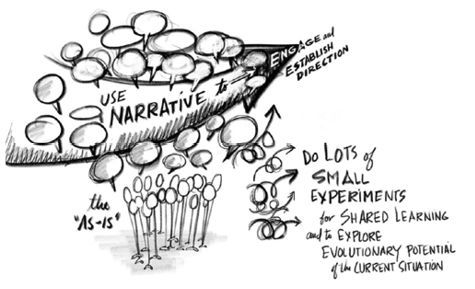
Figure 2. Using narratives and experiments to find direction and next steps
When the experiments show which changes are feasible and useful, we can make a more informed investment. As Peter Palchinsky proposed in the last century: try new things, make them small so that they don’t threaten existence, and learn from the experience. (20)
When to use it
Assessing team dynamics in a corporate setting to uncover hidden tensions.
Exploring user needs for a software product through narrative fragments.
Identifying cost-saving opportunities in manufacturing by disassembling components.
Before committing to a system modernization, experiment with current processes to discover needs and constraints that an initial requirements list may miss.
FROM THEORY TO EVERYDAY LIFE
In practice
Pfizer Anecdote Circles
In the Pfizer account, Tony Quinlan and Ron Donaldson used anecdote circles to collect employees’ experiences. These suggested that sales representatives’ attitudes and confidence deserved more attention than further product instruction. The fragments also prompted small changes that could be tried without a large change program.
Lotus Car Parts Breakdown
The new CEO of Lotus broke down three car models into parts and laid them out. All 900 employees tagged components as keep, renegotiate, redesign, or discard. This resulted in a weight reduction of 20 kg and cost savings of £3,000, plus quality improvements.
A MOMENT TO REFLECT
Put it to work.
How can anecdote circles help surface unspoken issues in your organization?
What are the context-sensitive constraints that enable or hinder your team's capabilities?
How can breaking down a system into fine-grained objects reveal new possibilities?
Often confused with
References
- Quote by John D. Niles — John D. Niles
- The Deep Dive — David Kelly
- Anecdote circles with Pfizer — Tony Quinlan and Ron Donaldson
- Dynamics in Action — Alicia Juarrero
- Lead with Respect — Unknown
- Palchinsky's principles — Peter Palchinsky
- The Sunday Times article — Unknown
CONTINUE THE CONVERSATION
Source texts
- Cynefin - Weaving Sense-Making into the Fabric of Our World ED02 (Dave Snowden Sonja Blignaut Zhen Goh)