Informal Fallacies
Informal fallacies are errors that require attention to an argument’s content, language, or context to identify. Examples include unsupported causal claims, circular reasoning, hasty generalization, irrelevant appeals, and shifts in the meaning of a term.
THE IDEA
Informal Fallacies
Informal fallacies are identified by examining the content, language, or context of an argument. Unlike a purely formal error, the problem may not be apparent from its abstract structure. These fallacies can occur in deductive as well as inductive reasoning. They include ambiguous wording, unsupported assumptions, irrelevant premises, and conclusions that go beyond the evidence.
A false-cause fallacy attributes an event to a cause without adequate support. A proposed explanation may be wrong, or the available evidence may simply be insufficient to establish it. Superstitions provide familiar examples:
-
Every time I watch my favorite team play at Casey’s Bar, they win.
-
Tomorrow night my team is playing.
-
Thus, I have to be at Casey’s Bar to watch the game to ensure they win again.
-
I hit the side of my TV when the picture was fuzzy, and it no longer was fuzzy.
-
So, it’s obvious that my hitting the side of the TV is what fixed it.
-
A black cat crosses your path.
-
Hence, that’s why you trip a minute later and fall.
False-cause arguments also appear in advertising and politics. An advertisement might attribute weight loss or improved memory to a pill without evidence that separates its effects from other factors. Likewise, holding a president solely responsible for unemployment or inflation can overlook other causes. The issue is whether the causal claim is supported, not merely whether it concerns a supplement or a politician.
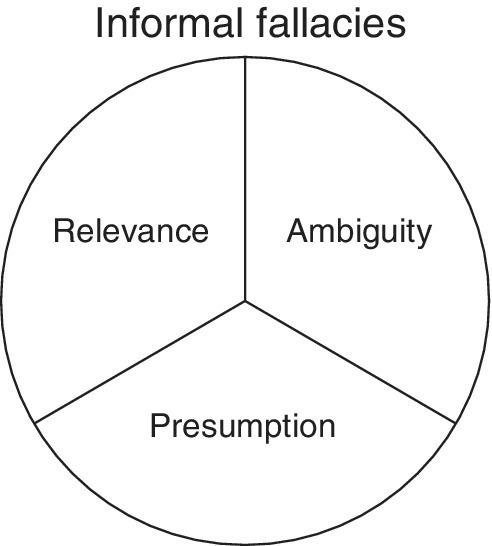
False cause is often classified as a fallacy of presumption. Such arguments rely on an assumption that has not been adequately established. Making that assumption explicit helps reveal where the reasoning needs support.
The sports fan presumes that watching at Casey’s Bar affects the team’s performance. A run of wins while the fan is there does not establish that connection. Player performance, opponents, and other conditions offer explanations that do not depend on the fan’s choice of venue.
The TV example needs more care. A hit might jostle a loose connection and thereby improve the picture. If so, it would be a cause of the improvement, even though it acts through an intermediate mechanism. What the sequence alone cannot establish is whether that happened. Calling a cause indirect does not make the explanation fallacious.
The final example is as absurd as the first. You tripped and fell a minute later because of something other than the supposed superstitious power associated with a black cat’s crossing your path.
Other fallacies often grouped under presumption include false dilemma, suppressed evidence, complex question, hasty generalization, and begging the question. Begging the question occurs when the justification for a premise already depends on accepting the conclusion. Consider:
- It says so in the Bible that God exists.
- Therefore, God exists.
You may ask a believer, “Why do you think that God exists?” or “What evidence or proof do you have that God exists?” The reply might be, “Well, it says in the Bible that God exists. In fact, the Bible talks about God all throughout.” Whether this is circular depends on the justification offered for accepting the Bible’s authority. If that authority rests only on the assumption that an existing God authored it, the dependency becomes clearer when written out:
- It says so in the Bible (written by a God that exists) that God exists.
- Therefore, God exists.
In that version, the reason given for accepting the premise depends on the very claim the argument is meant to establish. Repeating the claim cannot provide independent support. But a mere restatement is not always a fallacy: a valid inference can also translate a claim into equivalent words. For example:
- When you move your legs quickly across a solid surface in a steady gait, it’s beneficial to your body.
- Therefore, running is good for you.
This paraphrase can be a valid inference. It becomes inadequate only if it is offered as an independent reason to believe that running is beneficial.
Hasty generalization draws a broader conclusion than the evidence warrants. Someone may conclude “they’re all like that” after encountering only a few members of a group. Here, “they” refers to the group being generalized about. A prejudice can take this form:
- My experience of a person from that ethnicity, creed, or sex has been negative.
- So, they’re all like that. (Every experience I have, or anyone will have, of a person from that ethnicity, creed, or sex will be negative.)
The sample does not justify that conclusion. Generalization does not require meeting every member of a population, but it does require an adequate basis for the breadth of the claim. Sally may conclude that “Cars from Brand X are all lemons” after one bad experience. Likewise, hearing that “Frank got a case of E. coli from that place” does not establish that every restaurant patron will become ill. It may still justify concern or investigation; a good inspection record does not rule out a particular incident.
Informal fallacies are also commonly grouped under relevance and ambiguity. A fallacy of relevance offers premises that do not adequately support the conclusion, even though they may be emotionally persuasive. Examples include some appeals to the person (ad hominem), force, inappropriate authority, and popular opinion (ad populum). Personal information, expert testimony, or emotion is not automatically irrelevant; its role in the particular argument matters.
In an example from the source, a caller to Coast to Coast AM with George Noory discussed cryptozoology on January 5, 2016. Cryptozoology concerns supposed creatures such as Bigfoot, the Loch Ness monster, and chupacabra. The caller’s reasoning was approximately:
That there is no hard evidence of these cryptids is baffling because they exist. There are too many accounts of these creatures for them not to exist. One of these days, someone will find a carcass. They have to.
The caller acknowledges the value of “hard evidence” but treats the quantity of reports as decisive: “There are too many accounts of these creatures for them not to exist,” he claims. Research on eyewitness reliability over the last 50 years gives reasons to assess such reports carefully. Testimony can provide evidence, but reports may be mistaken, dependent on one another, or influenced by expectations. Their number alone cannot establish the conclusion. The argument has this form:
- Several people claim X is true or is the case.
- Therefore, X is true or is the case.
The caller’s claim that “There are too many accounts of these creatures for them not to exist,” does not follow from the number alone. Assessing the reports and seeking independent physical evidence would provide a better basis for judgment.
A fallacy of ambiguity depends on uncertain wording or a shift in meaning during an argument. Consider:
- The conflict in the Middle East is no news.
- And no news is good news.
- So, the conflict in the Middle East is good news.
Our intuition is that not only is the conflict in the Middle East not good news (in other words, the conclusion is false) but also that the conclusion does not follow from the premises. But why? What has occurred with this argument is known as equivocation, which refers to a term’s changing its meaning throughout the course of a sentence, discussion, or, in this case, an argument. Equivocation is a bad thing, logically, linguistically, and for many other reasons. Specifically, the meaning of no news has changed: in the first premise, it means something like “known by all or most people” while in the second, it means something like “nothing bad is happening, or otherwise, that grabs our attention.” When made explicit, we can see that the conclusion does not follow from the premises:
- The conflict in the Middle East is known by all or most people.
- And nothing bad is happening that grabs our attention is good news.
- So, the conflict in the Middle East is good news.
The argument cannot establish that “The conflict in the Middle East is good news,” because it relies on the change in meaning. A separate argument would be needed to support that claim.
This example also illustrates how content affects formalization. If the repeated expression is mistakenly treated as having one meaning, the argument can appear valid:
- CME is NN.
- NN is GN.
- So, CME is GN.
On that representation, NN links CME to GN. Once the two meanings are represented separately, the apparent connection disappears:
- CME is KBA.
- NBH is GN.
- So, CME is GN.
There is no longer a link from CME to GN and now, even formally, the argument is invalid.
Other fallacies commonly classified under ambiguity include amphiboly, accent, composition, and division. These labels help identify questions to ask about an argument; deciding whether an error has occurred still requires examining the actual reasoning.
When to use it
Evaluating causal claims in everyday life, such as health remedies or economic trends, to avoid false cause reasoning.
Analyzing political or marketing arguments that rely on popular opinion (ad populum) rather than evidence.
Detecting circular reasoning in debates about religion, ethics, or science by identifying begging the question.
Improving critical thinking in media consumption by spotting hasty generalizations based on anecdotal evidence.
FROM THEORY TO EVERYDAY LIFE
In practice
Superstitious Sports Fan
A person believes that watching their team play at a specific bar causes them to win, ignoring other factors like player performance or opponent strength. Example: "Every time I watch my team at Casey's Bar, they win. So I must go there to ensure victory."
TV Repair by Hitting
Someone hits a TV and the fuzzy picture clears. The sequence alone does not establish the cause. If the hit restored a loose connection, however, it could genuinely have caused the improvement through that mechanism.
Black Cat Superstition
A person trips after a black cat crosses their path and blames the cat, ignoring mundane causes like an uneven sidewalk.
Begging the Question (God's Existence)
Argument: 'It says in the Bible that God exists, therefore God exists.' This is circular if the Bible’s authority is justified only by assuming that God exists and authored it. Otherwise, the argument raises a separate question about why its testimony should be accepted.
Hasty Generalization (Ethnic Prejudice)
A person has one negative experience with someone from a particular ethnicity and concludes all members of that ethnicity are negative, ignoring variability.
Appeal to the People (Cryptids)
A radio caller argues that cryptids must exist because many people report seeing them. The number of reports alone does not settle whether they are accurate, independent, or descriptions of the same phenomenon.
Equivocation (Middle East Conflict)
Argument: 'The conflict in the Middle East is no news. No news is good news. Therefore, the conflict is good news.' The term 'no news' shifts meaning from 'widely known' to 'absence of bad news.'
A MOMENT TO REFLECT
Put it to work.
Can you identify a time when you committed the false cause fallacy by assuming a causal relationship that didn't exist? How could you have tested that assumption?
Think of a common belief or superstition you hold. Does it rely on hasty generalization or appeal to popular opinion? How would you evaluate the evidence more critically?
When you hear an argument that seems suspicious, how can you check for equivocation—where a key term changes meaning—before accepting the conclusion?
Often confused with
CONTINUE THE CONVERSATION
Source texts
- Bad Arguments 100 of the Most Important Fallacies in Western Philosophy (Steven Barbone, Michael Bruce)