Don’t Stop Unbelieving
The rethinking cycle begins with intellectual humility, leading to doubt, curiosity, and discovery, which in turn reinforce humility. In contrast, the overconfidence cycle traps us in pride, conviction, and confirmation bias, hindering our ability to update beliefs.
THE IDEA
DON’T STOP UNBELIEVING
As I’ve studied the process of rethinking, I’ve found that it often unfolds in a cycle. It starts with intellectual humility—knowing what we don’t know. We should all be able to make a long list of areas where we’re ignorant. Mine include art, financial markets, fashion, chemistry, food, why British accents turn American in songs, and why it’s impossible to tickle yourself. Recognizing our shortcomings opens the door to doubt. As we question our current understanding, we become curious about what information we’re missing. That search leads us to new discoveries, which in turn maintain our humility by reinforcing how much we still have to learn. If knowledge is power, knowing what we don’t know is wisdom.
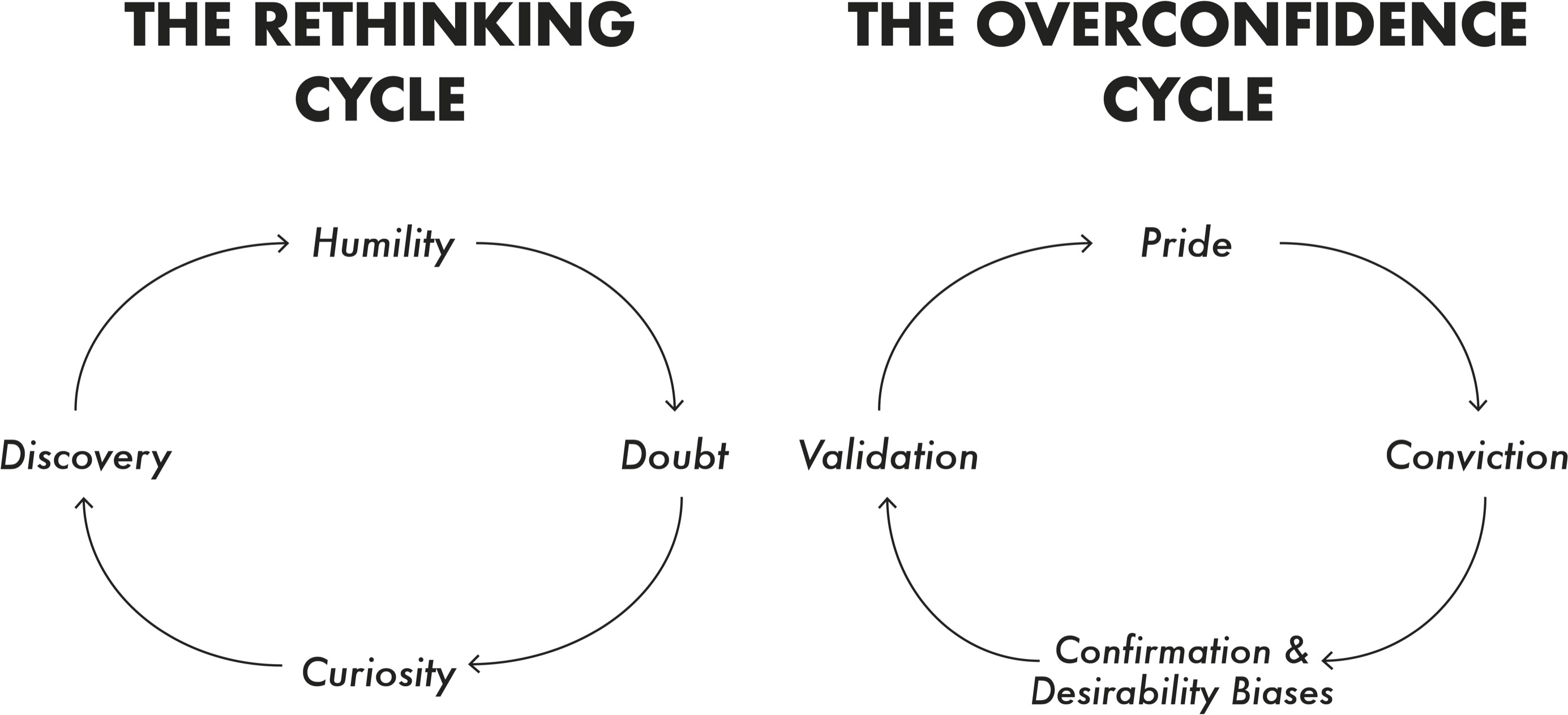
Scientific thinking favors humility over pride, doubt over certainty, curiosity over closure. When we shift out of scientist mode, the rethinking cycle breaks down, giving way to an overconfidence cycle. If we’re preaching, we can’t see gaps in our knowledge: we believe we’ve already found the truth. Pride breeds conviction rather than doubt, which makes us prosecutors: we might be laser-focused on changing other people’s minds, but ours is set in stone. That launches us into confirmation bias and desirability bias. We become politicians, ignoring or dismissing whatever doesn’t win the favor of our constituents—our parents, our bosses, or the high school classmates we’re still trying to impress. We become so busy putting on a show that the truth gets relegated to a backstage seat, and the resulting validation can make us arrogant. We fall victim to the fat-cat syndrome, resting on our laurels instead of pressure-testing our beliefs.
In the case of the BlackBerry, Mike Lazaridis was trapped in an overconfidence cycle. Taking pride in his successful invention gave him too much conviction. Nowhere was that clearer than in his preference for the keyboard over a touchscreen. It was a BlackBerry virtue he loved to preach—and an Apple vice he was quick to prosecute. As his company’s stock fell, Mike got caught up in confirmation bias and desirability bias, and fell victim to validation from fans. “ It’s an iconic product,” he said of the BlackBerry in 2011. “It’s used by business, it’s used by leaders, it’s used by celebrities.” By 2012, the iPhone had captured a quarter of the global smartphone market, but Mike was still resisting the idea of typing on glass. “I don’t get this,” he said at a board meeting, pointing at a phone with a touchscreen. “ The keyboard is one of the reasons they buy BlackBerrys.” Like a politician who campaigns only to his base, he focused on the keyboard taste of millions of existing users, neglecting the appeal of a touchscreen to billions of potential users. For the record, I still miss the keyboard, and I’m excited that it’s been licensed for an attempted comeback.
When Mike finally started reimagining the screen and software, some of his engineers didn’t want to abandon their past work. The failure to rethink was widespread. In 2011, an anonymous high-level employee inside the firm wrote an open letter to Mike and his co-CEO. “ We laughed and said they are trying to put a computer on a phone, that it won’t work,” the letter read. “We are now 3–4 years too late.”
Our convictions can lock us in prisons of our own making. Apple’s development of the iPhone offers a contrasting example of a leader changing his mind.
The legend of Apple’s renaissance revolves around the lone genius of Steve Jobs. It was his conviction and clarity of vision, the story goes, that gave birth to the iPhone. The reality is that he was dead-set against the mobile phone category. His employees advocated entering the category and helped change his mind. Although Jobs knew how to “think different,” it was his team that did much of the rethinking.
In 2004, a small group of engineers, designers, and marketers pitched Jobs on turning their hit product, the iPod, into a phone. “Why the f@*& would we want to do that?” Jobs snapped. “That is the dumbest idea I’ve ever heard.” The team had recognized that mobile phones were starting to feature the ability to play music, but Jobs was worried about cannibalizing Apple’s thriving iPod business. He hated cell-phone companies and didn’t want to design products within the constraints that carriers imposed. When his calls dropped or the software crashed, he would sometimes smash his phone to pieces in frustration. In private meetings and on public stages, he swore over and over that he would never make a phone.
Yet some of Apple’s engineers were already doing research in that area. They worked together to persuade Jobs that he didn’t know what he didn’t know and urged him to doubt his convictions. It might be possible, they argued, to build a smartphone that everyone would love using—and to get the carriers to do it Apple’s way.
When discussing a change, it can help to explain what will stay the same. A new strategy may preserve an organization’s purpose even as it changes the way people work.
The engineers who worked closely with Jobs understood that this was one of the best ways to convince him. They assured him that they weren’t trying to turn Apple into a phone company. It would remain a computer company—they were just taking their existing products and adding a phone on the side. Apple was already putting twenty thousand songs in your pocket, so why wouldn’t they put everything else in your pocket, too? They needed to rethink their technology, but they would preserve their DNA. After six months of discussion, Jobs finally became curious enough to give the effort his blessing, and two different teams were off to the races in an experiment to test whether they should add calling capabilities to the iPod or turn the Mac into a miniature tablet that doubled as a phone. Just four years after it launched, the iPhone accounted for half of Apple’s revenue.
The iPhone represented a dramatic leap in rethinking the smartphone. At the time of writing, subsequent smartphone innovation appeared more incremental: different sizes and shapes, better cameras, and longer battery life, with fewer fundamental changes to the purpose or user experience. Looking back, if Mike Lazaridis had been more open to rethinking his pet product, would BlackBerry and Apple have compelled each other to reimagine the smartphone multiple times by now?
The curse of knowledge is that it closes our minds to what we don’t know. Good judgment depends on having the skill—and the will—to open our minds. I’m pretty confident that in life, rethinking is an increasingly important habit. Of course, I might be wrong. If I am, I’ll be quick to think again.
When to use it
When evaluating a new technology for your business, use the rethinking cycle to avoid overconfidence in existing products.
During a team debate, acknowledge gaps in your knowledge and ask what evidence would change each person’s mind.
When personal beliefs are challenged, practice doubt and seek new information to update your understanding.
In education, teach students to question their knowledge and embrace rethinking as a habit.
FROM THEORY TO EVERYDAY LIFE
In practice
BlackBerry's Overconfidence Cycle
In Grant’s account, Mike Lazaridis’s conviction that customers wanted BlackBerry keyboards made it harder to reconsider touchscreens. Grant uses the story to illustrate how pride, confirmation bias and validation from existing fans can reinforce a leader’s position as a market changes.
Apple's Rethinking Cycle
Jobs initially opposed making a phone. His team argued that adding phone capabilities could extend Apple’s existing products while preserving its identity as a computer company. Grant describes the discussions as an example of rethinking that helped lead to the iPhone.
A MOMENT TO REFLECT
Put it to work.
Think of a time when you were stuck in an overconfidence cycle. How could you have used intellectual humility to break free?
How does the rethinking cycle apply to your current beliefs about a controversial topic?
What would it take for you to doubt a long-held conviction?
Often confused with
CONTINUE THE CONVERSATION
Source texts
- Think Again The Power of Knowing What You Dont Know (Adam Grant)