Deductive, Inductive, and Dialectical Reasoning
Deduction asks whether a conclusion must follow from its premises; a valid argument can still have false premises. Induction draws conclusions supported, but not guaranteed, by observations. Dialectical approaches examine competing ideas and contradictions to develop a better account of a problem.
THE IDEA
Thinking, Straight and Curved
Richard Nisbett compares forms of reasoning in this passage from Mindware.
People have discovered many different ways to reduce the likelihood of making an error in reasoning. One way is to obey the rules of formal logic—rules for reasoning that can be described in purely abstract terms without making any contact at all with real-world facts. If the structure of your argument can be mapped directly onto one of the valid forms of argument that logic specifies, you’re guaranteed a conclusion that follows deductively from the premises. Whether your conclusion is true is a different matter entirely and depends on the truth of your premises—the statements that precede your conclusion.
Formal logic is a type of deductive reasoning—“top-down” argument forms that produce conclusions that follow necessarily from the premises on which they are based.
Two kinds of formal logic have received a great deal of attention historically. The oldest is the syllogism. Syllogisms are used for some kinds of categorical reasoning. For example: All A are B, X is an A, therefore X is a B. (Most famously: All men are mortal, Socrates is a man, therefore Socrates is mortal.) Syllogisms have been around for at least twenty-six hundred years.
Formal logic also includes propositional logic, which is somewhat more recent, having first been treated seriously by fourth-century B.C. Greek Stoic philosophers. This kind of logic tells us how to reach valid conclusions from premises, such as with the logic of the conditional. For example: If P is the case, then Q is the case. P is the case, therefore Q is the case. (If it snows, the schools will be closed. It snowed. Therefore the schools will be closed.) P is a condition requiring Q, or, differently put, P is a sufficient condition for Q.
In contrast to deductive logic, inductive reasoning is a “bottom-up” type of reasoning. Observations are collected that suggest or support some conclusion. One type of inductive reasoning consists of observing facts and reaching a general conclusion about facts of their particular kind. Nisbett’s book discusses several forms of inductive reasoning. The scientific method nearly always involves—in fact often is completely dependent on—inductive reasoning of one kind or another. Inductive arguments can provide strong or weak support for a conclusion; even strong support does not make the conclusion follow with deductive necessity.
On the basis of observation and calculation we induce that the mean of the population of some events is X plus or minus Y standard deviations. Or we induce from observing the results of our experiment that A causes B, since we observe that every time A is the case B is also the case; when A is not the case, B is not the case. It’s more probable that A causes B if these things are true than if we’re missing those observations, but it’s not certain that A causes B. For example, something associated with A might be causing B. Inductive conclusions aren’t guaranteed to be true even if all the observations they are based on are true, there are many of them, and there are no exceptions. The generalization “all swans are white” is inductively valid but, as it turns out, not true.
Deductive and inductive reasoning schemas essentially regulate inferences. They tell us what kinds of inferences are valid and what kinds are invalid. A very different kind of system of reasoning, also developed about twenty-six hundred years ago in Greece, and developed at the same time in India, is called dialectical reasoning. This form of reasoning doesn’t so much regulate reasoning as suggest ways to solve problems.
Dialectical reasoning includes the Socratic dialogue, which is essentially a conversation or debate between two people trying to reach the truth by stimulating critical thinking, clarifying ideas, and discovering contradictions that may prompt the discussants to develop views that are more coherent and more likely to be correct or useful.
Versions associated with the eighteenth- and nineteenth-century philosophers Hegel, Kant, and Fichte are often summarized through the process of “thesis” followed by “antithesis” followed by “synthesis”—a proposition followed by a potential contradiction of that proposition, followed by a synthesis that resolves any contradiction.
Other types of reasoning that have been labeled “dialectical” were developed in China, also beginning around twenty-six hundred years ago. Nisbett characterizes Chinese dialectical traditions as addressing a broader range of issues than the Western and Indian versions described here. These traditions suggest ways of dealing with contradiction, conflict, change, and uncertainty. For example, whereas the Hegelian dialectic is “aggressive” in the face of contradiction in the sense that it seeks to obliterate contradictions between propositions in favor of some new proposition, Chinese dialectical reasoning often seeks to find ways in which the conflicting propositions can both be true.
Dialectical reasoning isn’t formal or deductive and usually doesn’t deal in abstractions. It’s concerned with reaching true and useful conclusions rather than valid conclusions. In fact, conclusions based on dialectical reasoning can actually be opposed to those based on formal logic.
Relatively recently, psychologists both in the East and in the West have begun to study dialectical reasoning, developing systematic descriptions of prior formulations and proposing new dialectical principles.
In the source book, Chapter 13 develops formal reasoning and Chapter 14 examines dialectical reasoning. Nisbett argues that both can be useful, with formal logic supporting scientific inference and dialectical approaches helping examine tensions among ideas.
Below are four cards. They’re randomly chosen from a deck of cards in which every card has a letter on one side and a number on the other. Please indicate which of the cards you would have to turn over in order to find out whether the card obeys this rule: “If a card has a vowel on one side, then it has an even number on the other side.” Turn over only those cards that are necessary to establish that the rule is being followed. Choose an answer before continuing.
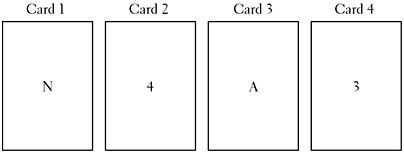
I must turn over:
a. Card 3 only
b. Cards 1, 2, 3, and 4
c. Cards 3 and 4
d. Cards 1, 3, and 4
e. Cards 1 and 3
We’ll return to this problem later in a different context.
* * *
Critical reasoning texts usually have a heavy dose of formal, deductive logic. This is done more because of ancient pedagogical tradition than because of any evidence of utility for everyday thought. And in fact, there are some reasons to suspect that most of what you read in this chapter on formal logic will be of limited value in solving problems in everyday life.
But there are nevertheless some good reasons to read about formal logic.
-
Formal logic is essential for science and mathematics.
-
The chapter sets up the stark contrast that exists between Western hyperrationality and Eastern dialectical habits of thought. The two systems of thought can both be applied to the same problem, generating different conclusions. The two systems also provide excellent platforms for critiquing each other.
-
An educated person should have some command over basic forms of logical reasoning.
-
Formal logic is interesting, at least to lots of people. (At any rate, in doses about the size of this chapter!)
The story about the Western origins of formal logic goes as follows: Aristotle got tired of hearing lousy arguments in the marketplace and the assembly. So he decided to develop reasoning templates to apply to arguments in order to analyze them for validity. An argument is valid if (and only if) its conclusions follow necessarily from its premises. Validity has nothing to do with truth. An argument can be invalid, but its conclusion can be true. An argument is valid if it has the proper structure, but its conclusion can nevertheless be false.
The concept of argument validity is important for many reasons. One reason is that you don’t want to allow someone to trick you (or allow you to trick yourself) by conferring plausibility on a conclusion because it follows from some premises—unless those premises are true and the conclusion follows necessarily from the premises. A second reason is that we don’t want to allow ourselves to disbelieve conclusions that we happen to dislike if the premises are clearly true and the form of the argument dictates that the conclusion must be true as well. A third reason is that if we have a clear grasp of the concept of validity as opposed to truth, we can assess whether a conclusion follows from its premises by stripping away the meaning from the premises and the conclusion, and thinking purely in terms of abstractions. As and Bs rather than birds and bees. That can show us that a conclusion at least follows from its premises, so even though the conclusion is highly implausible, it’s at least not the product of illogical reasoning.
Syllogisms
One of Aristotle’s major contributions to formal logic was the syllogism. The creation of syllogisms ballooned into a cottage industry in the Middle Ages, when monks generated dozens of them. From the Middle Ages until the late nineteenth century, philosophers and educators believed that syllogisms provided powerful rules for thought. Consequently they formed a large part of the curriculum in higher education in the West.
The issue of validity arises for syllogisms, which deal with categorical reasoning. Some kinds of categorical reasoning involve the quantifiers “all,” “some,” and “none.” The simplest syllogisms involve two premises and one conclusion. The simplest of those simple syllogisms, and one that we’re not normally at risk of getting wrong, is: All A are B, all B are C, all A are C. The classic here is:
All clerks are human.
All humans are bipedal.
—————————————
All clerks are bipedal.
The conclusion follows logically from the premises. If those premises are accepted as true in the example, the conclusion must also be accepted.
All clerks are human.
All humans have feathers.
——————————————
All clerks have feathers.
That argument is valid, too, though the conclusion is untrue. But the implausibility of the conclusion draws us toward feeling that the argument is also invalid. Substituting As, Bs, and Cs for clerks, humans, and feathers allows us to see the validity of the argument. That may force us to reconsider whether a conclusion is true, which can be useful.
The argument below is invalid even if we accept its premises and independently find its conclusion plausible.
All people on welfare are poor.
Some poor people are dishonest.
Therefore, some people on welfare are dishonest.
In abstract terms:
All A are B.
Some B are C.
Therefore, some A are C.
The exercise of abstracting the terms is useful because we may have the feeling that a conclusion is true because it seems plausible and because we have true premises that seem to support it logically. Finding that an argument is invalid strips away the feeling that the conclusion is necessarily true and may cause us to doubt it. (The key to recognizing the invalidity of the above argument is to realize that the As are a subset of the Bs.)
Things rapidly become more complicated from here: All A are B, some C are A, some C are B. Valid or not? No A are B, some C are B, no A are C. Valid or not?
You can spin these out till the cows come home. Medieval monks whiled away the weary hours by generating endless numbers of them. But I agree with the philosopher Bertrand Russell, who said that the syllogisms were as sterile as the monks. So much for twenty-six hundred years of pedagogy that assumed that syllogisms were crucial for effective thinking.
The most useful thing I’ve gained from instruction in categorical reasoning is learning how to draw Venn diagrams, named for the nineteenth-century logician John Venn, who invented a pictorial way of representing category membership. Every now and then I find these useful, even necessary, for representing relationships between categories. Figure 5 shows some of the more useful ones and will give you the general idea.
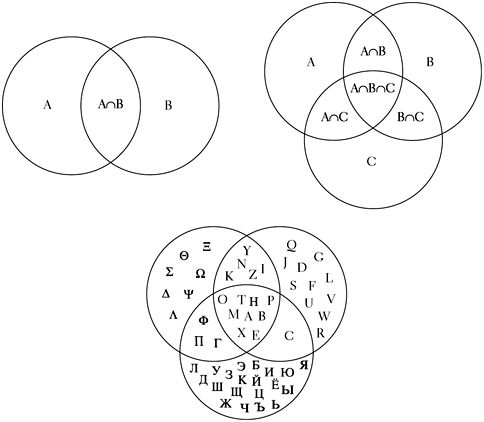
Figure 5. The intersection of categories that overlap with one another.
The top left picture in Figure 5 captures a particular syllogism that we do use in everyday life. It represents a situation in which some (but not all) A are B and some (but not all) B are A. A might stand for small furry animals and B might stand for duck-billed. As it happens there is one animal in the intersection of A and B, namely a duck-billed platypus. Or that top left picture could represent a situation in which some but not all of the students who are English speakers at an international school also speak French and some but not all French speakers speak English. (Some but not all A are B and some but not all B are A.) The exclusive English speakers (A only) must study mathematics with Ms. Smith; the exclusive French speakers (B) must study with M. Pirot. Students who speak both languages can study with either teacher.
The picture on the top right shows the much more complicated but not rare situation in which some A are B, some B are A, some A are C, some C are A, some B are C, and some C are B.
The bottom picture presents an actual example of that situation. It represents the intersections of letters that are found in Greek (top left), Latin (top right), and Russian (bottom). I defy you to reach the correct conclusion about overlap of categories solely by means of verbal propositions about categories. In any case, I’m sure I would end up merely with alphabet soup.
This is not enough on Venn diagrams to set you up for a very wide range of problems, but it gives you some of the basics on how to represent category inclusions and exclusions pictorially. You might find that learning more about Venn diagrams will be useful for you.
Propositional Logic
The disjunction example below uses exclusive or: exactly one of the alternatives holds. With inclusive or, both could hold, so affirming one would not rule out the other.
Syllogisms apply only to a tiny range of inferences that we need to make in everyday life. Much more important is propositional logic, which applies to an enormous range of inferential problems. Philosophers and logicians made sporadic contributions to propositional logic between roughly 300 B.C. and A.D. 1300. Beginning in the mid-nineteenth century, logicians started to make considerable progress on propositional logic, in particular focusing on “operators” such as “and” and “or.” “And” is concerned with “conjunctions,” such as “A is the case and B is the case; therefore A and B are both the case.” “Or” is concerned with “disjunctions,” such as “A is the case or B is the case; A is the case, therefore B is not the case.” Work on propositional logic in that era became the basis for computer design and programming.
At the beginning of the chapter, I asked you to solve a problem about cards. You can now see it was a problem requiring the application of conditional logic. If P then Q. “If a card has a vowel on one side, then it has an even number on the other side.” Before we see how well you did on the problem, let’s see how you do on the problem below.
You’re a police inspector. One of your tasks is to make sure that restaurants don’t sell alcohol to anyone under twenty-one. Your task is to say which of the customers below you have to check in order to see whether the customer is obeying this rule: “If a customer is drinking alcohol, the customer is at least twenty-one.” You should check only those customers necessary to establish that the rule is being followed.
The first table you see has four customers. You see that
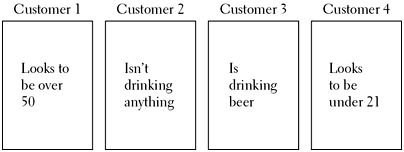
You need to check:
a. Customer 1
b. Customers 1, 2, 3, and 4
c. Customers 3 and 4
d. Customers 1, 3, and 4
e. Customers 1 and 3
I’m betting that you said option c, Customers 3 and 4. Now look back at the card problem. I’m betting that you didn’t say option c, cards 3 and 4. Can we agree that you should have? The logical structure of the two problems is identical. To test a conditional rule, check cases where its condition holds and cases where its required consequence does not. Those are the cases that could reveal a violation.
When to use it
Analyzing the logical structure of a scientific hypothesis or experiment.
Using Venn diagrams to clarify category relationships in business or project management (e.g., overlapping skill sets).
Applying conditional logic in programming (e.g., if-then statements in code).
Employing dialectical reasoning in group discussions to find a synthesis between conflicting ideas.
FROM THEORY TO EVERYDAY LIFE
In practice
Card Selection Task (Wason Selection Task)
The rule: 'If a card has a vowel on one side, then it has an even number on the other side.' You see four cards showing A, K, 4, and 7. To test the rule, you must turn over the vowel card (A) to check the number, and the odd number card (7) to check the letter. The other cards are irrelevant. This tests understanding of conditional logic (modus ponens and modus tollens).
Alcohol Age Verification Task
The rule: 'If a customer is drinking alcohol, the customer is at least twenty-one.' You see four customers: one drinking beer (age unknown), one drinking soda (age unknown), one aged 25 (drink unknown), and one aged 16 (drink unknown). To enforce the rule, you must check the beer drinker's age and the 16-year-old's drink. This is logically identical to the card problem.
A MOMENT TO REFLECT
Put it to work.
How can you use the concept of validity versus truth to evaluate an argument you encounter in a news article or political speech?
Think of a situation where you used inductive reasoning (e.g., concluding a pattern from observations). What are the potential pitfalls of that conclusion?
Could two apparently conflicting claims apply to different circumstances or mean different things? How would clarifying those differences help resolve a disagreement?
Often confused with
References
- Syllogistic Logic (Prior Analytics) — Aristotle (-350)
- Propositional Logic (Stoic Logic) — Stoic Philosophers (-300)
- Venn Diagrams — John Venn (1880)
- Dialectical Method (Phenomenology of Spirit) — Georg Hegel (1807)
- Critique of Syllogisms — Bertrand Russell (1900)
CONTINUE THE CONVERSATION
Source texts
- Mindware Tools for Smart Thinking (Richard E. Nisbett)