Baby Steps (Incremental Progress)
The idea that by taking a series of small, individually plausible steps, you can achieve a surprising and far-reaching outcome. This mental model underlies logical proofs, goal setting, and long chains of reasoning in everyday life.
THE IDEA
When Baby Steps Add Up
Kyle MacDonald is an internet legend who set himself the challenge of swapping a paper clip for a house. Not in one go, but by a series of swaps with people who didn’t think they were getting a raw deal. It’s true that the paper clip he started with was quite large (and red) – it wasn’t just a bog standard office-supplies paper clip.
It sounds completely implausible, but he did it with this long series of trades; at each step someone thought the two things in question were equivalent enough to be traded but he got very far from his original paper clip in the process:
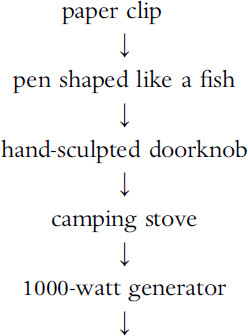
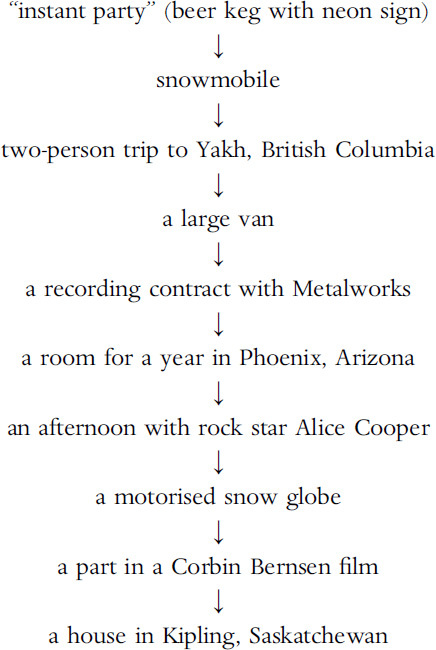
Apart from the mere fact of these trades having occurred, the thing that fascinates me about them is the question of why those trades were considered fair by the people involved. When MacDonald traded the afternoon with Alice Cooper for the snow globe, he had built up quite a following online, and this trade caused some consternation. But perhaps he knew what he was doing – did he know that the film director Corbin Bernsen collected these things, so he could make a good trade with him?
The final trade occurred because the people of Kipling (population: 1140) decided they wanted someone from their town to be in the film, so offered MacDonald a two-storey house in their town. He and his girlfriend moved in, apparently, in the autumn of 2006.
This episode fascinates me for many reasons, not least because it reminds me of a time when the internet wasn’t overtaken by insults and bullying. But I am really fascinated by this mental version of an optical illusion, where you can take tiny steps that don’t seem too surprising, and get somewhere that is extremely surprising and a very long way from where you started. This is how logic works. Each step you take is supposed to be entirely driven by logic, which means it should really just be an unpacking of some definitions, and should seem rather obvious and possibly even trivial. But when you stick them together in succession you can arrive somewhere that seems quite new, and very far from where you started. Kyle MacDonald’s series of trades was virtuosic and masterful. Long chains of logical implications can also be virtuosic and masterful. They are how mathematics progresses, and I will later argue that I think they are an essential skill of a powerfully rational person.
Building up a long chain of implications to arrive somewhere new is the idea of a logical proof, and it is how logical proofs work in mathematics. Real life is not mathematics, but we should still try to make logical arguments in real life that work in a similar (though not exactly the same) way. Every step in the argument should be a logical implication.
A more serious example of a long chain of implications is a study into why babies were suffering birth defects, described in The Power of Habit by Charles Duhigg. The birth defects were found to be caused by malnutrition in the mothers. But this wasn’t just during pregnancy – it was long-term malnutrition. Long-term malnutrition was found to be caused by poor nutrition, which was in turn caused by poor science education in school. That poor education was found to be caused by teachers not having a good enough science background in their training. So a surprising conclusion was drawn: requiring a higher level of science achievement in teachers would eventually reduce birth defects in babies. Incidentally Duhigg writes that the person who led this study was a young Paul O’Neill, who later became a renowned CEO and then United States Secretary of the Treasury. It is an example of a masterful construction of a long chain of implications in normal life.
When to use it
Breaking down a complex project into small, manageable tasks that each feel reasonable.
Constructing a persuasive argument or presentation by building from one logical point to the next.
Analyzing a problem (like a health or social issue) by tracing root causes through a chain of causality.
Setting personal habits: start with a tiny change (one pushup, one page of reading) and gradually scale up.
FROM THEORY TO EVERYDAY LIFE
In practice
From Paper Clip to House
Kyle MacDonald traded a single red paper clip through a series of 14 swaps, each step seeming fair to the other party, ultimately obtaining a house in Kipling, Saskatchewan.
Teacher Science Training and Birth Defects
Cheng retells Duhigg’s account of Paul O’Neill tracing a chain from birth defects through maternal malnutrition and science education to teacher preparation. The account proposes improving teachers’ science training as an intervention far upstream of the health outcome.
A MOMENT TO REFLECT
Put it to work.
Think of a long-term goal you have. What are the smallest incremental steps that could lead you there?
Consider a belief you hold strongly. Can you trace the logical chain of reasoning that led you to that belief? Is each step valid?
When you argue a point, do you ensure each claim logically follows from the previous? How can you strengthen your chain of reasoning?
References
- The Power of Habit — Charles Duhigg (2012)
CONTINUE THE CONVERSATION
Source texts
- The Art of Logic How to Make Sense in a World that Doesn’t (Eugenia Cheng)