Negating Implication
To negate a universal implication, identify a case where its condition holds but its conclusion does not. Having privilege, for example, does not imply being white if someone can have another form of privilege.
THE IDEA
NEGATING IMPLICATION
Now that we understand more about negation we can try applying it to a more complicated statement: a statement of implication.
We have seen the implication “If you are white then you have privilege”. We have seen that the converse “If you have privilege then you are white” isn’t true because you could be non-white but have other forms of privilege, for example by being male, rich, straight, cisgendered, able-bodied, tall, thin, educated. Since it isn’t true, we should be able to negate the statement.
It is tricky to negate implication. There isn’t a simple way to negate it by just sticking a “not” into the sentence, although it is tempting. We can try to say “If you have privilege then you are not white” which isn’t true. If you have privilege you might be white, but you might not.
We might try to say something like “There are other types of privilege besides white privilege”. This is a good step towards a logical negation, because it points toward a counterexample. The phrase “There are ...” expresses existence, developed further in Chapter 7.
A direct way to negate “implies” is by saying “does not imply”, as in “Having privilege does not imply that you are white”. Or we can just tack “It is not true that ...” onto the beginning of the statement. This is a foolproof way of negating a statement, it just tends to result in an unnatural sounding sentence. “It is not true that if you have privilege then you are white”.
In symbols we just sort of cross out the implication arrow and write
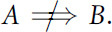
For a universal implication, a counterexample has the antecedent true and the consequent false: someone has privilege but is not white. This differs from claiming that everyone with privilege is non-white.
When to use it
Evaluating arguments in debates or discussions to ensure logical consistency.
Analyzing political or social claims that use if-then statements.
Teaching logic fundamentals in philosophy or mathematics classes.
Detecting fallacies in advertising or persuasive writing.
FROM THEORY TO EVERYDAY LIFE
In practice
Privilege Implication
The original example: The false converse 'If you have privilege then you are white' is negated by 'Having privilege does not imply that you are white', recognizing other forms of privilege (male, rich, straight, etc.).
Rain and Wet Ground
Consider 'If it rains then the ground is wet'. The negation 'It is not true that if it rains then the ground is wet' means it can rain without the ground being wet (e.g., if the ground is covered or water evaporates immediately).
A MOMENT TO REFLECT
Put it to work.
Think of a common implication in your daily life that might be false. How would you correctly negate it?
Why is simply adding 'not' to the consequent of an implication not a valid negation? Give an example.
In a disagreement, how can identifying a false implication help clarify the argument?
Often confused with
CONTINUE THE CONVERSATION
Source texts
- The Art of Logic How to Make Sense in a World that Doesn’t (Eugenia Cheng)