The Turkey Problem
The Turkey Problem illustrates how reliance on past evidence can lead to catastrophic surprise when a Black Swan event occurs, as in the case of a turkey being fed for a thousand days before Thanksgiving. It warns against mistaking absence of evidence for evidence of absence.
THE IDEA
The Great Turkey Problem
In Extremistan, one is prone to be fooled by the properties of the past and get the story exactly backwards. It is easy, looking at what is happening in the second graph of Figure 3, before the big jump down, to believe that the system is now safe, particularly when the system has made a progressive switch from the “scary” type of visibly volatile randomness at left to the apparently safe right. It looks like a drop in volatility—and it is not.
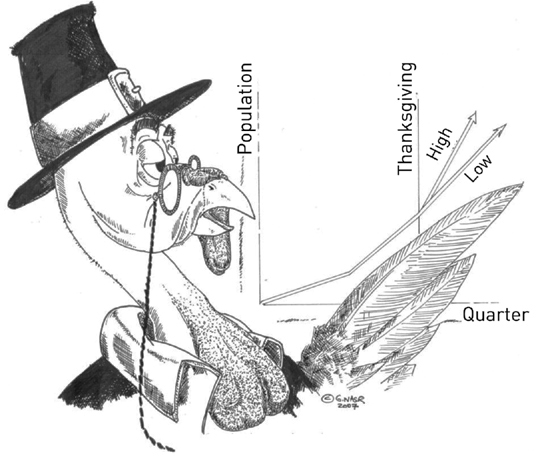
A turkey is fed for a thousand days by a butcher; every day confirms to its staff of analysts that butchers love turkeys “with increased statistical confidence.” The butcher will keep feeding the turkey until a few days before Thanksgiving. Then comes that day when it is really not a very good idea to be a turkey. So with the butcher surprising it, the turkey will have a revision of belief—right when its confidence in the statement that the butcher loves turkeys is maximal and “it is very quiet” and soothingly predictable in the life of the turkey. This example builds on an adaptation of a metaphor by Bertrand Russell. The key here is that such a surprise will be a Black Swan event; but just for the turkey, not for the butcher.
We can also see from the turkey story the mother of all harmful mistakes: mistaking absence of evidence (of harm) for evidence of absence, a mistake that we will see tends to prevail in intellectual circles and one that is grounded in the social sciences.
So our mission in life becomes simply “how not to be a turkey,” or, if possible, how to be a turkey in reverse—antifragile, that is. “Not being a turkey” starts with figuring out the difference between true and manufactured stability.
The reader can easily imagine what happens when constrained, volatility-choked systems explode. We have a fitting example: the removal of the Baath Party, with the abrupt toppling of Saddam Hussein and his regime in 2003 by the United States. More than a hundred thousand persons died, and ten years later, the place is still a mess.
When to use it
Evaluating financial models that assume market stability based on years of low volatility.
Assessing political stability in regions where oppressive regimes suppress dissent.
Making personal decisions that rely on historical patterns (e.g., job security, health risks) while accounting for rare shocks.
Designing systems (e.g., infrastructure, supply chains) that can withstand unforeseen disruptions.
FROM THEORY TO EVERYDAY LIFE
In practice
The Turkey and the Butcher
A turkey is fed for a thousand days, leading its analysts to conclude that butchers love turkeys. A few days before Thanksgiving, the butcher’s plans overturn that conclusion. The surprise belongs to the turkey; the butcher expected it.
The 2003 Iraq Invasion
Taleb uses the overthrow of Saddam Hussein’s regime in 2003 and his account of over a hundred thousand deaths and prolonged instability to illustrate his argument about suppressed volatility. This is his political analogy for manufactured stability.
A MOMENT TO REFLECT
Put it to work.
In what areas of your life or work might you be a 'turkey,' relying on past data without considering rare but impactful events?
How can you distinguish between true stability and manufactured stability in systems you observe?
What steps can you take to become 'antifragile' rather than vulnerable to Black Swan events?
CONTINUE THE CONVERSATION
Source texts
- Antifragile (Nassim Nicholas Taleb)