The Team Model
A framework for evaluating team composition by defining necessary skills, rating team members, and comparing with self-evaluations to identify strengths, weaknesses, and alignment.
THE IDEA
The Team Model
Is your team up to the job?
Regardless of whether you are the head of a kindergarten or of a national sports team, or whether you want to set up a company or a fundraising committee, you will be asking yourself the same questions: Do I have the right people for this project? Do our skills correspond to our goals? Are we capable of doing what we want to do?
This team model will help you to judge your team. Begin by defining the skills, expertise and resources that you think are important for carrying out the project. Note the skills that are absolutely necessary for the job. Distinguish between soft skills (e.g., loyalty, motivation, reliability) and hard skills (e.g., computer, business and knowledge of foreign languages). For each skill, define where your critical boundary lies on a scale of zero to ten. For example, an acceptable level of fluency in French might be five. Now judge your “players” according to these criteria. Connect the points with a line. What are the team’s weaknesses, and what are their strengths?
Even more revealing than the model itself is the subsequent self-evaluation by the team members. A good team is one that can correctly judge its own capabilities.
Beware! Real strength lies in differences, not in similarities.
The best executive is the one who has sense enough to pick good men to do what he wants done, and self-restraint enough to keep from meddling with them while they do it. Theodore Roosevelt
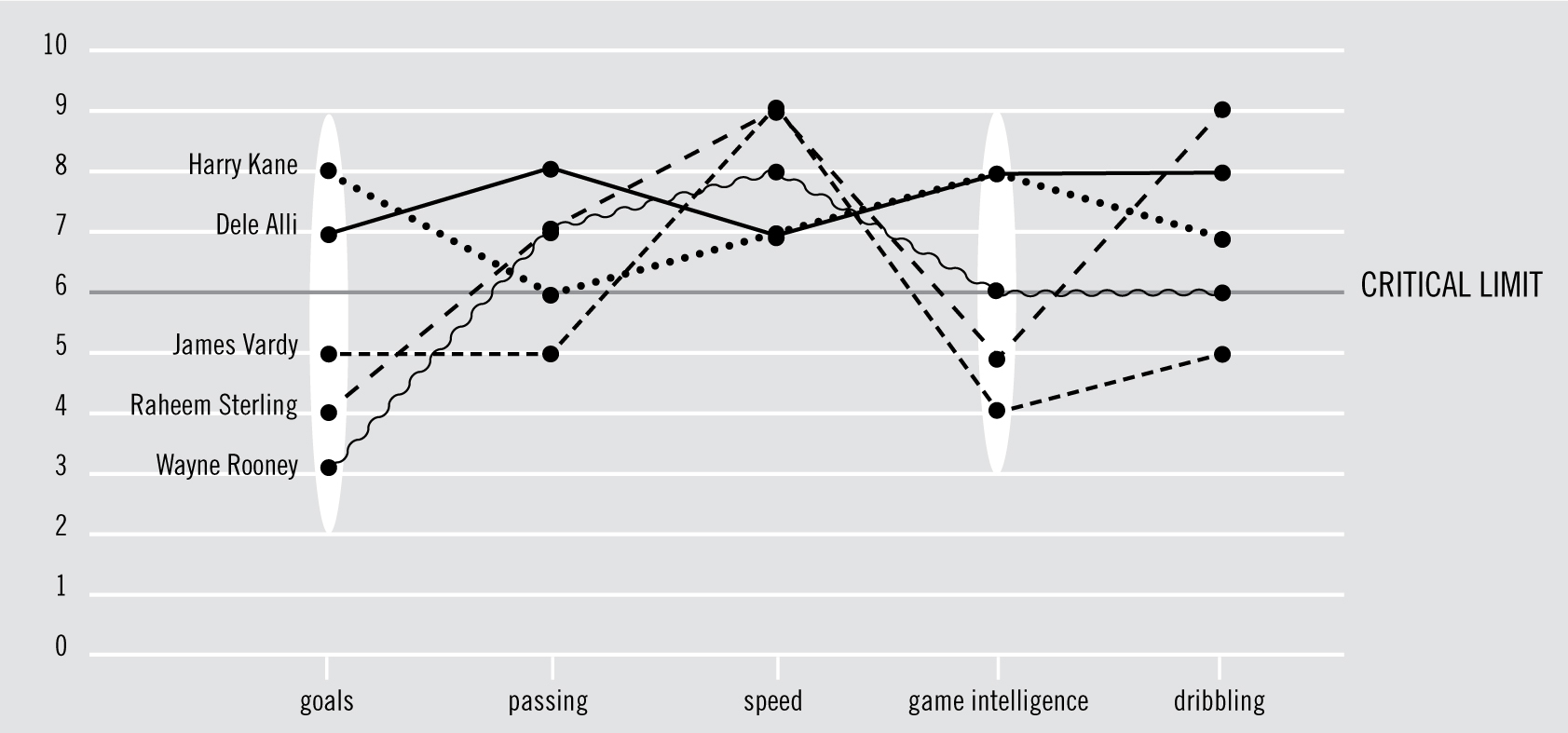
(Based on players’ performance in the 2016/17 Premier League.) Create new criteria that apply to your team’s objective and evaluate each team member against them. Afterward, ask the team members to evaluate themselves. How do the curves compare?
When to use it
Selecting players for a sports team
Forming a cross-functional project team
Assessing a fundraising committee
Evaluating a teaching staff for a school
FROM THEORY TO EVERYDAY LIFE
In practice
Evaluating a football team
A coach rates speed, passing accuracy, stamina, tactical awareness, and teamwork, then asks players to rate themselves. Differences between the curves identify questions to investigate against performance evidence; they do not establish whose judgment is correct.
Assessing a software project team
A project manager defines programming, database, communication, and time-management criteria on a 0–10 scale. Developers’ self-ratings differ from the manager’s communication ratings, so they review concrete examples before deciding whether coaching or clearer expectations are needed.
A MOMENT TO REFLECT
Put it to work.
What are the most critical skills for your team's current objective?
How accurately can your team members assess their own abilities?
What does the comparison between your ratings and self-ratings reveal about team dynamics?
CONTINUE THE CONVERSATION
Source texts
- The Decision Book Fifty Models for Strategic Thinking