The Pareto Principle
The Pareto Principle, or 80/20 rule, describes uneven contributions: roughly 80% of an outcome may come from 20% of its contributors. Treat the ratio as a pattern to investigate in a particular setting, not a fixed law.
THE IDEA
THE PARETO PRINCIPLE
WHY 80 PERCENT OF THE OUTPUT IS ACHIEVED WITH 20 PERCENT OF THE INPUT
The following ratios are the book’s illustrations of concentrated outcomes, not measurements established here for every setting.
At the beginning of the twentieth century, the Italian economist Vilfredo Pareto observed that 80 percent of Italy’s wealth belonged to 20 percent of the population. And that’s not all: 20 percent of workers do 80 percent of the work; 20 percent of criminals commit 80 percent of the crimes. The book also suggests that 20 percent of car drivers cause 80 percent of accidents. And 20 percent of hedge funds invest 80 percent of the money invested; 20 percent of pub-goers consume 80 percent of the alcohol consumed. We wear 20 percent of the clothes we have in our wardrobes and spend 80 percent of our time with 20 percent of our friends. In business meetings, 80 percent of the decisions are made in 20 percent of the time, and 20 percent of a company’s clients (products) are responsible for 80 percent of its turnover.
Of course, the Pareto rule cannot be applied to everything (the book also mentions the “64/4” rule, because 80 percent of 80 is 64 and 20 percent of 20 is 4; applying it requires the same concentration pattern within the smaller group). For time planning, investigate whether roughly 20 percent of the effort contributes 80 percent of the results in the task at hand. The relationship must be checked rather than assumed.
I am definitely going to take a course on time management … just as soon as I can work it into my schedule. Louis E. Boone
 See also: Long-tail model (p. 106)
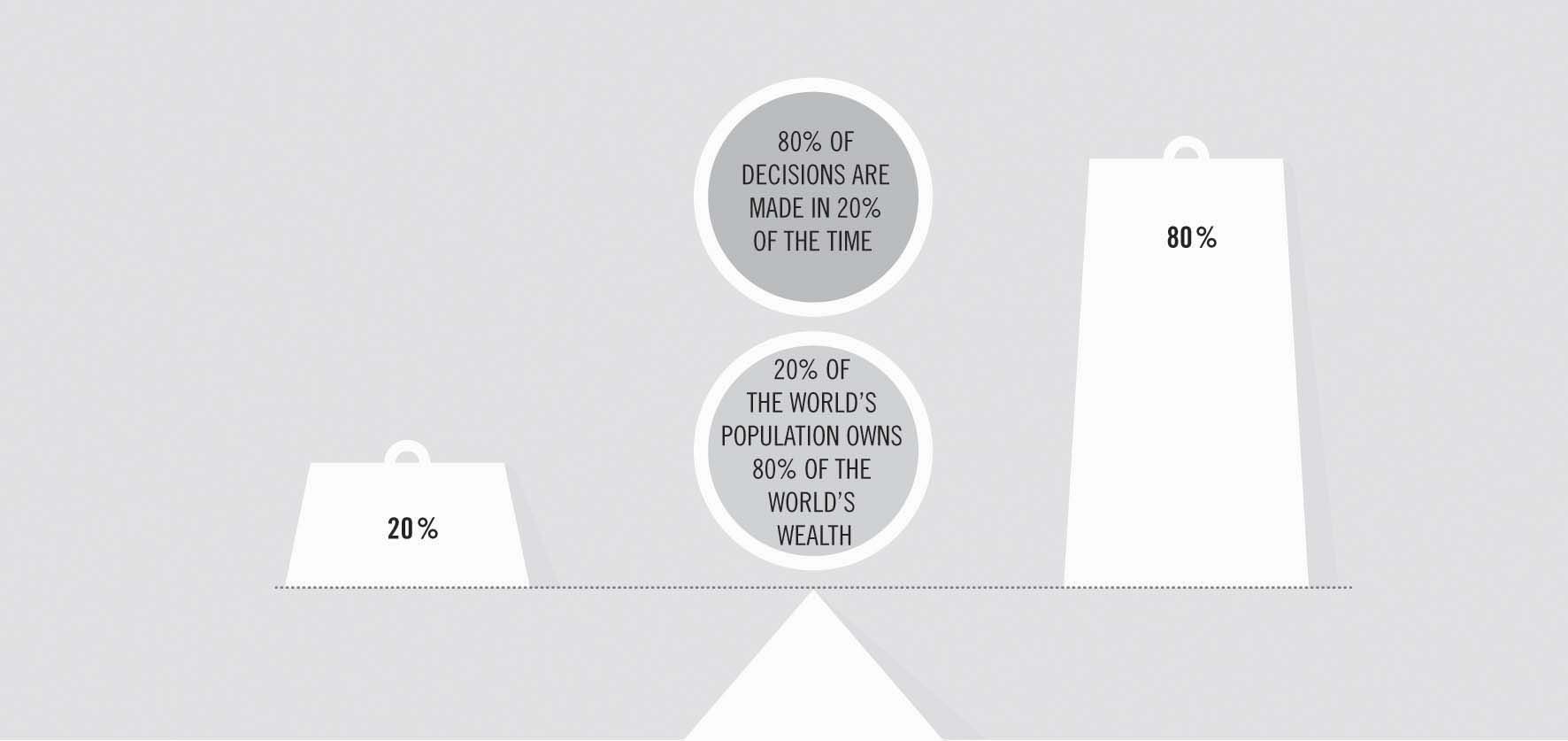
The Pareto principle describes the statistical phenomenon whereby a small number of high values contribute more to the total than a high number of low values.
When to use it
Time management: focus on the most important tasks that yield the greatest results.
Business: checking whether a group such as the top 20% of customers accounts for 80% of revenue, and considering costs and future potential before setting priorities.
Goal setting: prioritize the few actions that lead to the majority of progress.
FROM THEORY TO EVERYDAY LIFE
In practice
Wealth distribution
The book attributes to Pareto the observation that 80% of Italy’s wealth belonged to 20% of the population. The passage does not supply the underlying dataset.
Workplace productivity
As an illustration, 20% of workers might contribute 80% of measured output. Whether this describes a particular workplace depends on the task, measurement, and data.
A MOMENT TO REFLECT
Put it to work.
Does a set of tasks taking about 20% of your effort produce about 80% of your results, or does your actual pattern differ?
Consider your friendships: do you spend 80% of your time with 20% of your friends? How might this insight affect your social time?
How can you apply the Pareto principle to your business’s customer base to maximize revenue?
CONTINUE THE CONVERSATION
Source texts
- The Decision Book Fifty Models for Strategic Thinking