The Nine Steps of Weighted Ranking
A step-by-step framework for ranking items by multiple weighted criteria using pair-wise comparisons to determine priorities.
THE IDEA
The Nine Steps of Weighted Ranking
Step 1: List all of the major criteria for ranking.
Step 2: Pair-rank the criteria.
Step 3: Select the top several criteria and assign them proportional weights (their sum must equal 1.0).
Step 4: Construct a Weighted Ranking Matrix (see Figure 10-24) and enter the items to be ranked, the selected criteria, and the criteria weights.
Step 5: Pair-rank all of the items by each criterion, recording in the appropriate spaces the number of “votes” each item receives.
Step 6: Multiply the votes by the respective criterion’s weight.
Step 7: Add the weighted votes for each item and enter the sums in the column headed “Total Votes.”
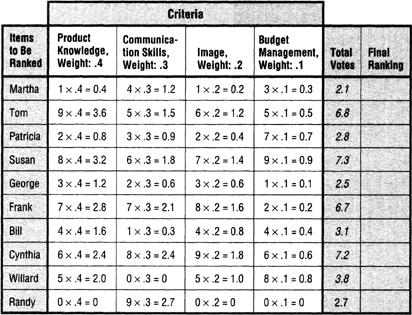
FIGURE 10-22
Step 8: Determine the final rankings and enter them in the last column, headed “Final Ranking.” The item with the most votes is ranked highest.
Step 9: Perform a sanity check.
The original practice problems are not included here. The two figure labels in the excerpt also differ and need checking against the source.
When to use it
Choosing a vendor from multiple proposals based on criteria like price, quality, and delivery time.
Prioritizing product features for a development roadmap when resources are limited.
Selecting a candidate for a job by evaluating qualifications and fit.
Ranking investment opportunities by factors such as risk, return, and liquidity.
FROM THEORY TO EVERYDAY LIFE
In practice
Selecting a Project Management Software
Criteria: cost, usability, features, support. Pair-rank criteria to assign weights (e.g., cost 0.3, usability 0.25, features 0.25, support 0.2). Then pair-rank each software option by each criterion, multiply by weights, sum, and rank.
Ranking Job Candidates
Criteria: experience, education, interview performance, job-relevant collaboration skills. Weight each (e.g., 0.4, 0.2, 0.3, 0.1). Compare candidates pair-wise per criterion to assign votes, apply weights, compute total scores, and final ranking.
A MOMENT TO REFLECT
Put it to work.
How do different weight assignments affect the final ranking? Experiment with extreme weights.
What pitfalls might arise from using subjective pair-wise comparisons? How would you mitigate them?
In what situations would a simpler ranking method (e.g., unweighted sum) be preferable to weighted ranking?
CONTINUE THE CONVERSATION
Source texts
- The Thinkers Toolkit by Morgan D Jones