The Hostile Media/Mediator Effect
Opposing partisans may judge the same coverage as biased against their own side. A related hostile mediator effect occurs when each party sees a third-party mediator as giving the other side more attention or support.
THE IDEA
The Hostile Media/Mediator Effect
Opposing partisans exposed to the same set of “objective” facts interpret those facts differently as they fill in details of context and content, infer connections, and use idiosyncratic scripts and schemas in the search for coherence and meaning. Cognitive biases lead them to see and remember a reality that is consistent with their beliefs and expectations, while motivational biases cause them to see what is consistent with their needs, wishes, and self-interest. Through such information-processing biases, two opposing partisans who encounter the same facts, historical accounts, scientific evidence, or even witness the same events can find additional support for their preconceptions. Thus, advocates and opponents of capital punishment, asked by Lord, Ross, and Lepper (1979) to review a pair of studies providing mixed results on the deterrent effects of capital punishment, later reported themselves to be even more polarized in their views than before. Similarly, the Princeton and Dartmouth football fans in Hastorf and Cantril’s (1954) study who viewed the film of a then-recent hard-fought contest between their teams, seemingly saw two different games – each with a different balance of misdeeds by the two teams.
These studies raise a further question: how would the partisans respond to each other’s assessments, or to an assessment by a supposedly neutral third party? Suppose that a capital punishment proponent in the Lord et al. study heard a capital punishment opponent claim that the balance of evidence in the two studies they had read justified an end to legal executions, or suppose that some social scientist claimed that the two studies were equally probative and urged both partisan groups to moderate their positions accordingly. By the same token, suppose that the Hastorf and Cantril partisans were asked about the assessment of the game offered by the other school’s commentators, or to rate the impartiality of the referee who had tried to assess penalties in an evenhanded manner. In both studies, we suspect, the partisan groups would feel that their counterparts were either lying for strategic reasons or guilty of bias in their perceptions and recollections. We further suspect that, in both instances, the two opposing groups would perceive a lack of objectivity on the part of the supposedly neutral adjudicator.
The conjecture that partisans’ biased information processing would lead them to perceive bias on the part of disinterested third parties led Vallone, Ross, and Lepper (1985) to explore the hostile media effect. Capitalizing on longstanding, passionately held, differences of opinion about the Arab–Israeli conflict, these investigators presented pro-Israeli and pro-Arab partisans with identical samples of major network television coverage of the Beirut massacre. The reactions of these viewers showed that biased perceptions can indeed give rise to perceptions of bias (Fig. 36.2A). Pro-Arab and pro-Israeli viewers alike were convinced that the media had favored the other side, that their own side had been treated unfairly, and that the media’s biases reflected the self-interest and ideology of those responsible for the program. There was also evidence, reminiscent of Hastorf and Cantril, that the groups in effect “saw” different programs (see Fig. 36.2B). Whereas pro-Israeli viewers claimed that the reports contained a greater percentage of material that was hostile to Israel than favorable, pro-Arab viewers made just the opposite assessment. Perhaps the most telling result was both sides’ concern that neutral viewers of the program would be swayed in the direction of their adversaries.
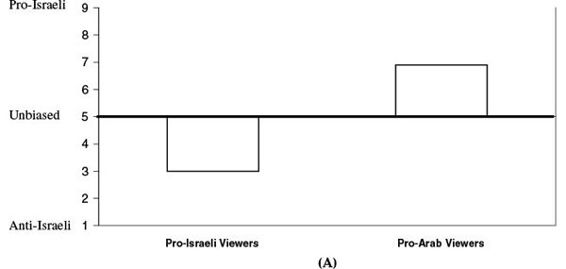
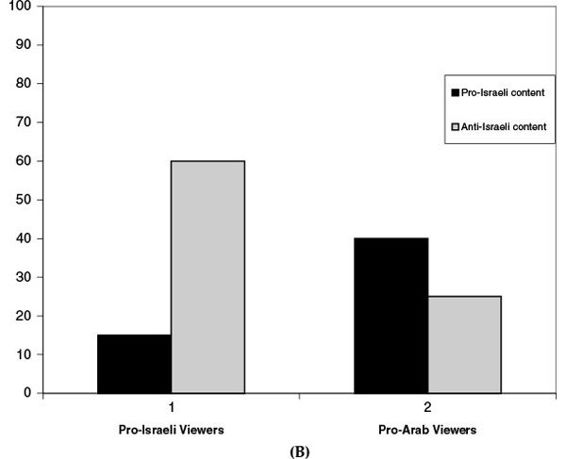
Figure 36.2. (A) Perceived bias in media sample. (B) Estimated percentage of pro-Israeli versus anti-Israeli content in media sample.
Could the same processes that lead partisans to perceive the media as hostile also lead them to hold a similarly jaundiced view of third-party mediators who are attempting to apply fair and consistent standards and give both sides a fair chance to make their case? A role-play study by Morris and Su (1999) confirmed this unhappy scenario. Neutral third parties trying to mediate a conflict between a “programming manager” and a “contract administrator” were perceived, by both parties, as having been more receptive and having devoted more time to the concerns of the other side.
When to use it
Analyzing why different political groups accuse the same news outlet of bias.
Mediating workplace conflicts where each party feels the mediator is partial.
Designing balanced media literacy programs that address partisan perceptions.
Understanding public reactions to independent investigations or fact-checking reports.
FROM THEORY TO EVERYDAY LIFE
In practice
Capital Punishment Studies (Lord, Ross, & Lepper, 1979)
Advocates and opponents of capital punishment reviewed two studies with mixed deterrence findings and afterward reported more polarized views. This illustrates biased interpretation of evidence; it is background for the hostile media argument rather than a direct test of perceived media hostility.
Princeton-Dartmouth Football Game (Hastorf & Cantril, 1954)
Princeton and Dartmouth fans watched the same game film but reported different patterns of infractions. The study illustrates how opposing viewers can interpret the same event differently.
Arab-Israeli Conflict Coverage (Vallone, Ross, & Lepper, 1985)
Pro-Israeli and pro-Arab partisans watched identical news coverage of the Beirut massacre. Both groups rated the coverage as biased against their side, and estimated different percentages of pro- versus anti-Israeli content.
Role-Play Mediation (Morris & Su, 1999)
In a simulated conflict between a programming manager and a contract administrator, neutral mediators were perceived by both parties as having devoted more time and attention to the other side's concerns.
A MOMENT TO REFLECT
Put it to work.
Recall a time you felt news coverage was unfair to a group you identify with. How might the hostile media effect have influenced your perception?
In a disagreement with a colleague, consider a neutral third party’s role. Did you feel they favored the other side? How does the hostile mediator effect apply?
When opposing groups both call coverage biased, how would you assess its accuracy and fairness? What evidence would distinguish a problem in the reporting from a difference in expectations?
References
- Biased Assimilation and Attitude Polarization: The Effects of Prior Theories on Subsequently Considered Evidence — Lord, C. G., Ross, L., & Lepper, M. R. (1979)
- They Saw a Game: A Case Study — Hastorf, A. H., & Cantril, H. (1954)
- The Hostile Media Phenomenon: Biased Perception and Perceptions of Media Bias in Coverage of the Beirut Massacre — Vallone, R. P., Ross, L., & Lepper, M. R. (1985)
- The Hostile Mediator Phenomenon — Morris, M. W., & Su, S. K. (1999)
CONTINUE THE CONVERSATION
Source texts
- Heuristics and Biases The Psychology of Intuitive Judgment (Thomas Gilovich, Dale Griffin, Daniel Kahneman)