The Gap-in-the-Market Model
A three-dimensional framework for identifying a bankable business idea by mapping competitors on key axes (e.g., location, price, cool factor) to uncover overlooked niches, while warning that absence of competition may indicate lack of demand.
THE IDEA
THE GAP-IN-THE-MARKET MODEL
HOW TO RECOGNIZE A BANKABLE IDEA
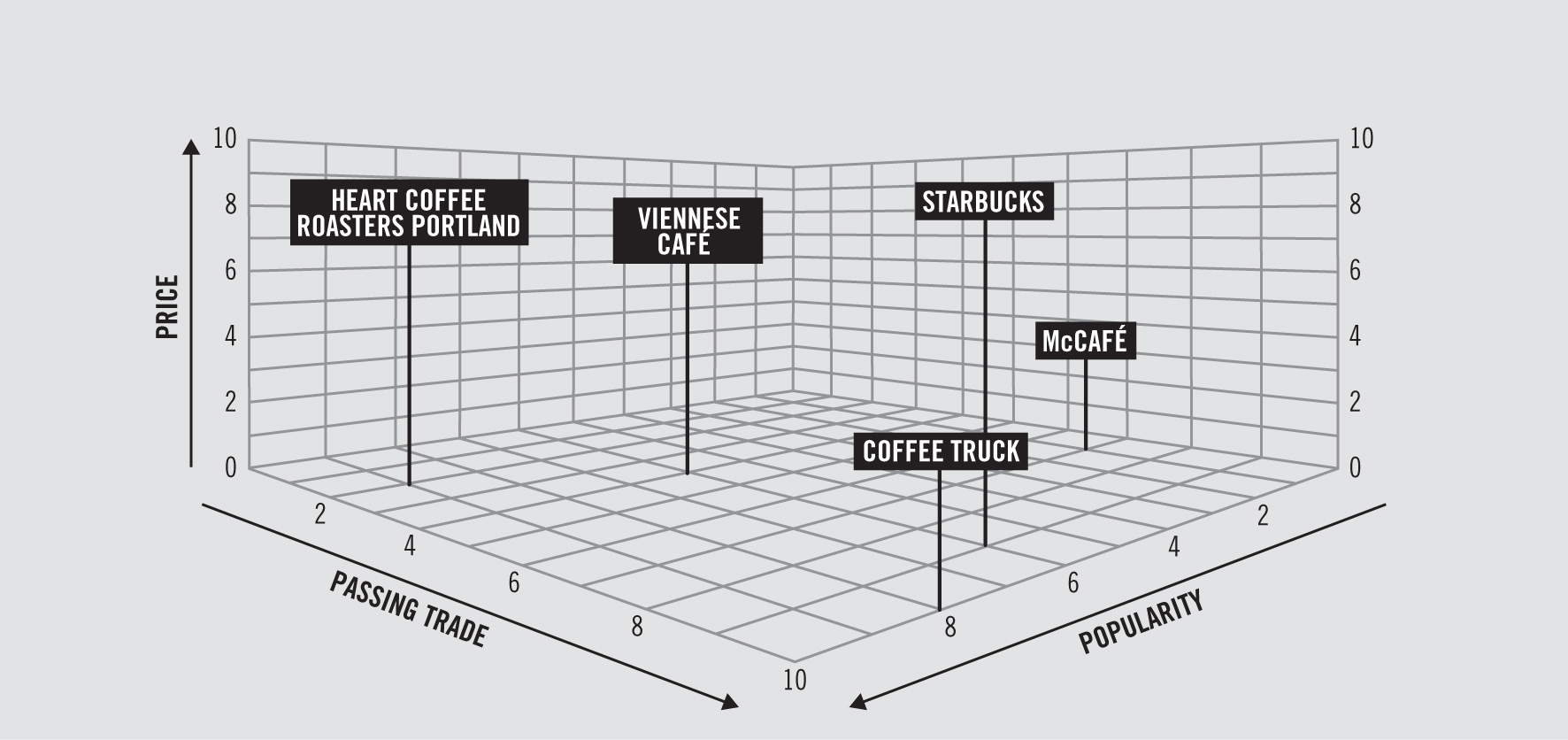
The gap-in-the-market model depicts competitors along three dimensions to help identify possible openings. Draw three axes that measure the development of your market, your customers and your future products.
Say that you want to open a new café. Position your competitors on the graph according to the following criteria:
• X-axis: Location (how much foot traffic does this street get?)
• Y-axis: Price (how expensive is the coffee?)
• Z-axis: Cool factor (how popular is the café?)
In a crowded area, ask what would make customers choose your offering. The source emphasizes ambitious differentiation through a “category killer.” It presents Starbucks as an example of turning an everyday product into a premium experience. Another approach is to look for a niche that competitors have overlooked.
Beware! If nobody else is in that area, you should check if there is any demand in the first place.
Positioning is like drilling for oil. Close is not good enough.
When to use it
Identifying a product gap when launching a new business in a competitive industry
Evaluating the viability of expanding into a new geographic market or customer segment
Choosing a store location by balancing cost, visibility, and brand perception
Assessing whether to compete head-on with established players or find a differentiated niche
FROM THEORY TO EVERYDAY LIFE
In practice
Opening a new café
An entrepreneur plots cafés by foot traffic, coffee price, and popularity. A region of moderate foot traffic, low prices, and low popularity has few competitors. Before treating it as an opening, she investigates customer demand and whether a café could operate there profitably.
A MOMENT TO REFLECT
Put it to work.
What are the three most critical dimensions for your industry or market?
How can you differentiate your offering from competitors that cluster in dense areas of the model?
What steps can you take to validate that a seemingly empty niche actually has unmet demand?
CONTINUE THE CONVERSATION
Source texts
- The Decision Book Fifty Models for Strategic Thinking