The Four Color Team Model
Erikson maps team activities to four colors: Yellow for ideas, Red for decisions, Green for execution, and Blue for review. The scheme can prompt discussion of missing responsibilities, but a color label does not establish someone’s competence.
THE IDEA
Group Dynamics at Their Finest
Erikson proposes a team with a balance of the colors in his framework. The Yellow comes up with a new idea, the Red makes the decision, the Green has to do all the work, and the Blue evaluates and makes sure that the results are excellent. But this isn’t the case. Not infrequently, we find Yellows in positions better suited to Reds. Or, in the worst cases, they have been able to talk their way into a job that actually requires Blue behavior. Indeed, there are many examples of people who are sitting in the wrong chairs, and part of the explanation lies in the fact that they lack the natural prerequisites to manage their jobs. Moreover, all this has to do with what driving forces different people have. Different people are motivated by different things, and it can cause them to move away from their core behavior in specific situations. The role also depends on what motivates the individual.
The diagram illustrates Erikson’s proposed combinations. Use it to ask about working preferences, then assess the actual skills and responsibilities a team needs.
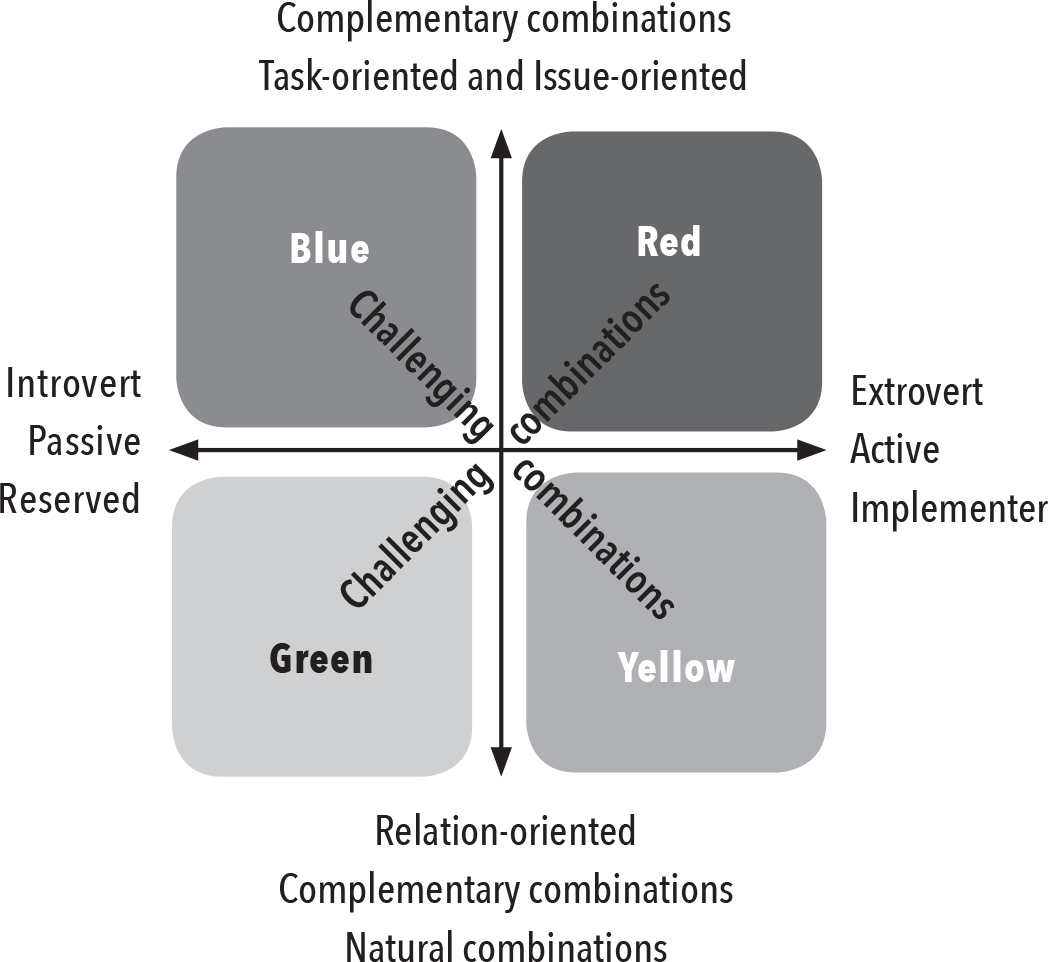
As you can see, different colors work differently together. Again, there are plenty of exceptions, but if no one in the group has any knowledge of their behavior pattern some colors will naturally work well together. For instance, it’s generally easier for two people to work together if they have the same sense of tempo and work at a similar speed.
When to use it
Assembling a project team by checking who will generate options, make decisions, execute work, and review results.
Discussing a team conflict by asking what each person needs to carry out their responsibilities.
Reviewing task assignments against demonstrated strengths and stated working preferences.
Designing recruitment criteria around the work and abilities missing from a team.
FROM THEORY TO EVERYDAY LIFE
In practice
Ideal Team Composition
In a perfectly balanced team, a Yellow proposes a creative marketing campaign, the Red decides to proceed, the Green executes the campaign logistics, and the Blue reviews the results for quality assurance.
Mismatched Roles
A team member who enjoys generating ideas is assigned responsibility for making final decisions. If decisions are delayed, the manager examines authority, skills, and support rather than assuming a personality label explains the difficulty.
A MOMENT TO REFLECT
Put it to work.
Think about your current team: which color roles are overrepresented or missing? How does that affect your team's performance?
Reflect on a project where responsibilities were mismatched. Which skills, preferences, or authority did the assignment overlook?
If you recruited a new team member, which demonstrated ability or missing responsibility would you prioritize?
CONTINUE THE CONVERSATION
Source texts
- Surrounded By Idiots (Thomas Erikson)