The Feedback Box
A decision framework for categorizing feedback to determine which criticisms and compliments to act on, distinguishing between what to keep and what to change.
THE IDEA
THE FEEDBACK BOX
DEALING WITH OTHER PEOPLE’S COMPLIMENTS AND CRITICISMS
Feedback is one of the most difficult and sensitive processes in groups. It is easy to hurt people with criticism, but false compliments are also unhelpful. Compliments often make us too complacent, while criticism damages our self-esteem and can lead us to make unwise choices.
The one-dimensional question “What did you find good, what did you find bad?” is therefore not necessarily helpful. In terms of what can be learned from feedback, it is better to ask yourself “What can I do with this criticism?” In other words, see what can stay as it is, and what needs to change (but may have been good up till now).
It is not only about working out what has not succeeded, it is also about deciding whether and how to react. The model will help you to categorize the feedback you receive in order to clearly establish a plan of action.
It is also important to ask yourself honestly: “Which success or failure was in fact due to luck?” Were you the winner of a match because the ball found its way into the net purely by chance? Do you really deserve this compliment?
Pay attention to your thoughts, because they become words.
Pay attention to your words, because they become actions.
Pay attention to your actions, because they become habits.
Pay attention to your habits, because they become your character.
Pay attention to your character, because it is your fate.
Attributed to the Talmud in the source; the attribution is not established here.
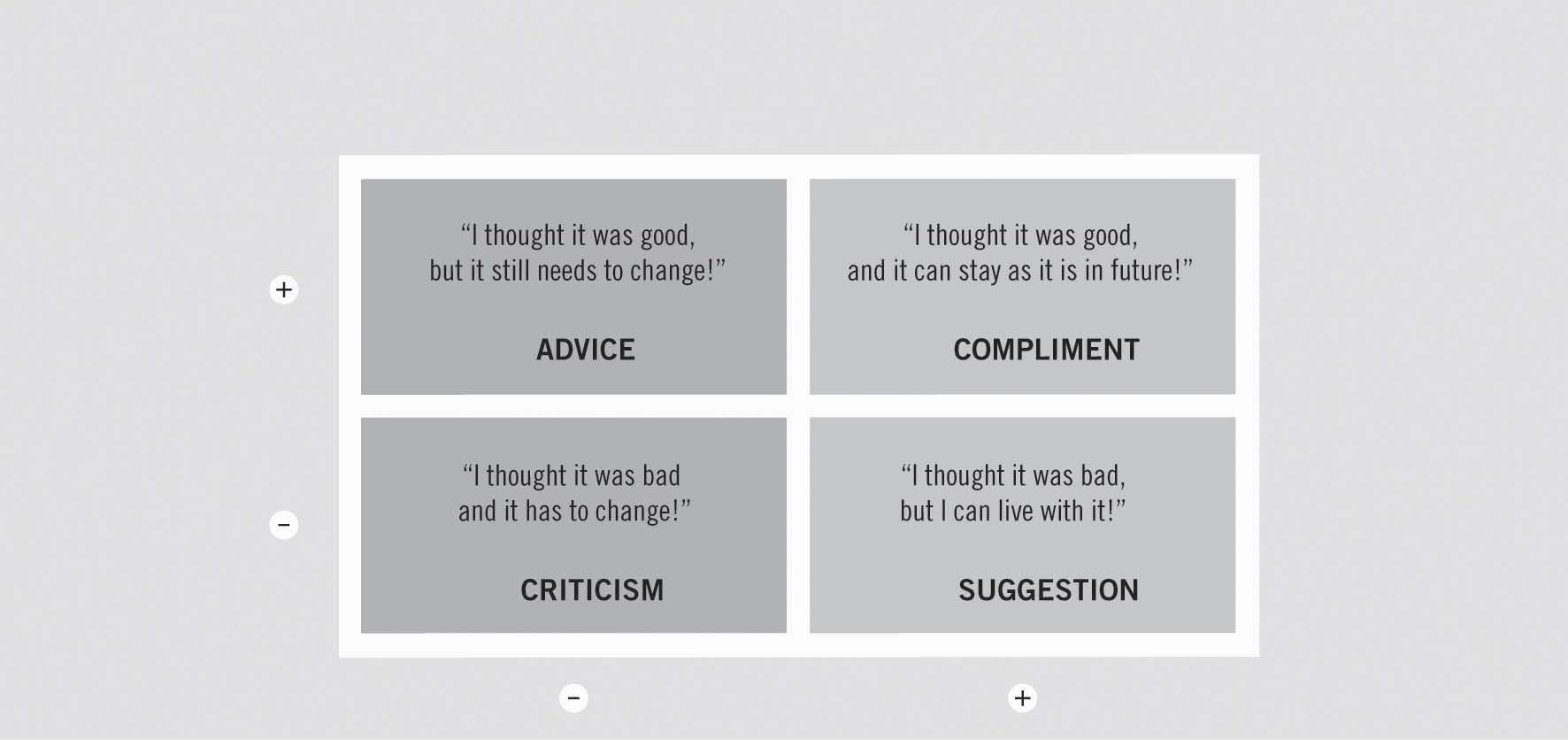
The matrix is referenced in the image, but its category labels are not supplied in the text. Consider the feedback you have received. What advice do you want to follow? Which criticisms prompt you to take action? Which suggestions can you ignore?
When to use it
When receiving feedback after a team project.
During a performance review to prioritize areas for development.
When giving feedback to ensure it is constructive and actionable.
After receiving mixed feedback from a client to create an improvement plan.
FROM THEORY TO EVERYDAY LIFE
In practice
Receiving feedback on a presentation
After a presentation, a colleague says the slides were cluttered and the delivery was engaging. Ask for specific examples of both. Simplify crowded slides and identify which delivery choices are worth repeating; consider audience familiarity when judging the result.
Performance review at work
A manager criticizes time management and praises teamwork. Ask which incidents support each assessment, what circumstances affected the results, and what to change or repeat. Neither praise nor criticism should be assigned to luck without a reason.
A MOMENT TO REFLECT
Put it to work.
What can I do with this criticism to improve?
Which of my successes or failures were actually due to luck?
How do I decide which feedback to act on and which to ignore?
CONTINUE THE CONVERSATION
Source texts
- The Decision Book Fifty Models for Strategic Thinking