The Double-Loop Learning Model
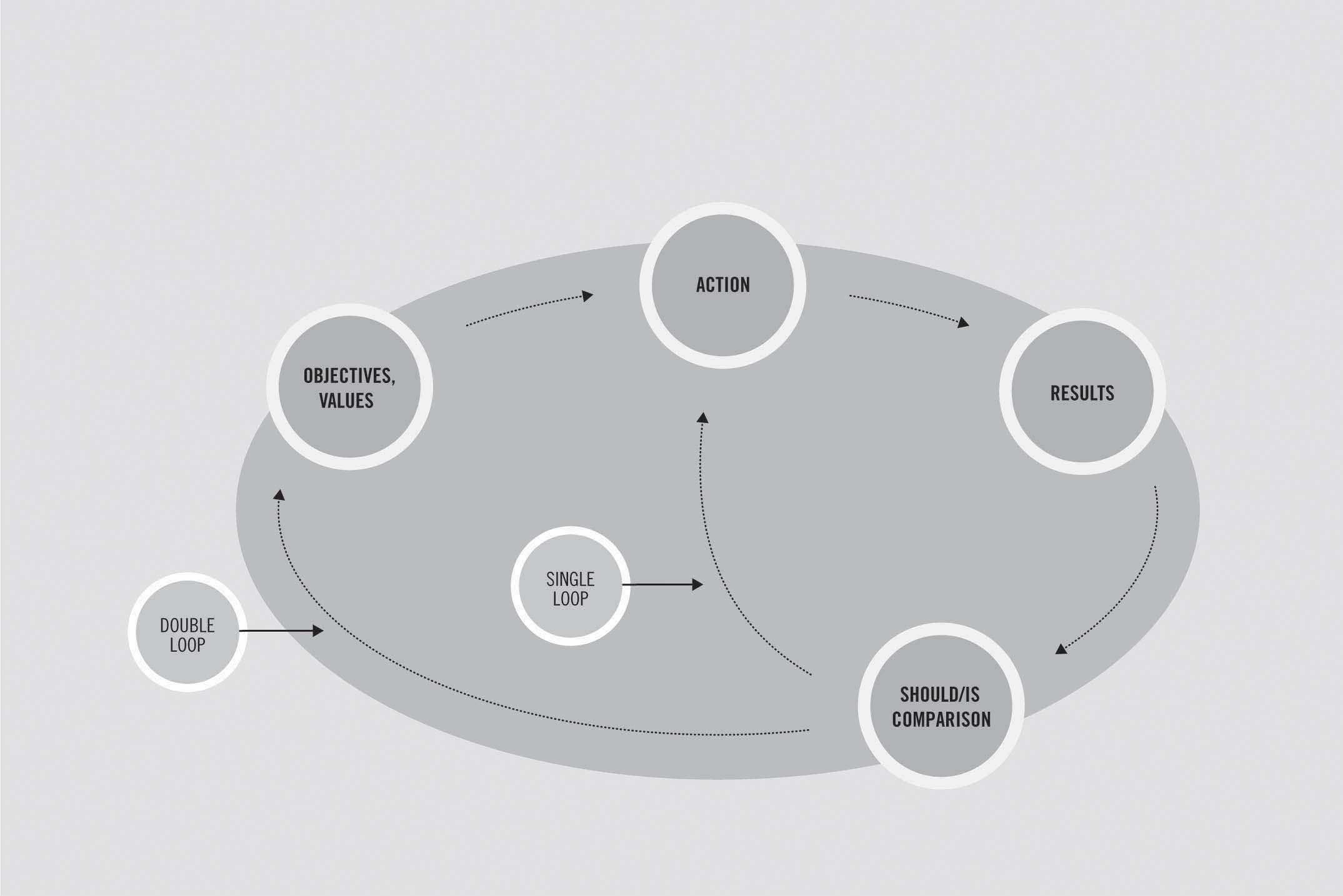
Double-loop learning questions the objectives, assumptions, and values behind an action. It goes beyond adjusting a method to meet an existing goal and asks whether the goal or governing assumptions should also change.
THE IDEA
The Double-Loop Learning Model
HOW TO LEARN FROM YOUR MISTAKES
Double-loop learning involves reflecting on your actions and learning from them. It sounds simple but is almost impossible.
The theory is based on the work of the system theoreticians Heinz von Foerster and Niklas Luhmann, in particular on the idea of “second-order observation.” Strictly speaking, this is not a model but a technique for know-alls. How can you master this desirable technique? Simple: you learn how to observe first-order observers.
First-order observers see things as they appear to them. For them, the world is simply there. Second-order observers, on the other hand, attribute what the first-order observers see to how they see it. In other words, second-order observers observe a way of observing. During the act of observing, first-order observers are unaware of their own way of observing – it is their blind spot. Recognizing this blind spot enables second-order observers to become know-alls. They are able to point out to the first-order observers that it is possible to observe differently and thus see things differently.
The psychologist Chris Argyris and the philosopher Donald Schön developed double-loop learning out of these theoretical ideas on observation. In the best-case scenario, the single loop (the first-order observation) is best practice. Something that works well is not changed but simply repeated. In the worst-case scenario it is worst practice – the same mistake is repeated, or a problem is solved without questioning how it arose in the first place.
In double-loop learning you think about and question what you are doing, and try to break your own pattern, not simply by doing something differently, but by thinking about why you do it the way you do it. What are the objectives and values behind your actions? If you are fully aware of these, you may be able to change them.
The problem inherent in the double loop is the discrepancy between what we say we are about to do (known as espoused theory) and what we actually do (known as theory in use). If we really want to change something, it is not enough to create guidelines for our employees or ourselves, or to give directives. These only reach us as a command (espoused theory). Real changes occur when we reassess our more deeply rooted reasons, objectives and values. These are the “force fields” that affect the theory in use.
 See also: Black box model (p. 118)
When to use it
Identifying and breaking recurring mistakes in organizational processes.
Personal development: changing deep-seated habits by questioning underlying values.
Improving team culture by addressing root causes of conflicts rather than just symptoms.
Strategic decision-making: questioning the objectives and assumptions behind a chosen strategy.
FROM THEORY TO EVERYDAY LIFE
In practice
Single-loop vs. double-loop in business
A company repeatedly misses sales targets. Single-loop learning: they increase advertising spending. Double-loop learning: they question the underlying assumption that more advertising leads to more sales, and instead reconsider the product-market fit or sales process.
Personal habit change
Someone tries to stop procrastinating. Single-loop: they set stricter deadlines. Double-loop: they examine why they procrastinate—perhaps fear of failure or perfectionism—and address those root causes.
A MOMENT TO REFLECT
Put it to work.
When was the last time you broke a familiar pattern in your life and really did something differently?
Which pattern would you like to break?
What is preventing you from breaking it?
References
- Double-loop learning — Chris Argyris and Donald Schön (1978)
CONTINUE THE CONVERSATION
Source texts
- The Decision Book Fifty Models for Strategic Thinking