The Crossroads Model
A decision framework for finding direction in life by reflecting on your past, values, important people, hindrances, and fears, then imagining six different possible paths forward.
THE IDEA
THE CROSSROADS MODEL
SO, WHAT NEXT?
We all have times in our lives when we find ourselves at a crossroads, and ask ourselves: Where now? The crossroads model helps you to find your direction in life. Fill in the model on the basis of the following questions:
Where have you come from?
How have you become who you are? What have been the main decisions, events and obstacles in your life, and who were your main influences? Think about your education, your home, where you grew up. And make a note of keywords that strike you as important.
What is really important to you?
Write down the first three things that come into your head. You don’t have to go into detail or be specific. What are your values? What do you believe in? Which principles are important to you? When everything fails, what remains?
Which people are important to you?
Here you should think of people whose opinions you value, and who influence your decisions, as well as those who are affected by your decisions. Think also about the people you like and those you fear.
What is hindering you?
What aspects of your life prevent you from thinking about the really important things? Which deadlines do you have in your head, and what is hindering you? What do you have to do, and when?
What are you afraid of?
List the things, circumstances or people that cause you worry and rob you of your strength.
Look at your notes. What’s missing? What issues have arisen? Do the keywords you’ve written down tell the story of how you became who you are today? If necessary, jot down more keywords and questions. Now look at the roads that lie ahead of you. We have given six examples. Imagine each one:
1. The road I have already been down.
2. The road that beckons – what have I always wanted to try?
3. The road that I imagine in my wildest dreams, regardless of whether it is achievable or not – what do I dream of?
4. The road that seems most sensible to me, the one that people whose opinion I value would suggest to me.
5. The road not traveled – one I have never considered before.
6. The road back to a place I once felt safe.
You decide.
When was the last time you did something for the first time?
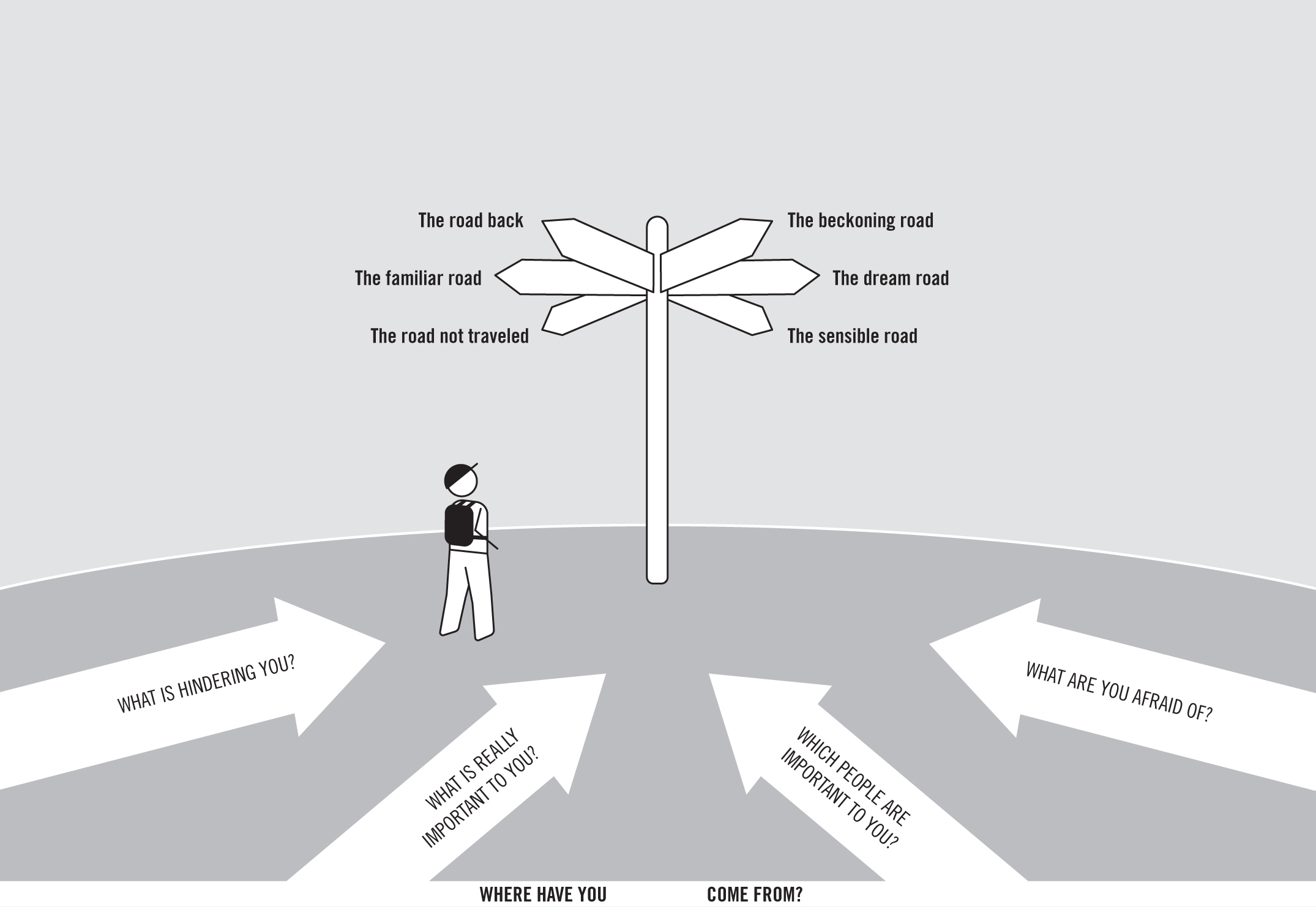
Answer the questions by yourself or together with a good friend. Then imagine the road that you could take.
When to use it
Deciding on a career path or major life transition such as changing jobs, retiring, or starting a business.
Evaluating a relationship decision, such as moving in together or ending a partnership.
Choosing between education options, such as which degree to pursue or whether to return to school.
Navigating a personal crisis or period of uncertainty to gain clarity on priorities.
FROM THEORY TO EVERYDAY LIFE
In practice
Career change decision
A person feels stuck in their current job. They use the Crossroads Model to reflect on their past career choices (where they came from), identify their core values (e.g., creativity, autonomy), consider the opinions of a mentor and family, list fears (e.g., financial instability), and then imagine each of the six roads—such as the road that beckons (starting a freelance business) and the sensible road (staying in the current job but switching departments). This clarity helps them choose a path aligned with their values.
Relocation dilemma
Someone considering moving to a new city for a relationship uses the model. They reflect on their upbringing in a small town, their value of family closeness, the influence of their partner, fear of loneliness, and then explore the roads: the known road (staying home), the beckoning road (moving for love), the wildest dream (moving abroad), and the sensible road (a compromise location). The process reveals what truly matters.
A MOMENT TO REFLECT
Put it to work.
Where have you come from? What key events and influences shaped you?
What is really important to you? List your top three values without overthinking.
When was the last time you did something for the first time? How can you bring that spirit into your current crossroads?
CONTINUE THE CONVERSATION
Source texts
- The Decision Book Fifty Models for Strategic Thinking