The Consequences Model
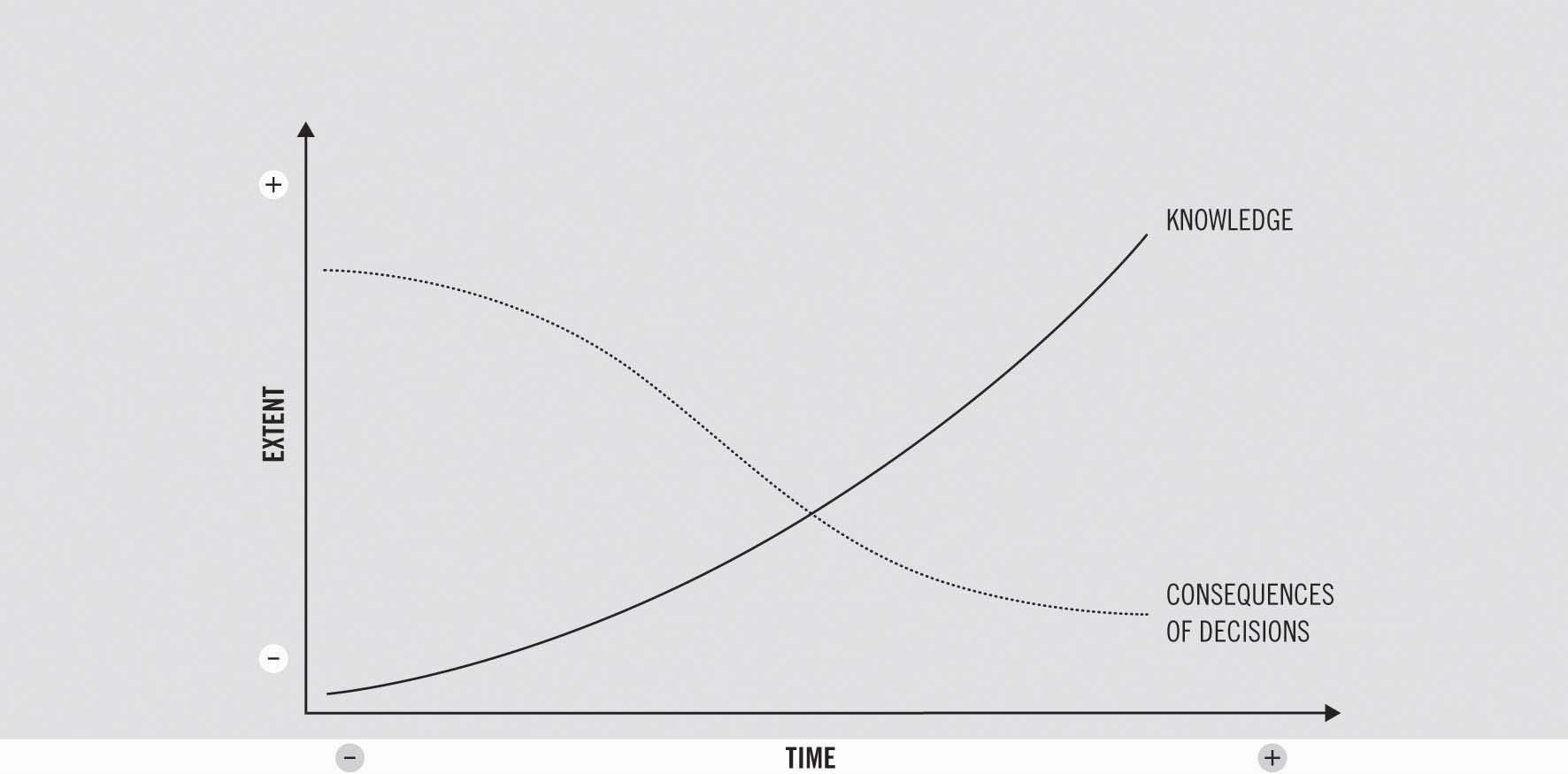
The consequences model highlights a project tradeoff: early decisions can shape much of the work while information is still limited. It encourages timely decisions and explicit communication when a decision is deferred.
THE IDEA
THE CONSEQUENCES MODEL
WHY IT IS IMPORTANT TO MAKE DECISIONS PROMPTLY
We are often forced to make decisions based on limited or ambiguous information. At the beginning of a project, for example, when the finer details have yet to be clarified, we need to be bold in our decision-making – particularly because these early decisions have the most far-reaching consequences. Toward the end of a project we know more and have fewer doubts, but by then there is no longer anything fundamental to decide.
The most important question, then, is how we can bridge the chasm between doubt and decision.
Beware! We often defer decisions because we have doubts. But not making a decision is a decision in itself. If you delay a resolution it is often an unconscious decision, one that you do not communicate. This leads to uncertainty in a team. So if you want to make a decision later, be sure to communicate this clearly.
With this model, the Danish organization theorists Kristian Kreiner and Søren Christensen encourage us to be courageous, and make decisions based on minimal information.
I'd rather regret the things I have done than the things that I haven't. Lucille Ball
 See also: Stop Rule (p. 46)
When to use it
Starting a new business venture with limited market data — early choices define the business model.
Deciding on a project scope early in the planning phase — delaying can lead to scope creep or lost opportunities.
Setting a hiring decision date that allows essential checks while accounting for the cost of delay.
Choosing a strategic direction for a team with ambiguous objectives — early clarity drives alignment.
FROM THEORY TO EVERYDAY LIFE
In practice
Startup Pivot Decision
A founder receives early feedback suggesting a different product direction. The founder compares the cost of committing now with the value of further testing, recognizing that an early choice could shape much of the company’s work.
Project Scope Go/No-Go
A manager must decide whether to proceed after a preliminary feasibility study. They identify what remains uncertain, what delay would cost, and which commitments can be revised. If they defer, they tell the team when and on what basis the decision will be made.
A MOMENT TO REFLECT
Put it to work.
When have you delayed a decision because of doubts? What were the consequences of that delay?
How can you encourage yourself or your team to make decisions more boldly when information is scarce?
What is one decision you are currently deferring? If you had to decide right now based on what you know, what would you choose?
CONTINUE THE CONVERSATION
Source texts
- The Decision Book Fifty Models for Strategic Thinking