The Buyer's Decision Model
The buyer’s model offers ways to stop a purchase decision from becoming an endless search: limit research, prioritize requirements, use the 10-10-10 exercise, and consider help in breaking a genuine tie.
THE IDEA
THE BUYER’S DECISION MODEL
HOW TO BUY A CAR
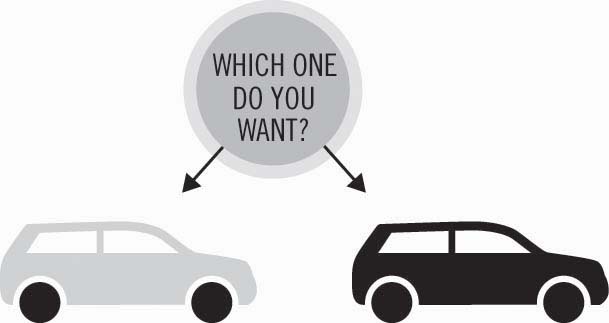
Let’s say you want to buy a car, but can’t make a decision. Four main hints and an additional exercise:
1. Establish a research strategy.
The problem of research is that we never know enough but can quickly know too much. Research can improve a choice, but continuing indefinitely may add little useful information. You could spend the rest of your life reading car reviews. Here’s what to do: set yourself your own limits, e.g., three hours on Google, ask three friends, visit two car dealers.
2. Lower your expectations.
Don’t look for the perfect car: look for a car that fulfills your basic requirements. So says psychology professor Barry Schwarz. Even if it isn’t the best choice, it can make you happier than no car at all or endlessly searching for one. Here’s what to do: put your five most important criteria for the car in order of priority. Delete the last two.
3. Don’t worry.
According to the psychologist Daniel Gilbert, most decisions are not as lasting as we might think in the moment of making them. Here’s what to do: use the 10-10-10 technique of Suzy Welch, who graduated from Harvard in the top 5 percent of her class. In relation to buying a car, ask yourself: What consequences will my decision have in 10 days? What consequences will it have in 10 months? And in 10 years?
4. Let somebody else decide.
Most people think it is better to make decisions themselves. The book cites Simona Botti’s research at London Business School on doubts about choices we make ourselves. It suggests delegating a choice between relatively equal cars. Before doing so, consider whether the person deciding understands your priorities and has incentives compatible with them; a seller’s preference may differ from yours.
Or you can follow the example of Ignatius of Loyola, co-founder of the Jesuit order: spend three days acting as if you had decided on option one, then spend three days acting as if you had decided on option two, and only then make a decision.
When to use it
Choosing a laptop or smartphone
Deciding on a vacation destination
Comparing job offers against your priorities while recognizing the costs of continuing the search.
Choosing a house or apartment
FROM THEORY TO EVERYDAY LIFE
In practice
Establish a research strategy
Set limits: three hours on Google, ask three friends, visit two car dealers.
Lower your expectations
Use Barry Schwarz's advice: prioritize five criteria, delete the last two.
Don't worry
Use Suzy Welch's 10-10-10 technique: consider consequences in 10 days, 10 months, 10 years.
Let somebody else decide
The book cites Simona Botti’s work to suggest that delegating a close choice can reduce doubt. It also describes Ignatius of Loyola’s exercise: act as though you selected each option in turn, spending three days with the first before trying the second. These are different ways to explore a choice, rather than a reason to hand any purchase to a seller.
A MOMENT TO REFLECT
Put it to work.
How can you apply the 10-10-10 technique to a current decision you are facing?
Think of a time when you over-researched a purchase. How could the buyer's decision model have helped?
When might it be beneficial to let someone else make a decision for you?
CONTINUE THE CONVERSATION
Source texts
- The Decision Book Fifty Models for Strategic Thinking