The 3-D Heuristic
A perceptual heuristic where the brain automatically interprets a 2-D image as a 3-D scene, causing a bias in size judgment. Objects that appear more distant are perceived as larger on the page, leading to predictable errors.
THE IDEA
THE 3-D HEURISTIC
Have a look at the picture of the three men and answer the question that follows.
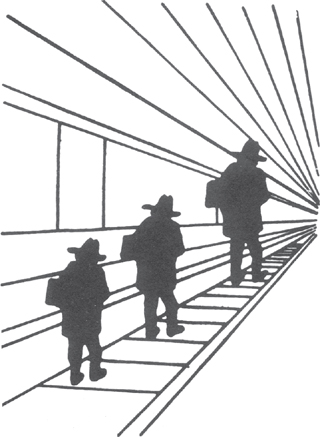
Figure 9
As printed on the page, is the figure on the right larger than the figure on the left?
The obvious answer comes quickly to mind: the figure on the right is larger. If you take a ruler to the two figures, however, you will discover that in fact the figures are exactly the same size. Your impression of their relative size is dominated by a powerful illusion, which neatly illustrates the process of substitution.
The corridor in which the figures are seen is drawn in perspective and appears to go into the depth plane. Your perceptual system automatically interprets the picture as a three-dimensional scene, not as an image printed on a flat paper surface. In the 3-D interpretation, the person on the right is both much farther away and much larger than the person on the left. For most of us, this impression of 3-D size is overwhelming. Only visual artists and experienced photographers have developed the skill of seeing the drawing as an object on the page. For the rest of us, substitution occurs: the dominant impression of 3-D size dictates the judgment of 2-D size. The illusion is due to a 3-D heuristic.
What happens here is a true illusion, not a misunderstanding of the question. You knew that the question was about the size of the figures in the picture, as printed on the page. If you had been asked to estimate the size of the figures, we know from experiments that your answer would have been in inches, not feet. You were not confused about the question, but you were influenced by the answer to a question that you were not asked: “How tall are the three people?”
The essential step in the heuristic—the substitution of three-dimensional for two-dimensional size—occurred automatically. The picture contains cues that suggest a 3-D interpretation. These cues are irrelevant to the task at hand—the judgment of size of the figure on the page—and you should have ignored them, but you could not. The bias associated with the heuristic is that objects that appear to be more distant also appear to be larger on the page. As this example illustrates, a judgment that is based on substitution will inevitably be biased in predictable ways. In this case, it happens so deep in the perceptual system that you simply cannot help it.
When to use it
Designing visual advertisements or packaging where size perception influences consumer behavior.
Creating realistic virtual reality environments that exploit depth cues to alter perceived object size.
Training visual artists or photographers to override this heuristic when assessing relative sizes in images.
Understanding how eyewitnesses might misjudge distances or sizes in a crime scene based on perspective.
FROM THEORY TO EVERYDAY LIFE
In practice
Corridor Perspective Illusion
A drawing of three men in a corridor with perspective cues makes the rightmost figure appear larger even though all are the same size on the page. The viewer's automatic 3-D interpretation overrides the actual 2-D size judgment.
A MOMENT TO REFLECT
Put it to work.
Can you think of a real-world situation where your automatic perception of depth or size might lead you to a biased judgment?
How might this heuristic affect decisions in photography, art, or architectural design?
What other everyday experiences involve an automatic substitution of an irrelevant attribute for the relevant one?
CONTINUE THE CONVERSATION
Source texts
- Thinking, Fast and Slow (Daniel Kahneman)