Self vs Other Predictions: Overconfidence in Predicting Others' Behavior
In the reported experiment, participants were about equally confident in predictions of themselves and others, but more accurate about themselves. The authors explain this through the distinction between an impression's strength and the amount or reliability of evidence supporting it. They also describe cases where self-predictions are underconfident or overconfident.
THE IDEA
Study 4: Self versus Other
In this study, we ask people to predict their own behavior, about which they presumably know a great deal, and the behavior of others, about which they know less. If people base their confidence primarily on the strength of their impression with insufficient regard for its weight, we expect more overconfidence in the prediction of others than in the prediction of self.
Fourteen pairs of same-sex students, who did not know each other, were asked to predict each other’s behavior in a task involving risk. They were first given 5 min to interview each other, and then they sat at individual computer terminals where they predicted their own and their partner’s behavior in a Prisoner’s Dilemma–type game called “The Corporate Jungle.” On each trial, participants had the option of “merging” their company with their partner’s company (i.e, cooperating), or “taking over” their partner’s company (i.e., competing). If one partner tried to merge and the other tried to take over, the cooperative merger took a steep loss and the corporate raider made a substantial gain. However, if both partners tried a takeover on the same trial, they both suffered a loss. There were 20 payoff matrices, some designed to encourage cooperation and some designed to encourage competition.
Subjects were asked to predict their own behavior for 10 of the payoff matrices and the behavior of the person they had interviewed for the other 10. The order of the two tasks was counterbalanced, and each payoff matrix appeared an equal number of times in each task. In addition to predicting cooperation or competition for each matrix, subjects indicated their confidence in each prediction (on a scale from 50% to 100%). Shortly after the completion of the prediction task, subjects played 20 trials against their opponents, without feedback, and received payment according to the outcomes of the 20 trials.
The analysis is based on 25 subjects who completed the entire task. Overall, subjects were almost equally confident in their self predictions (M = 84%) and in their predictions of others (M = 83%), but they were considerably more accurate in predicting their own behavior (M = 81%) than in predicting the behavior of others (M = 68%). Thus, people exhibited considerable overconfidence in predictions of others, but were relatively well calibrated in predicting themselves (Fig. 13.5).
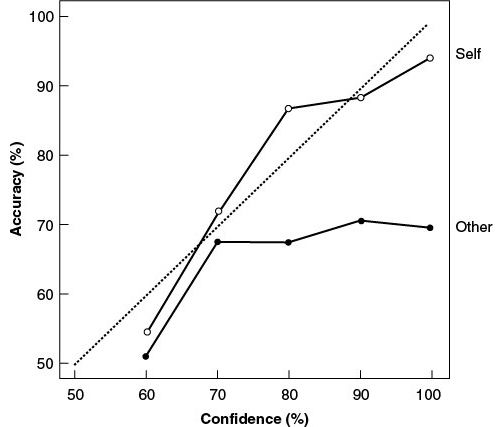
Figure 13.5. Predicting self and other.
In some circumstances, in which the strength of evidence is not extreme, the prediction of one’s own behavior may be underconfident. In the case of a job choice, for example, underconfidence may arise if a person has good reasons for taking job A and good reasons for taking job B, but fails to appreciate that even a small advantage for job A over B would generally lead to the choice of A. If confidence in the choice of A over B reflects the balance of arguments for the two positions (Koriat, Lichtenstein, & Fischhoff, 1980), then a balance of 2 to 1 would produce confidence of about 2/3, although the probability of choosing A over B is likely to be higher. In a further observation, we discreetly approached colleagues faced with a choice between job offers and asked them to estimate the probability that they would choose one job over another.
The average confidence in the predicted choice was a modest 66%, but only 1 of the 24 respondents chose the option to which he or she initially assigned a lower probability, yielding an overall accuracy rate of 96%. It is noteworthy that there are situations in which people exhibit overconfidence even in predicting their own behavior (Vallone, Griffin, Lin, & Ross, 1990). The key variable, therefore, is not the target of prediction (self versus other), but rather the relation between the strength and the weight of the available evidence.
The tendency to be confident about the prediction of the behavior of others but not of one’s own behavior has intriguing implications for the analysis of decision making. Decision analysts commonly distinguish between decision variables that are controlled by the decision maker and state variables that are not under his or her control. The analysis proceeds by determining the values of decision variables (i.e., decide what you want) and assigning probabilities to state variables (e.g., the behavior of others). Some decision analysts have noted that their clients often wish to follow an opposite course: determine or predict (with certainty) the behavior of others and assign probabilities to their own choices. After all, the behavior of others should be predictable from their traits, needs, and interests, whereas our own behavior is highly flexible and contingent on changing circumstances (Jones & Nisbett, 1972).
When to use it
Business strategy: predicting competitors' moves while evaluating internal capabilities.
Negotiation: anticipating the other party's concessions while planning own flexibility.
Personal relationships: assessing a friend's likely response to an invitation.
Decision analysis: separating decision variables (under your control) from state variables (others' actions).
FROM THEORY TO EVERYDAY LIFE
In practice
Prisoner's Dilemma Game Experiment
Participants predicted their own and their partner's behavior in a Prisoner's Dilemma game. They were equally confident in both predictions (84% vs 83%) but were more accurate for self (81%) than for others (68%), demonstrating overconfidence in predicting others.
Job Choice Underconfidence
In the authors’ observation of colleagues choosing between job offers, average confidence in the predicted choice was 66%, while accuracy was 96%. These self-predictions were underconfident; this result does not establish that self-prediction is always well calibrated.
A MOMENT TO REFLECT
Put it to work.
Think of a time when you were overconfident about someone else's future actions. What evidence did you base your prediction on?
How can the distinction between strength and weight of evidence help you calibrate predictions about yourself and others?
In a group decision, how might the tendency to be overconfident about others' behavior affect outcomes?
Often confused with
References
- Reasons for confidence — Koriat, A., Lichtenstein, S., & Fischhoff, B. (1980)
- Overconfidence in the prediction of one's own behavior — Vallone, R., Griffin, D., Lin, S., & Ross, L. (1990)
- The actor and the observer: Divergent perceptions of the causes of behavior — Jones, E. E., & Nisbett, R. E. (1972)
CONTINUE THE CONVERSATION
Source texts
- Heuristics and Biases The Psychology of Intuitive Judgment (Thomas Gilovich, Dale Griffin, Daniel Kahneman)