Self-Serving Bias in Trait Assessments
In the reported study, participants rated themselves above average on desirable traits and below average on undesirable traits. Self-enhancement was stronger for more ambiguous traits.
THE IDEA
Self-Serving Bias in Trait Assessments
Table 18.1. Mean Percentile Rankings as a Function of Trait Desirability and Ambiguity
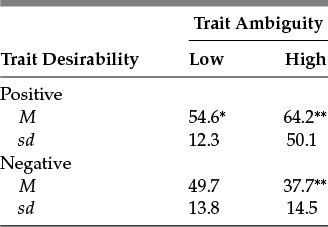
Note: n = 27. Different from 50th percentile:
A correlational analysis that focused on the individual trait terms themselves also confirmed the role of ambiguity and desirability in self-serving assessments. For each trait, we computed a self-enhancement score. For positive traits, this consisted of how far subjects’ mean response on each trait deviated positively from a response of 50. For negative traits, we computed how far subjects’ responses deviated from 50 in a negative direction. When these self-enhancement scores were correlated with the degree of rated ambiguity of the traits, we found a significant correlation, r(26) = .47, p *< .*02.
When to use it
In performance reviews, employees may inflate ratings on ambiguous positive skills; managers should seek concrete behavioral examples.
When designing self-report surveys, clearly define trait terms to reduce ambiguity and minimize self-serving bias.
In negotiations, people may overestimate their own contributions due to ambiguous positive traits; use objective metrics to calibrate.
FROM THEORY TO EVERYDAY LIFE
In practice
Experiment on Trait Self-Ratings
Participants rated themselves on a set of traits varying in desirability and ambiguity. Results showed self-enhancement: higher ratings for desirable traits (above the 50th percentile) and lower for undesirable traits (below the 50th percentile), with the effect stronger for more ambiguous traits.
A MOMENT TO REFLECT
Put it to work.
Think of a time you rated yourself highly on a vague positive trait like 'insightful'. How might ambiguity have influenced your self-assessment?
Identify a trait you consider negative but ambiguous (e.g., 'moody'). Do you tend to downplay how much it applies to you?
How could understanding this bias help you interpret others' self-assessments more objectively?
CONTINUE THE CONVERSATION
Source texts
- Heuristics and Biases The Psychology of Intuitive Judgment (Thomas Gilovich, Dale Griffin, Daniel Kahneman)