Satisficing by Fast and Frugal Heuristics
Fast and frugal heuristics compare two options using a limited search for predictive cues. Minimalist and Take the Best are examples of simple rules for deciding which option is likely to score higher on a criterion.
THE IDEA
SATISFICING BY FAST AND FRUGAL HEURISTICS
There are infinitely many kinds of tasks that heuristics can be designed to perform. The task considered here is predicting or inferring which of two objects scores higher on a criterion. Which soccer team will win? Which of two cities has a higher homelessness rate? Which applicant will do a better job? To make such predictions, the heuristics use uncertain cues that indicate, with some probability, higher values on the criterion.
Consider, for example, the task of inferring which of two cities has a higher homelessness rate, using the data on 50 U.S. cities from Tucker (1987). An excerpt from this data including the values for Los Angeles, Chicago, New York, and New Orleans on six cues and the criterion is shown in Table 31.1. One cue (rent control) is binary, and the other five have been dichotomized at the median. Unitary cue values (1) indicate higher values on the criterion and zero cue values (0) indicate lower values. For example, because cities with rent control more often have a higher homelessness rate than cities without rent control, cities that have rent control are marked with a cue value of 1 for this cue. (In contrast, if cities without rent control more often had the higher homelessness rate, then having rent control would be marked by a 0.)
Table 31.1. Cues for Predicting Homelessness in U.S. Citiesa
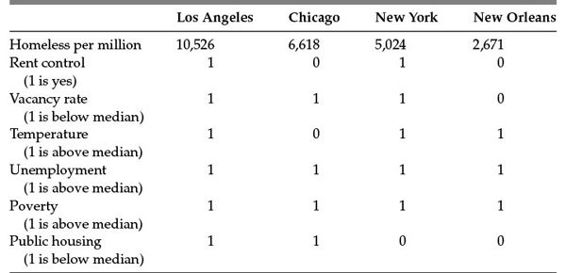
a Cues are ordered by validity, with rent control having the highest validity (.90). Further explanation in text.
Source: Tucker (1987).
Of course, people generally do not have such tables of information handy; they have to search for information, in their memories or in libraries. But how could one construct a heuristic that cheaply (rather than optimally) limits search and computations? Two examples of such heuristics are Minimalist and Take the Best, which are drawn from a family of fast and frugal heuristics (Gigerenzer & Goldstein, 1996; Gigerenzer, Hoffrage, & Kleinbolting, 1991; Gigerenzer, Todd, & the ABC group, 1999).
When to use it
A doctor quickly diagnosing a patient based on a few key symptoms rather than running all possible tests.
A consumer choosing between two products by considering only the most important feature (e.g., price) and ignoring others.
Comparing companies with a cue-based rule whose predictive performance has been evaluated on relevant historical data.
A manager selecting job candidates by checking the most predictive credential (e.g., relevant degree) first and stopping if it differentiates.
FROM THEORY TO EVERYDAY LIFE
In practice
Predicting Homelessness Rates in U.S. Cities
In the historical city dataset, rent control has a reported cue validity of .90. Take the Best checks cues in order of validity and stops at the first one that distinguishes the cities. If only one city has rent control, this cue leads it to predict a higher homelessness rate there. This illustrates the rule’s use of that dataset, rather than establishing a general causal effect of rent control.
Choosing Between Two Job Applicants
A manager quickly decides which applicant is likely to perform better using the Take the Best heuristic. The manager sequentially considers cues in order of their predictive validity (e.g., relevant work experience, education, interview score) and chooses the applicant who scores higher on the first cue that differentiates them.
A MOMENT TO REFLECT
Put it to work.
Think of a recent decision you made with limited information. Could a fast and frugal heuristic have been used? How would you implement it?
In what situations might satisficing with these simple heuristics lead to errors compared to more complex reasoning? Provide an example.
Identify a real-world prediction task (e.g., which news article is more popular) and design a fast and frugal heuristic for it using cues you consider valid.
References
- Homelessness data on U.S. cities — Tucker (1987)
- Reasoning the fast and frugal way: Models of bounded rationality — Gigerenzer & Goldstein (1996)
- Probabilistic mental models: A Brunswikian theory of confidence — Gigerenzer, Hoffrage, & Kleinbolting (1991)
- Simple heuristics that make us smart — Gigerenzer, Todd, & the ABC group (1999)
CONTINUE THE CONVERSATION
Source texts
- Heuristics and Biases The Psychology of Intuitive Judgment (Thomas Gilovich, Dale Griffin, Daniel Kahneman)