Samuelson's Problem
Samuelson's friend rejected a favorable gamble in which he could lose $100 or win $200, yet was willing to take many such bets together. The problem shows how evaluating small, independent risks as a group can change the effect of loss aversion on a decision.
THE IDEA
SAMUELSON’S PROBLEM
The great Paul Samuelson—a giant among the economists of the twentieth century—famously asked a friend whether he would accept a gamble on the toss of a coin in which he could lose $100 or win $200. His friend responded, “I won’t bet because I would feel the $100 loss more than the $200 gain. But I’ll take you on if you promise to let me make 100 such bets.” Unless you are a decision theorist, you probably share the intuition of Samuelson’s friend, that playing a very favorable but risky gamble multiple times reduces the subjective risk. Samuelson found his friend’s answer interesting and went on to analyze it. He proved that under some very specific conditions, a utility maximizer who rejects a single gamble should also reject the offer of many.
Remarkably, Samuelson did not seem to mind the fact that his proof, which is of course valid, led to a conclusion that violates common sense, if not rationality: the offer of a hundred gambles is so attractive that no sane person would reject it. Matthew Rabin and Richard Thaler pointed out that “the aggregated gamble of one hundred 50–50 lose $100/gain $200 bets has an expected return of $5,000, with only a 1/2,300 chance of losing any money and merely a 1/62,000 chance of losing more than $1,000.” Their point, of course, is that if utility theory can be consistent with such a foolish preference under any circumstances, then something must be wrong with it as a model of rational choice. Samuelson had not seen Rabin’s proof of the absurd consequences of severe loss aversion for small bets, but he would surely not have been surprised by it. His willingness even to consider the possibility that it could be rational to reject the package testifies to the powerful hold of the rational model.
Let us assume that a very simple value function describes the preferences of Samuelson’s friend (call him Sam). To express his aversion to losses Sam first rewrites the bet, after multiplying each loss by a factor of 2. He then computes the expected value of the rewritten bet. Here are the results, for one, two, or three tosses. They are sufficiently instructive to deserve some pupil-dilating effort.
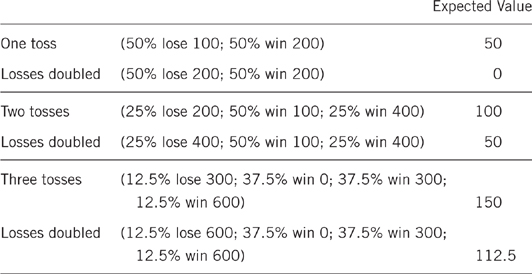
You can see in the display that the gamble has an expected value of 50. However, one toss is worth nothing to Sam because he feels that the pain of losing a dollar is twice as intense as the pleasure of winning a dollar. After rewriting the gamble to reflect his loss aversion, Sam will find that the value of the gamble is 0.
Now consider two tosses. The chances of losing have gone down to 25%. The two extreme outcomes (lose 200 or win 400) cancel out in value; they are equally likely, and the losses are weighted twice as much as the gain. But the intermediate outcome (one loss, one gain) is positive, and so is the compound gamble as a whole. Now you can see the cost of narrow framing and the magic of aggregating gambles. Here are two favorable gambles, which individually are worth nothing to Sam. If he encounters the offer on two separate occasions, he will turn it down both times. However, if he bundles the two offers together, they are jointly worth $50!
Things get even better when three gambles are bundled. The extreme outcomes still cancel out, but they have become less significant. The third toss, although worthless if evaluated on its own, has added $62.50 to the total value of the package. By the time Sam is offered five gambles, the expected value of the offer will be $250, his probability of losing anything will be 18.75%, and his cash equivalent will be $203.125. The notable aspect of this story is that Sam never wavers in his aversion to losses. However, the aggregation of favorable gambles rapidly reduces the probability of losing, and the impact of loss aversion on his preferences diminishes accordingly.
Now I have a sermon ready for Sam if he rejects the offer of a single highly favorable gamble played once, and for you if you share his unreasonable aversion to losses:
I sympathize with your aversion to losing any gamble, but it is costing you a lot of money. Please consider this question: Are you on your deathbed? Is this the last offer of a small favorable gamble that you will ever consider? Of course, you are unlikely to be offered exactly this gamble again, but you will have many opportunities to consider attractive gambles with stakes that are very small relative to your wealth. You will do yourself a large financial favor if you are able to see each of these gambles as part of a bundle of small gambles and rehearse the mantra that will get you significantly closer to economic rationality: you win a few, you lose a few. The main purpose of the mantra is to control your emotional response when you do lose. If you can trust it to be effective, you should remind yourself of it when deciding whether or not to accept a small risk with positive expected value. Remember these qualifications when using the mantra:
• It works when the gambles are genuinely independent of each other; it does not apply to multiple investments in the same industry, which would all go bad together.
• It works only when the possible loss does not cause you to worry about your total wealth. If you would take the loss as significant bad news about your economic future, watch it!
• It should not be applied to long shots, where the probability of winning is very small for each bet.
If you have the emotional discipline that this rule requires, you will never consider a small gamble in isolation or be loss averse for a small gamble until you are actually on your deathbed—and not even then.
This advice is not impossible to follow. Experienced traders in financial markets live by it every day, shielding themselves from the pain of losses by broad framing. As was mentioned earlier, we now know that experimental subjects could be almost cured of their loss aversion (in a particular context) by inducing them to “think like a trader,” just as experienced baseball card traders are not as susceptible to the endowment effect as novices are. Students made risky decisions (to accept or reject gambles in which they could lose) under different instructions. In the narrow-framing condition, they were told to “make each decision as if it were the only one” and to accept their emotions. The instructions for broad framing of a decision included the phrases “imagine yourself as a trader,” “you do this all the time,” and “treat it as one of many monetary decisions, which will sum together to produce a ‘portfolio.’ ” The experimenters assessed the subjects’ emotional response to gains and losses by physiological measures, including changes in the electrical conductance of the skin that are used in lie detection. As expected, broad framing blunted the emotional reaction to losses and increased the willingness to take risks.
The combination of loss aversion and narrow framing is a costly curse. Individual investors can avoid that curse, achieving the emotional benefits of broad framing while also saving time and agony, by reducing the frequency with which they check how well their investments are doing. Closely following daily fluctuations is a losing proposition, because the pain of the frequent small losses exceeds the pleasure of the equally frequent small gains. Once a quarter is enough, and may be more than enough for individual investors. In addition to improving the emotional quality of life, the deliberate avoidance of exposure to short-term outcomes improves the quality of both decisions and outcomes. The typical short-term reaction to bad news is increased loss aversion. Investors who get aggregated feedback receive such news much less often and are likely to be less risk averse and to end up richer. You are also less prone to useless churning of your portfolio if you don’t know how every stock in it is doing every day (or every week or even every month). A commitment not to change one’s position for several periods (the equivalent of “locking in” an investment) improves financial performance.
When to use it
Reviewing investment results over longer intervals to reduce emotional reactions to daily gains and losses.
Accepting small positive expected value bets in gambling or business decisions when they are part of a long series of similar independent bets.
Portfolio diversification: When making multiple investments in different industries, treat them as a bundle rather than evaluating each in isolation.
Decision-making in negotiations: When facing multiple small risks, aggregate them mentally to see the overall favorable odds instead of focusing on each potential loss.
FROM THEORY TO EVERYDAY LIFE
In practice
Samuelson's friend rejecting a single gamble
Samuelson's friend refuses a 50/50 bet to lose $100 or win $200 because the pain of loss outweighs the gain, but accepts when offered 100 such bets aggregated.
Experiment with traders and narrow vs. broad framing
Students were asked to make risky decisions under narrow framing (each decision isolated) or broad framing (thinking like a trader). Broad framing reduced emotional response to losses and increased risk-taking.
A MOMENT TO REFLECT
Put it to work.
Think of a time you rejected a favorable opportunity because you focused on the potential loss rather than the overall expected gain. How could you reframe that decision to see it as part of a larger set of similar opportunities?
If you check your investment portfolio daily, how might that affect your emotional well-being and investment decisions? What would happen if you checked only quarterly?
In what areas of your life besides finance could you apply the mantra 'you win a few, you lose a few' to reduce emotional reactions to individual outcomes?
Often confused with
CONTINUE THE CONVERSATION
Source texts
- Thinking, Fast and Slow (Daniel Kahneman)