Safe Staffing
Safe Staffing is the principle that having a minimum number of appropriately trained and experienced staff is critical to safety and quality outcomes, particularly in high-reliability organizations like aviation and healthcare.
THE IDEA
Safe Staffing
Human Factors and just culture perspectives have been critical to airline safety, and by the late 1970s, a concept called ‘crew resource management’ (CRM) developed. It looks at many of the behavioural factors that can arise between crew members in a cockpit alongside an even more fundamental point, viz. if you want a safe flight you need to ensure (i) a minimum number of crew members (in the cockpit and the cabin) and (ii) crew with the appropriate training to fly the particular aircraft and even certifications to land on certain runways (e.g. Lukla in Nepal).2 These expectations in aviation are not ‘advisory’; if you don't have the correct number of crew with the right amount of experience, you will not be allowed to fly the aircraft.
You will see the equivalent requirement in a maritime context with ‘bridge resource management’ and ‘engine room resource management’, as well as in other high‐reliability contexts (e.g. railways and nuclear), with minimum staffing levels addressed in specific laws and regulations.3
In this vein, in healthcare, the 1999 landmark report in the United States, ‘To err is human’, demonstrated the link between the number of nurses and trained medical staff on a ward with better or worse patient outcomes.4 Thus, an intensive care ward has patients with a certain level of need and if you want to treat them effectively and reduce the number of adverse events, you will need a minimum number of staff to cope with the workload you are likely to get. In a general ward, you will most likely need fewer staff to keep everyone safe, but there will still be a minimum ‘safe staffing’ level.
Illustration 11.1 summarises the safe staffing concept and highlights that if there is a limitation on staff numbers, there is an increasing chance of less good outcomes for patients depending on the type of workload the staff will have (often linked to the type of ward).
In many other countries (UK, Canada, Australia, etc.), ‘safe staffing’ guidance has been developed in a healthcare context to recommend or require a minimum number of staff for a given type of ward.5 It also applies to other contexts (e.g. in operating theatres).
Organisations such as the UK’s NICE have also set out ‘warning indicators’ indicating inadequate staff levels (e.g. delays in giving medicines at the right time).6 The results of required staff vs. actual staff should then be reviewed regularly, to address gaps. The idea is that adequate resource acts as a preventative measure to stop bad things from happening. Conversely, a lack of resource creates cracks or stress points that can result in incidents, especially at peak times.
The topic of ‘safe staffing’ has become a national news story in the UK and other countries since the COVID‐19 (CV19) pandemic because of the increased healthcare demand, and the sometimes‐limited availability of doctors and nurses.7
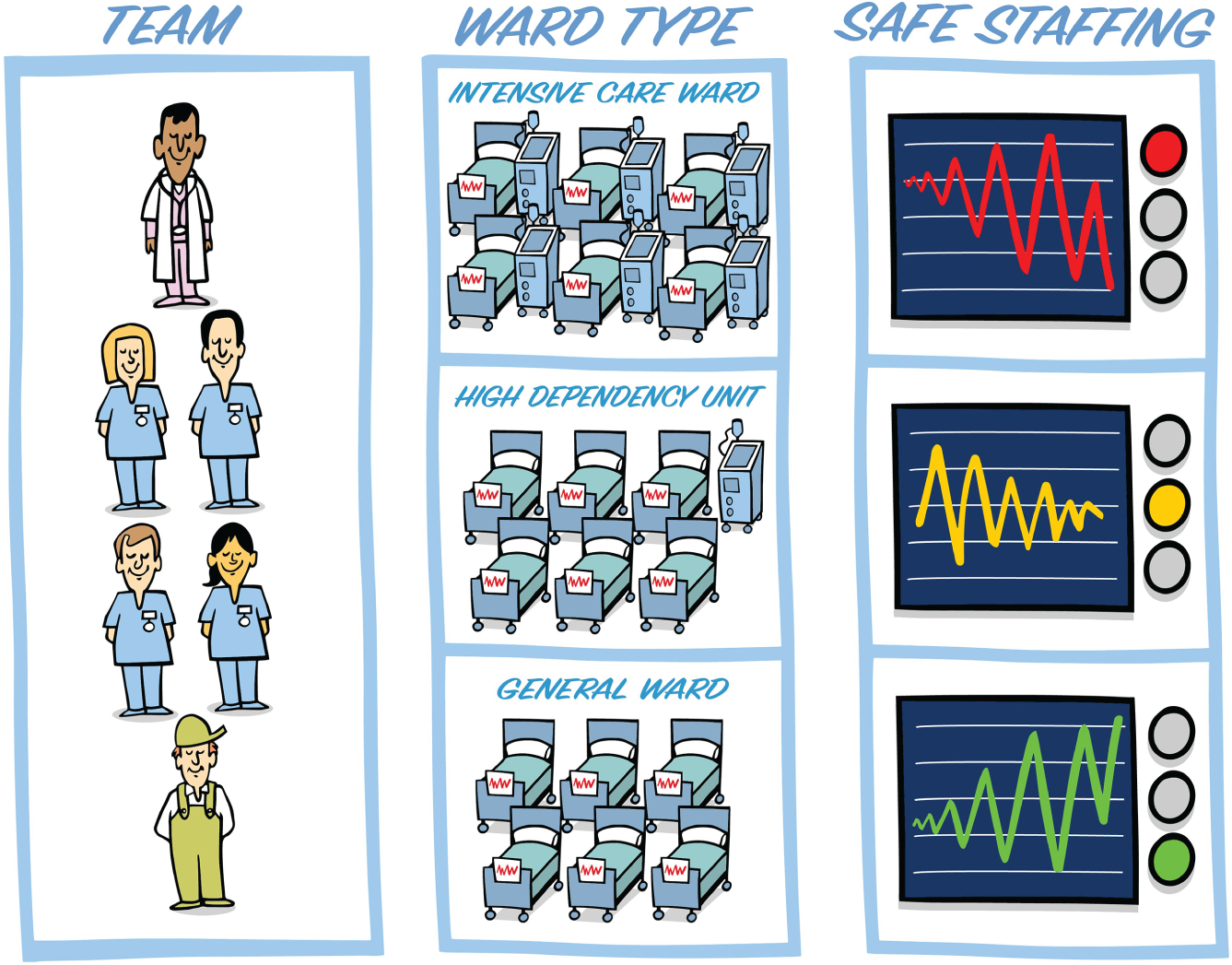
Illustration 11.1 Safe staffing
Sadly, you can also see this issue clearly when there is a war or conflict zone; an absence of ambulances and safe, working, hospital facilities, and qualified doctors and nurses can lead to worse outcomes for those caught in the crossfire as well as those just needing routine healthcare treatment. Likewise, in relation to other humanitarian goals (shelter, food and water), if you don't have the correct quantity and quality of resources for a relief programme, you risk worse outcomes for those in need despite the heroic efforts of staff and communities on the ground to do all that they can to help them.
The same thing applies in relation to more conventional project management. Suppose you plan to deliver something by a given date. In that case, you will need an appropriate level of resources, materials, personnel and contractors (numbers, skills and experience) to succeed. However, unlike getting ready for a flight, it's not unusual for senior managers to start projects and programmes knowing that not all the needed resources have yet been secured, but hoping there is enough slack in the timeline to get sufficient resources to meet key deadlines. Sometimes organisations put in place the necessary steps to make this work (e.g. expediting recruitment), but often you will find organisations getting caught out because ‘lead times’ turn out to be beyond what was either planned or required by the demands of the project.8
And the question of the appropriate staffing levels to carry out tasks properly also applies to ‘business as usual’ activities, such as checking payments before they are made or ensuring product quality. Too often, I have seen organisations where something has gone badly wrong. Then, everyone turns around and says, ‘How did it get so bad?’ to discover either (i) there were no ‘guide rails’ to keep resources at an appropriate level or (ii) there were only limited ‘early warning signs’ that standards were slipping or (iii) requests for extra resources had been made, but securing this was – literally – ‘too little, too late’.
Even with adequate staffing, short‐term pressures can require disciplined prioritisation. Staffing plans and decisions about which tasks take priority need to work together, as they do in aviation, medicine and other High‐Reliability Organisations (HROs).
When to use it
A hospital emergency department assesses the staff and skills needed for likely patient demand and plans how to respond to a disaster surge.
In a software development project, safe staffing means having enough developers and testers to meet the release deadline without sacrificing quality.
An airline checks that the flight has the required cockpit and cabin crew, with the qualifications needed for that aircraft and operation.
A manufacturing plant checks whether staffing levels leave enough time and expertise for quality-control work, including during demand peaks.
FROM THEORY TO EVERYDAY LIFE
In practice
Aviation Crew Requirements
A flight must meet the crew-number, training, and certification requirements that apply to its aircraft and operation before departure. A staffing plan therefore needs to cover the required qualifications as well as the headcount.
Healthcare Staffing Ratios
The source cites 'To err is human' when discussing staffing and patient outcomes. An intensive care ward’s staffing needs reflect the intensity of care its patients require; headcount alone does not capture the necessary skills and experience.
A MOMENT TO REFLECT
Put it to work.
Think of a recent project or operation you were involved in. Were the staffing levels adequate for the workload? What warning signs might indicate understaffing?
How can organizations ensure that safe staffing levels are maintained during peak times or unexpected surges?
What are the potential consequences of violating safe staffing principles in your field?
References
- To Err is Human: Building a Safer Health System — Institute of Medicine (1999)
CONTINUE THE CONVERSATION
Source texts
- Beyond the Five Whys Root Cause Analysis and Systems Thinking (James C. Paterson)