Rhythm
Rhythm is the pattern and pace of events that provides structure and direction in music, language, and daily life. It synchronizes us with our environment and influences our emotions, attention, and social connections.
THE IDEA
Rhythm
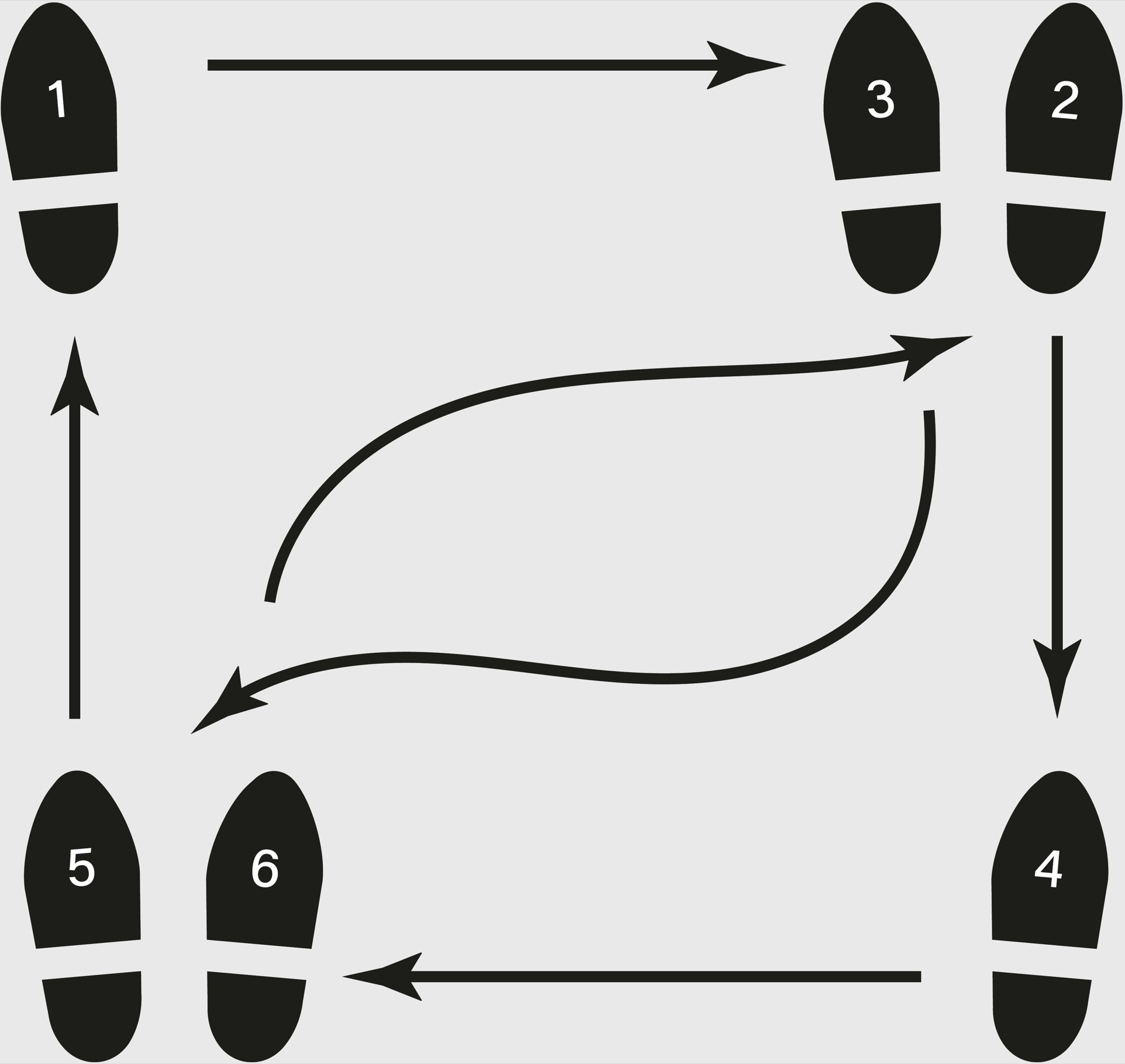
Pace yourself.
Why do we care about rhythm? It connects us to the world. It plays a role in listening, in language, in understanding speech in noisy places, in walking, and even in our feelings toward one another.
—Nina Kraus [1]
Rhythm is the pattern and pace at which things happen. We can hear it in music, follow it in speech, and notice it in the routines we share.
In music, rhythm is the element of time. Most people easily identify and anticipate rhythm. Margaret Mary Barela explains, “Our perception of time is an integral part of musical experience. Once our attention is directed to that aspect, we can make comments about our perception of the way time-space has been filled.” [2] To identify the rhythm in a piece of music, we pay attention to the recurring movement of strong and weak notes, and rests or silences.
It is the relation between repetition and difference that allows rhythm to be both produced and perceived.
—Sara Adhitya [3]
In music, rhythm indicates when notes are played, how long they are played, and the intensity at which they are played. Think about any song you listen to: not all of its notes have the same intensity or pace. Some are louder or are played faster. If every note were played exactly the same way, a song would be very boring to listen to. Musical movement is like a wave, and “it is rhythm that determines the shape of the wave.” [4]
Part of what makes music enjoyable is our ability to anticipate what comes next in a rhythm pattern, but as with incentives, we get a rush from uncertain payoffs when the stakes are low. Therefore, musicians play with both meeting and thwarting our expectations to create particular emotional effects, such as by changing up the tempo at an unusual moment, or by layering multiple rhythms on top of one another. Too much predictability is boring; too little is disorienting. “It’s not just the stressing of some beats,” writes Philip Ball, “but an asymmetry of events that creates a true sense of rhythm and avoids monotony.” [5] If you think of how we speak, versus how we usually depict robots speaking, you can appreciate how a little uncertainty and anticipation can be exciting and engaging.
Thwarted rhythmic expectations in a piece of music wake us up. They make it harder to tune out. Research has demonstrated, as scientist John Powell explains, “we are equally surprised by increases or reductions in loudness (or even sudden silences) [which] shows that it’s the change in pattern which is important. A pattern of sounds makes you expect a continuation of that pattern, and if your expectations are violated, your brain starts paying attention.” [6]
Some music has no steady underlying pulse. That does not mean it lacks rhythm: notes and silences can still form patterns whose timing varies. A regular beat is one way to organize musical time.
In a musical composition, rhythm is the backbone and thus gives the piece its structure. But although rhythm is ubiquitous, what makes a rhythm is not. There are cultural variations in rhythm patterns and beat perception, and we seem to prefer what we already understand. “What we hear in music is conditioned not only by what sound is actually produced,” Philip Ball writes, “but also by what sound one’s ear is attuned to and expects.” [7]
Similar to our daily lives, music need not have only one rhythm. Polyrhythmic music is common in many musical cultures, most notably African drum music, as Powell explains:
One of the oldest African musical genres is drums-only music, which often employs polyrhythms. A polyrhythm is produced when two or more drummers follow different but linked agendas at the same time, creating complex and interesting effects from a combination of rhythms. [8]
The broadest generalization which can be made about the rhythmic experience is that it provides for the listener a sense of motion and direction.
—Margaret Mary Barela [9]
Our bodies easily find themselves in tune with rhythms. John Powell explains that scientific studies and our everyday experiences show us that “under the right conditions your heart rate can rise or fall toward the beat of the music you are listening to, and this fools your brain into experiencing the emotion that is appropriate to your new heart rate.” [10]
Our emotions are easily influenced by rhythm. “The speed of the music gives the clearest indicator of its mood.” [11] Generally, fast speeds signify happiness, fear, or anger, while slow speeds indicate tenderness or sadness. We look for other cues in music to figure out the mood the music is trying to convey, but the conventions are far from universal; it’s possible, for example, to have very sad music that moves quickly. Rhythm, however, usually forms our largest impression of the mood of the music. David Byrne suggests that the “happiness” of rhythms can override “melancholy” melodies for many listeners of the tragic lyrics of flamenco and salsa songs. [12]
Rhythm also shapes other arts, offering further ways to notice how patterns of timing affect an experience.
Rhythm impacts the structure of individual works of poetry, dance, and literature. Virginia Woolf asserted, “All writing is nothing but putting words on the backs of rhythm. If they fall off the rhythm, one’s done.” [13]
When we come across rhythm, we identify it as the base of what we are experiencing. It provides a structure that we can easily pick out and mimic. Therefore, most humans can share an experience of togetherness when listening to rhythms.
Rhythms also form the backdrop to our days, as many elements of our world follow a beat through time. Using rhythm as a model helps us understand what we can change and accomplish by modifying a rhythm.
It is because it is thus inborn in us that we can never silence music, any more than we can stop our heart from beating; and it is for this reason too that music is so universal and has the strange and illimitable power of a natural force.
—Virginia Woolf [14]
When to use it
Time Management: Crafting a weekly work schedule with a rhythm of deep work, meetings, breaks, and reflection to maintain sustainable productivity.
Public Speaking: Varying the pace and pausing at strategic moments to engage the audience, similar to musical phrasing.
Team Building: Introducing a shared rhythmic activity (like a clapping exercise) to foster group cohesion and alignment.
Music selection: Notice how different tempos and patterns affect your attention or mood, rather than assuming the same rhythm has the same effect on everyone.
FROM THEORY TO EVERYDAY LIFE
In practice
Daily Routine Rhythm
You begin the morning with focused work, take a break, and then move into meetings. Repeating that sequence creates a familiar rhythm. An unexpected meeting interrupts it, so you decide whether to move the work block or resume it afterward.
Music Practice and Learning
When learning a new piece on the piano, you first focus on the rhythm—the pattern of notes and rests. If you get the rhythm wrong, the melody feels off. As you practice, you internalize the rhythm, and small variations in tempo or dynamics add expressiveness, making the performance engaging rather than robotic.
A MOMENT TO REFLECT
Put it to work.
Think about your daily schedule: What is its rhythm, and where could a slight adjustment—like changing the pace or inserting a pause—improve your focus or creativity?
Recall a piece of music that surprised you with an unexpected rhythmic change. How did that affect your attention and emotion? How can you apply similar strategic surprises to your communication or teaching?
Identify a situation where you felt ‘in sync’ with a group (a team, a class, a crowd). What rhythm was present, and how can you deliberately create that synchrony in future collaborations?
CONTINUE THE CONVERSATION
Source texts
- The Great Mental Models Volume 4 Economics and Art