Retrospective Reasoning: Theory-Driven Inferences about Counterfactual Worlds
When experts explain history as inevitable, a plausible alternative history can threaten their account. Tetlock found that experts with strong theoretical commitments and a preference for explanatory closure were more likely to reject such alternatives, sometimes arguing that another event would have produced the same outcome.
THE IDEA
Retrospective reasoning: theory-driven inferences about counterfactual worlds
Close-call counterfactuals play a central role in cushioning conditional forecasts from the logical sting of unexpected events. The more theory-driven an expert’s style of reasoning, the more likely the expert was to endorse scenarios in which the predicted event (that did not occur) almost occurred: the “I-was-almost-right” defense. Shifting from prospective to retrospective reasoning, however, there are good reasons for expecting the opposite functional relationship to emerge: the more theory-driven the expert’s style of reasoning, the more inclined the expert should be to dismiss close-call counterfactuals as whimsical and far-fetched. A good example of how close-call counterfactuals can undermine belief systems arises whenever experts offer confidently deterministic explanations of the past that portray what happened as inevitable but then confront plausible arguments that highlight how easily events might have gone down a different path. For instance, many students of world politics subscribe to some variant of the deterministic thesis that World War I was inevitable – perhaps because of the inherent instability of multiethnic empires and of multipolar balances of power or perhaps because of the widespread perception that the side that mobilized and struck first would possess a decisive advantage. Let’s suppose that we challenge these experts with the argument, “If the assassination of Archduke Ferdinand on June 28, 1914, had been thwarted, then World War I would not have broken out in August, 1914.” These experts have three distinct lines of defense:
1. They could challenge the mutability of the antecedent and insist that it is hard to undo the assassination because the Archduke was so detested in Sarajevo and the Serbian assassins were so determined. Few experts, however, endorse this defense in this case – perhaps because the assassination depends on a transparently improbable series of coincidences, each easily “undoable” by the standards of Kahneman and Miller’s (1986) norm theory.
2. They could challenge the adequacy of the connecting principles linking antecedent to consequent. Counterfactual arguments are inherently elliptical; it is too exhausting to spell out the exhaustive lists of background assumptions that must be satisfied to sustain even the simplest antecedent–consequent linkages. To invoke the standard example, “If the match had been struck, it would have lighted” rests on an elaborate matrix of assumptions, including the presence of oxygen, the absence of water, sufficient friction, and the proper chemical composition of the match. In the Archduke counterfactual, experts could challenge the connecting principles by arguing that Austro-Hungary would have attacked Serbia anyway and the assassination merely provided a convenient casus belli.
3. They could concede both the mutability of the antecedent (“Yes, the Archduke could have escaped death on July 28, 1914”) and the soundness of the connecting principles (“Yes, war probably would not have broken out that summer”), but insist that the war would not have been long delayed because some other match would have ignited the conflagration. This defense, the most popular of the three in this case, is designated a second-order counterfactual: It undoes the undoing of the original close-call counterfactual. Second-order counterfactuals allow for deviations from reality but minimize the significance of the deviations by invoking higher-order forces that soon bring events in the simulated world back toward the observed historical path.
Drawing on this analysis, Tetlock (1998) argued that individual differences in both theoretical outlook and cognitive style (especially in preferences for parsimony and explanatory closure) should predict resistance to close-call counterfactuals that erode favorite deterministic accounts of the past (covering laws; Hempel, 1965). Belief-system defense now requires invoking the “I-was-not-almost-wrong” defense: demonstrating that, although it might seem easy to derail a particular historical process, on close inspection it proves remarkably difficult. As soon as one cuts off one causal pathway to the observed outcome, another pathway arises, hydralike, in a second-order counterfactual.
To test these hypotheses, Tetlock (1998) constructed scales to measure four dimensions of beliefs about political causality: (1) the instability of the balance of power as a necessary and sufficient explanation for the outbreak of war in general and for World War I in particular; (2) the efficacy of classic balance-of-power mechanisms in preventing the emergence of hegemons on the European continent in the last few centuries; (3) the Soviet political system as an adequate explanation for both Stalinist tyranny in domestic policy and external expansion in foreign policy; and (4) the role played by nuclear weapons in preventing a third world war between the United States and the Soviet Union. Tetlock (1998) also constructed a composite (multimethod) indicator of cognitive style by combining responses to a truncated version of Kruglanski and Webster’s (1996) need-for-closure scale with integrative complexity scores derived from coding experts’ open-ended explanations for why the 20th century turned out to be as violent as it did. Henceforth, this measure is designated strength of preferences for parsimony and explanatory closure.
As Table 42.3 indicates, the predicted pattern emerged. The stronger their preconceptions about history, the more unequivocally experts rejected close-call counterfactuals that poked indeterminacy holes in the applicability of those preconceptions to a particular historical episode – in the process, often invoking all three layers of belief-system defense. For example, experts whose essentialist outlook on the Soviet Union stressed the inherently expansionist character of the regime objected most forcefully to counterfactual claims that the Cold War could easily have been avoided by triggering Stalin’s cerebral hemorrhage in 1945 instead of 1953 or by triggering FDR’s stroke in 1944 instead of 1945, thereby replacing Truman with a relatively left-wing president (Wallace). Experts who believed in the inherent stability of nuclear deterrence and the rationality of policy makers were more skeptical of close-call counterfactuals that implied that we came precariously close to a nuclear Armageddon in the Cuban missile crisis or in other Cold-War confrontations. Perhaps most interesting, this skepticism was not limited to challenging the political logic connecting antecedents to consequents or to invoking the even more abstract second-order close-call-counterfactual defense. Many experts also challenged the mutability of medical antecedents (the health of leaders) and meteorologic antecedents (cloud cover over Cuba in October). Indeed, the three belief-system-defenses were sufficiently intercorrelated to aggregate them into a single index.
Table 42.3. Multiple Regression Analyses for Predicting Resistance to Close-Call Counterfactuals at Key Junctures in 20th Century History
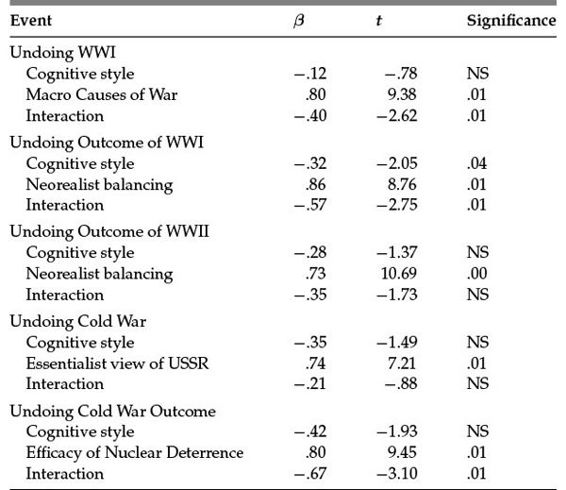
The individual-difference measure of cognitive style played a robust moderator-variable role. Experts with strong preferences for parsimony and explanatory closure were most dismissive of close-call counterfactuals that poked holes in favorite covering laws. The predicted interaction materialized in the clear majority of historical domains examined.
Here we confront an interesting choice of normative value spin to be placed on styles of reasoning. Academic observers can either (1) applaud the high-parsimony respondents for their logical rigor and taut belief systems and deplore their low-parsimony counterparts for their mental sloppiness and loose-linkage belief systems; or (2) criticize the high-parsimony respondents for their mental rigidity and lack of historical imagination and praise their low-parsimony counterparts for their cognitive flexibility and vision. Either way, the data reveal a belief-system continuum anchored at one end by theorists with great tolerance for ambiguity who acknowledge a multiplicity of possible histories of the twentieth century and anchored at the other end by theorists with strong preferences for explanatory closure who insist that things had to work out as they did and have little tolerance for counterfactual “parlor games.” Toward the middle of the continuum is the bulk of our sample: theorists who acknowledge systemic constraints on what could have happened but who concede that it was often possible for history to stray, sometimes for prolonged periods, from the observed path. These latter theorists give their counterfactual imaginations freer rein than their high-parsimony counterparts but are more likely to rein in those imaginations than their low-parsimony counterparts.
When to use it
Analyzing historical interpretations and debates about inevitability.
Evaluating risk management strategies by considering close-call near misses.
Understanding resistance to alternative explanations in policy debates.
Improving decision-making by acknowledging multiple possible outcomes.
FROM THEORY TO EVERYDAY LIFE
In practice
The Assassination of Archduke Franz Ferdinand
Historians who view World War I as inevitable often dismiss the counterfactual that if the assassination had been thwarted, war would not have broken out in August 1914. They may argue that Austro-Hungary would have found another casus belli (challenging connecting principles) or that another event would have triggered the war (second-order counterfactual).
Avoiding the Cold War
Experts who emphasized Soviet expansionism resisted counterfactuals in which shifting the timing of Stalin’s or FDR’s death could have avoided the Cold War. They challenged the proposed changes, their political consequences, or the idea that those consequences would last.
A MOMENT TO REFLECT
Put it to work.
Consider a historical event you view as inevitable. What specific counterfactual changes would you need to imagine to make it unlikely?
How does your preference for parsimony influence your acceptance of counterfactual explanations?
In what ways do you use second-order counterfactuals to defend your own past decisions?
Often confused with
References
- Norm theory: Comparing reality to its alternatives — Kahneman and Miller (1986)
- Close-call counterfactuals and belief-system defenses — Tetlock (1998)
- Aspects of Scientific Explanation — Hempel (1965)
- Motivated resistance to exposure to conflicting information — Kruglanski and Webster (1996)
CONTINUE THE CONVERSATION
Source texts
- Heuristics and Biases The Psychology of Intuitive Judgment (Thomas Gilovich, Dale Griffin, Daniel Kahneman)