Result Mining
Before clicking a search result, examine the URL, title, and snippet to quickly assess the source's authority and relevance. This practice, called result mining, saves time and improves search efficiency.
THE IDEA
Interpreting and Mining Search Results
You type “Does marijuana help cataracts?”
Here’s what Google gives you (fig. 3.2). A result at the top with your exact question. It’s practically begging for you to click.
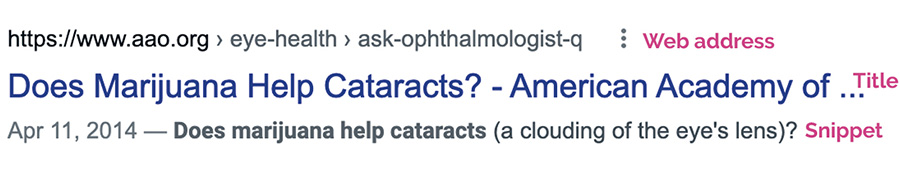
Figure 3.2 Elements of a Google result. (Google and the Google logo are trademarks of Google LLC.)
Resist the urge. You can learn a whole lot about a result before you click. The extra seconds it takes will pay off in the time you save later.
This practice is called result mining: inspect the result before deciding whether to open it. It takes practice to recognize which clues are useful.
First things first. A typical Google result has three main parts:
- 1 The web address
- 2 The blue title (the link you click on)
- 3 A block of text drawn from the website—Google calls this a “snippet” (in general, snippets are created when Google matches the words in your search to words in the result and then highlights them in bold)
Your search brings up aao.org. The American Academy of . . . something. You spot “ophthalmologist” after the URL; this must be a group of eye doctors. Following the dot-org domain you see these little > signs pointing to “eye-health” and then “ask-ophthalmologist-q.” All this means is that there are different sections to the site, and Google is telling you where on the site the results are located. This result seems on target. Medical. Authoritative. Short. You click in.
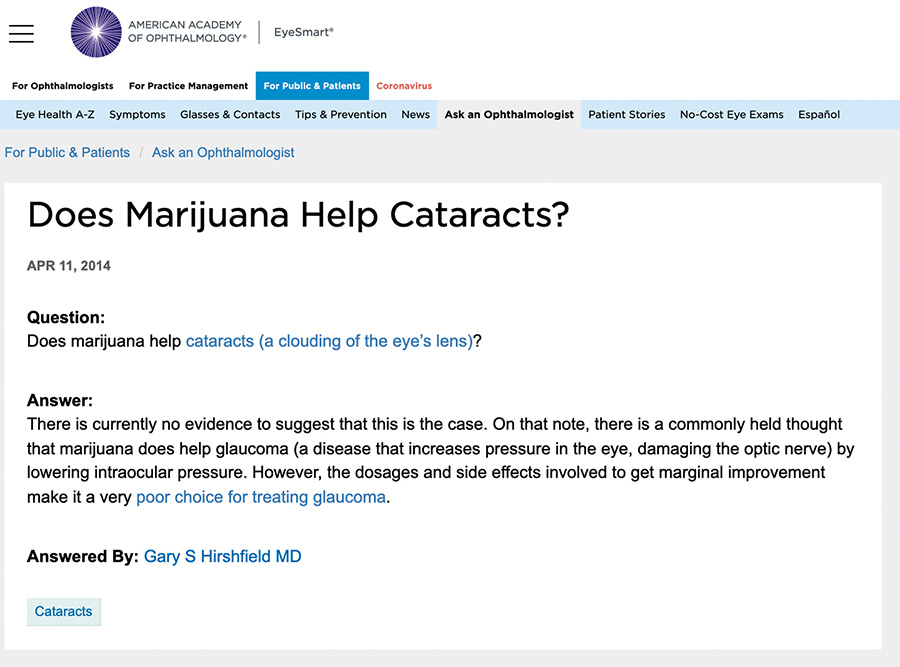
Figure 3.3 The American Academy of Ophthalmology’s answer about whether marijuana helps cataracts (https://www.aao.org/eye-health/ask-ophthalmologist-q/does-marijuana-help-cataracts)
Hmm . . . “no evidence” that marijuana helps with cataracts. (Could it be that Nana’s neighbors were thinking about marijuana and glaucoma? That too looks iffy.) You could continue looking at other sites, or even search “Gary S. Hirshfield MD,” the doctor who wrote the post. You could go to Wikipedia to confirm that the American Academy of Ophthalmology, with thirty-two thousand members, is the main group of eye doctors in the United States. You could even do more research to get a better handle on this issue. For now, though, this answer suffices.
When to use it
When researching a school paper, inspect search results for clues about who published them and whether they address the question.
Before trusting a health claim, use the result’s address and snippet to identify a source worth checking, then inspect the page and its evidence.
In professional research, result mining speeds up literature review by pre-evaluating results.
FROM THEORY TO EVERYDAY LIFE
In practice
Evaluating a search result for 'Does marijuana help cataracts?'
In the source’s search example, the address, title, and section names suggest that the aao.org result concerns eye health. After opening it, the reader finds an answer attributed to the American Academy of Ophthalmology. The result’s visible clues help select a page to inspect; a .org address alone does not establish authority.
A MOMENT TO REFLECT
Put it to work.
Next time you search for medical advice, how can you use result mining to identify trustworthy sources?
Why is it important to examine the URL and snippet before clicking a result?
How does result mining help you avoid misinformation and save time?
CONTINUE THE CONVERSATION
Source texts
- Verified How to Think Straight, Get Duped Less, and Make Better Decisions about What to Believe Online (Mike Caulfield, Sam Wineburg)