Replication
DNA replication copies genetic material. Mitosis divides a cell’s duplicated chromosomes between daughter cells, while meiosis produces cells with reduced chromosome sets for sexual reproduction. As an analogy, copying and recombining suggest different ways to preserve useful practices and introduce variation.
THE IDEA
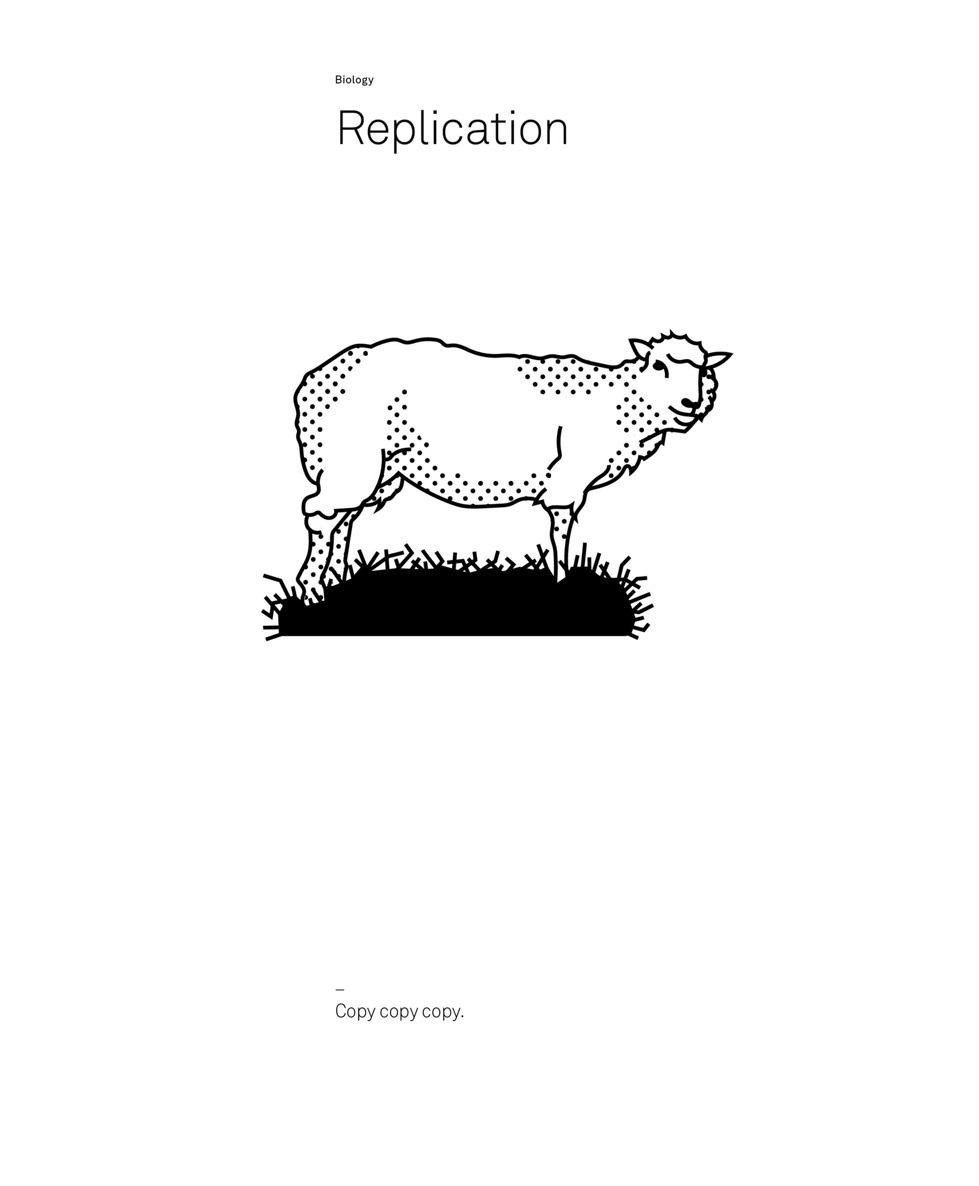
Replication
DNA replication copies genetic material before a cell divides. In tissues such as skin, repeated cell division replaces cells that are lost. Accurate copying helps preserve the instructions needed to make and maintain those cells, though copying errors can occur.
Mitosis is the division of a cell’s duplicated chromosomes between daughter nuclei. Together with division of the cell itself, it produces daughter cells with largely the same genetic information. DNA copying precedes mitosis; the terms describe different parts of the process.
« In an adapted unit, most variation introduced by errors (mutations) in copying are harmful. For an adapted entity, therefore, increasing fidelity in copying, or mechanisms that concentrate error in parts of the code where they will be least harmful or most helpful, will be favored. »
Geerat Vermeij1
As a general model, replication requires:
- A code representing what is to be replicated,
- A means of copying that code,
- A place and machinery to use the code to construct the copy.
Sexual reproduction adds recombination and the combination of genetic material from parents. Meiosis produces cells with reduced chromosome sets and reshuffles inherited material. In humans, fertilization combines an egg and a sperm to restore a full set. Meiosis and fertilization are distinct processes.
Recombination generates new combinations of traits that natural selection can act on. Some combinations improve fitness in a particular environment; others do not. Sexual reproduction does not guarantee adaptation or prevent all harmful mutations. Asexual lineages can also vary through mutation.
Outside biology, copying a working method can preserve consistency, while combining methods can generate alternatives. This is an analogy for thinking about continuity and change, rather than a biological explanation of how organizations or ideas behave. The same distinction can help clarify what we mean by preserving a legacy: continuing a person’s work is not the same process as copying their DNA.
When to use it
When extending a project workflow across an organization, identify what needs to remain consistent and where teams can test changes.
When comparing financial plans, separate the value of following a consistent savings habit from the risks and assumptions of adding new investment strategies.
A musician can copy a composition to study its technique, then try combining elements from different genres to develop new work.
FROM THEORY TO EVERYDAY LIFE
In practice
Individual Learning
A language learner first copies useful phrases and then combines vocabulary and sentence patterns to express new ideas. This illustrates the copy-and-combine analogy; learning a language is not literally mitosis or meiosis.
Business Expansion
A restaurant chain copies a working menu and operating process across locations. In a new market, it tests combinations of that model with local ingredients and preferences. Copying preserves a baseline; variation creates alternatives to assess.
A MOMENT TO REFLECT
Put it to work.
Which practices do you copy consistently? What evidence would tell you they need to change?
What could you learn by combining elements from different approaches? How would you test the result?
In what ways does your drive for self-preservation influence your decisions about legacy and the impact you leave behind?
References
- Unknown — Geerat Vermeij
CONTINUE THE CONVERSATION
Source texts
- The Great Mental Models Volume 2 Physics, Chemistry and Biology