Relativity
Special relativity describes space and time using the same physical laws in every inertial frame and an invariant speed of light in vacuum. General relativity describes gravity through spacetime curvature and includes special relativity as a local limit.
THE IDEA
Relativity
A familiar joke attributed to Einstein puts it this way:
Put your hand on a hot stove for a minute, and it seems like an hour. Sit with a pretty girl for an hour, and it seems like a minute. That’s relativity.
The joke describes our perception of time. Physical relativity concerns measurements made by clocks and rulers, regardless of how time feels to an observer.
Special relativity
Special relativity has two postulates:
- The laws of physics are the same in every inertial frame: a reference frame moving at constant velocity relative to other inertial frames.
- The speed of light in vacuum is the same for every inertial observer, independent of the motion of the light source.
The theory does not forbid forces or acceleration. It can describe accelerating objects in flat spacetime; it does not describe gravity through spacetime curvature.
Imagine a car traveling smoothly at 50 mph relative to the road. In an idealized experiment confined to its interior, with no acceleration or outside reference, you cannot distinguish uniform motion from rest. You can describe the car as stationary and the road as moving backward at 50 mph. These descriptions use different frames; neither establishes an absolute state of rest. Acceleration, by contrast, is detectable within the car.
The postulates change how different observers relate measurements of time, distance, and simultaneity:
- Relativity of simultaneity: events simultaneous in one inertial frame need not be simultaneous in another moving relative to it.
- Time dilation: a moving clock ticks more slowly relative to the coordinate time of an inertial frame.
- Length contraction: an object moving relative to an observer is measured to be shorter along its direction of motion, with its endpoints measured simultaneously in that observer’s frame.
- Mass–energy equivalence: E = mc² relates an object’s rest energy to its invariant mass.
- A speed limit for information: no local signal or material object can transmit information faster than light in vacuum.
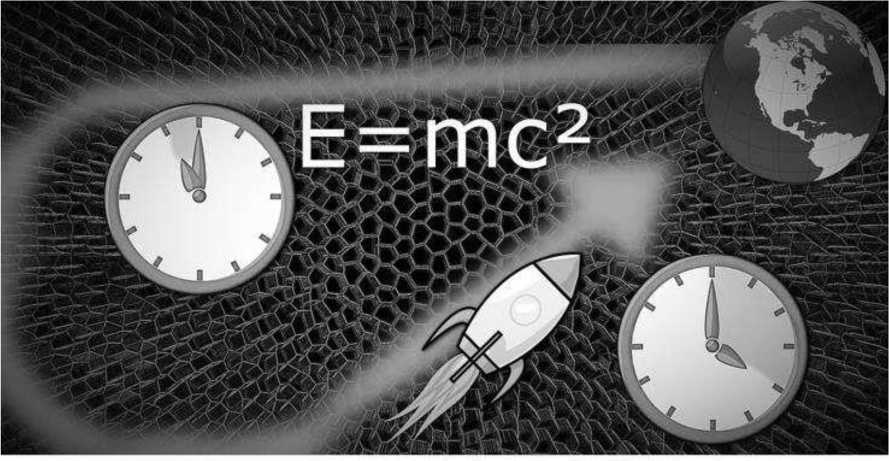
Einstein introduced special relativity in his 1905 paper, On the Electrodynamics of Moving Bodies. Its account of light is consistent with the Michelson–Morley experiment’s failure to detect the expected aether wind.
Lorentz transformations relate space and time coordinates in different inertial frames. They replace the Galilean transformations used in Newtonian mechanics, which assume the same time for all observers. At everyday speeds, the difference is usually very small.
Some presentations use relativistic mass to describe an object’s increasing energy as its speed rises. The same physics can be expressed using invariant mass and relativistic energy and momentum; the object’s invariant mass need not increase.
General relativity
Einstein developed general relativity during the years 1907–1915. An important starting point was the equivalence principle: within a sufficiently small region, the effects of a uniform gravitational field and those of uniform acceleration can be indistinguishable. This is a local statement; measurements across a larger region can reveal tidal effects.
In general relativity, an object in free fall follows an inertial path through curved spacetime when no nongravitational force acts on it. Newtonian mechanics instead describes its falling motion as acceleration caused by a gravitational force.
General relativity extends special relativity to curved spacetime. It is not simply incompatible with it: special relativity applies locally, and Newtonian gravity remains a useful approximation in suitable conditions. In 1915, Einstein formulated field equations relating spacetime curvature to energy, momentum, and stress.
The theory accounts for several effects:
- Gravitational time dilation: clocks deeper in a static gravitational field run more slowly relative to clocks higher up.
- Orbital precession: the theory accounts for the additional precession of Mercury’s orbit that Newtonian gravity alone does not explain, and for effects seen in binary pulsars.
- Light deflection: light follows paths that bend around massive bodies.
- Frame-dragging: rotating masses affect nearby spacetime and motion.
- Cosmic expansion: expanding-universe solutions allow sufficiently distant galaxies to recede faster than light in terms of changing cosmological distance. This does not mean that they locally travel through space faster than light.
Changes in the gravitational field propagate at the speed of light. The metric describes spacetime geometry and determines the paths of freely falling objects. Together, the theories explain why measurements of time and distance depend on motion and gravity while physical laws retain a consistent form.
When to use it
Global Positioning System (GPS) relies on relativistic corrections for precise timing due to both velocity (special relativity) and gravitational potential (general relativity) differences.
Particle accelerators use relativistic energy and momentum to calculate how much energy is needed as particles approach the speed of light.
Astronomical observations of light deflection around massive bodies (gravitational lensing) confirm general relativity and are used to map dark matter.
Time dilation explains why high-energy cosmic ray muons, created in the upper atmosphere, can reach Earth's surface before decaying—their internal clocks run slower from our perspective.
FROM THEORY TO EVERYDAY LIFE
In practice
A Joke about the Feeling of Time
The hot-stove joke contrasts how long an experience feels. It is an analogy about subjective time, not an example of the physical time dilation measured by clocks.
No Absolute Motion in a Car
Inside an idealized car moving uniformly at 50 mph, an experiment with no outside reference cannot reveal absolute uniform motion. The road provides a reference for relative speed, while acceleration can be detected within the car.
Michelson–Morley Experiment
The Michelson–Morley experiment did not detect the expected aether wind. Its null result is consistent with special relativity’s invariant speed of light; interpreting that result requires more than treating one experiment as proof of the entire theory.
Precession of Mercury's Orbit
General relativity explains the additional precession of Mercury’s orbit that Newtonian gravity alone leaves unexplained. This was an important successful test of the theory.
A MOMENT TO REFLECT
Put it to work.
How does the relativity of simultaneity challenge our everyday understanding of 'now'?
Why do GPS systems need to account for both special and general relativistic effects to function accurately?
If you were in a windowless ship accelerating at 9.8 m/s², which local measurements would resemble those made while standing on Earth? What measurements over a larger region might distinguish the situations?
References
- On the Electrodynamics of Moving Bodies — Albert Einstein (1905)
- Zur allgemeinen Relativitätstheorie — Albert Einstein (1915)
CONTINUE THE CONVERSATION
Source texts
- Wisdom Theory 100 Mental Models (2020) (Wisdom Theory)