Reductio ad Unlikely
A probabilistic version of reductio ad absurdum used in null hypothesis significance testing; it assumes the null hypothesis is true and rejects it if an observed outcome is highly improbable, but this reasoning is flawed because improbable events occur frequently.
THE IDEA
REDUCTIO AD UNLIKELY
The stickiest philosophical point in a significance test comes right at the beginning, before we run any of the sophisticated algorithms developed by Fisher and honed by his successors. It’s right there at the beginning of step 2:
“Suppose the null hypothesis is true.”
But what we’re trying to prove, in most cases, is that the null hypothesis isn’t true. The drug works, Shakespeare alliterates, the Torah knows the future. It seems very logically fishy to assume exactly what we’re aiming to disprove, as if we’re in danger of making a circular argument.
On this point, you can rest easy. Assuming the truth of something we quietly believe to be false is a time-honored method of argument that goes all the way back to Aristotle; it is the proof by contradiction, or reductio ad absurdum. The reductio is a kind of mathematical judo, in which we first affirm what we wish eventually to deny, with the plan of throwing it over our shoulder and defeating it by means of its own force. If a hypothesis implies a falsehood,* then the hypothesis itself must be false. So the plan goes like this:
- Suppose the hypothesis H is true.
- It follows from H that a certain fact F cannot be the case.
- But F is the case.
- Therefore, H is false.
Say someone exclaims to you that two hundred children were killed by gunfire in the District of Columbia in 2012. That’s a hypothesis. But it might be somewhat hard to check (by which I mean that I typed “number of children killed by guns in DC in 2012” into the Google search bar and did not immediately learn the answer). On the other hand, if we assume the hypothesis is correct, then there cannot have been any fewer than two hundred homicides in total in DC in 2012. But there were fewer; in fact, there were only eighty-eight. So the exclaimer’s hypothesis must have been wrong. There’s no circularity here; we’ve “assumed” the false hypothesis in a kind of tentative, exploratory way, setting up the counterfactual mental world in which H is so and then watching it collapse under pressure from reality.
Put this way, the reductio sounds almost trivial, and in a sense, it is; but maybe it’s more accurate to say it’s a mental tool we’ve grown so used to handling that we forget how powerful it is. In fact, it’s a simple reductio that drives the Pythagoreans’ proof of the irrationality of the square root of 2; the one so awesomely paradigm-busting they had to kill its author; a proof so simple, refined, and compact that I can write it out whole in a page.
Suppose
H: the square root of 2 is a rational number
that is, √2 is a fraction m/n where m and n are whole numbers. We might as well write this fraction in lowest terms, which means that if there is a common factor between the numerator and denominator, we divide it out of both, leaving the fraction unchanged: no reason to write 10/14 instead of the simpler 5/7. So let’s rephrase our hypothesis:
H: the square root of 2 is equal to m/n, where m and n are whole numbers with no factor in common.
In fact, this means we can be sure it’s not the case that m and n are both even; for to say both numbers are even is exactly to say both have 2 as a factor. In that case, as in the case of 10/14, we could divide both numerator and denominator by 2 without changing the fraction, which is to say it was not in lowest terms after all. So
F: both m and n are even
is false.
Now since √2= m/n, then by squaring both sides we see that 2= m^2 / n^2 or, equivalently, that 2n^2 = m^2. So m^2 is an even number, which means that m itself is even. A number is even just when it can be written as twice another whole number; so we can, and do, write m as 2k for some whole number k. Which means that 2n^2 = (2k)^2 = 4k^2. Dividing both sides by 2, we find that n^2 = 2k^2.
What’s the point of all this algebra? Simply to show that n^2 is twice k^2, and therefore an even number. But if n^2 is even, so must n be, just like m is. But that means that F is true! By assuming H we have arrived at a falsehood, even an absurdity; that F is false and true at once. So H must have been wrong. The square root of 2 is not a rational number. By assuming it was, we proved that it wasn’t. It’s a weird trick indeed, but it works.
You can think of the null hypothesis significance test as a sort of fuzzy version of the reductio:
- Suppose the null hypothesis H is true.
- It follows from H that a certain outcome O is very improbable (say, less than Fisher’s 0.05 threshold).
- But O was actually observed.
- Therefore, H is very improbable.
Not a reductio ad absurdum, in other words, but a reductio ad unlikely.
A classical example comes from the eighteenth-century astronomer and clergyman John Michell, among the first to take a statistical approach to the study of the heavenly bodies. The cluster of dim stars in one corner of the constellation Taurus has been observed by just about every civilization. The Navajo call them Dilyehe, “the sparkling figure”; the Maori call them Matariki, “the eyes of god.” To the ancient Romans they were a bunch of grapes and in Japanese they’re Subaru (in case you ever wondered where the car company’s six-star logo came from). We call them the Pleiades.
All these centuries of observation and mythmaking couldn’t answer the fundamental scientific question about the Pleiades: is the cluster actually a cluster? Or are the six stars separated by unfathomable distances, but arrayed by chance in almost the exact same direction from Earth? Points of light, placed at random in our frame of vision, look something like this:
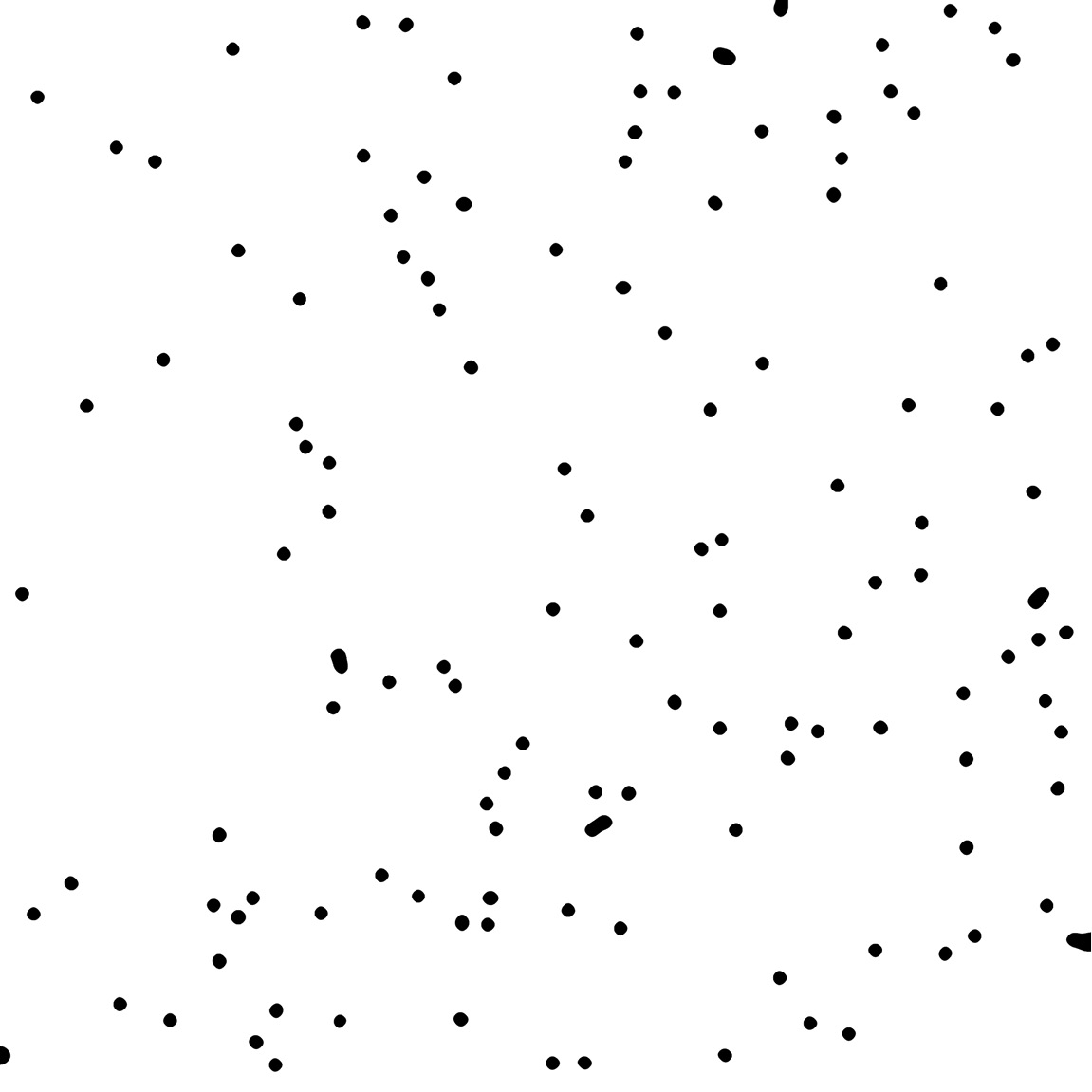
You see some clumps, right? That’s to be expected: there will inevitably be some groups of stars that wind up almost on top of one another, simply by happenstance. How can we be sure that’s not what’s going on with the Pleiades? It’s the same phenomenon Gilovich, Vallone, and Tversky pointed out: a perfectly consistent point guard, who enjoys no hot streaks and suffers no slumps, will nonetheless sometimes nail five shots in a row.
In fact, if there were no big visible clusters of stars, as in this picture:
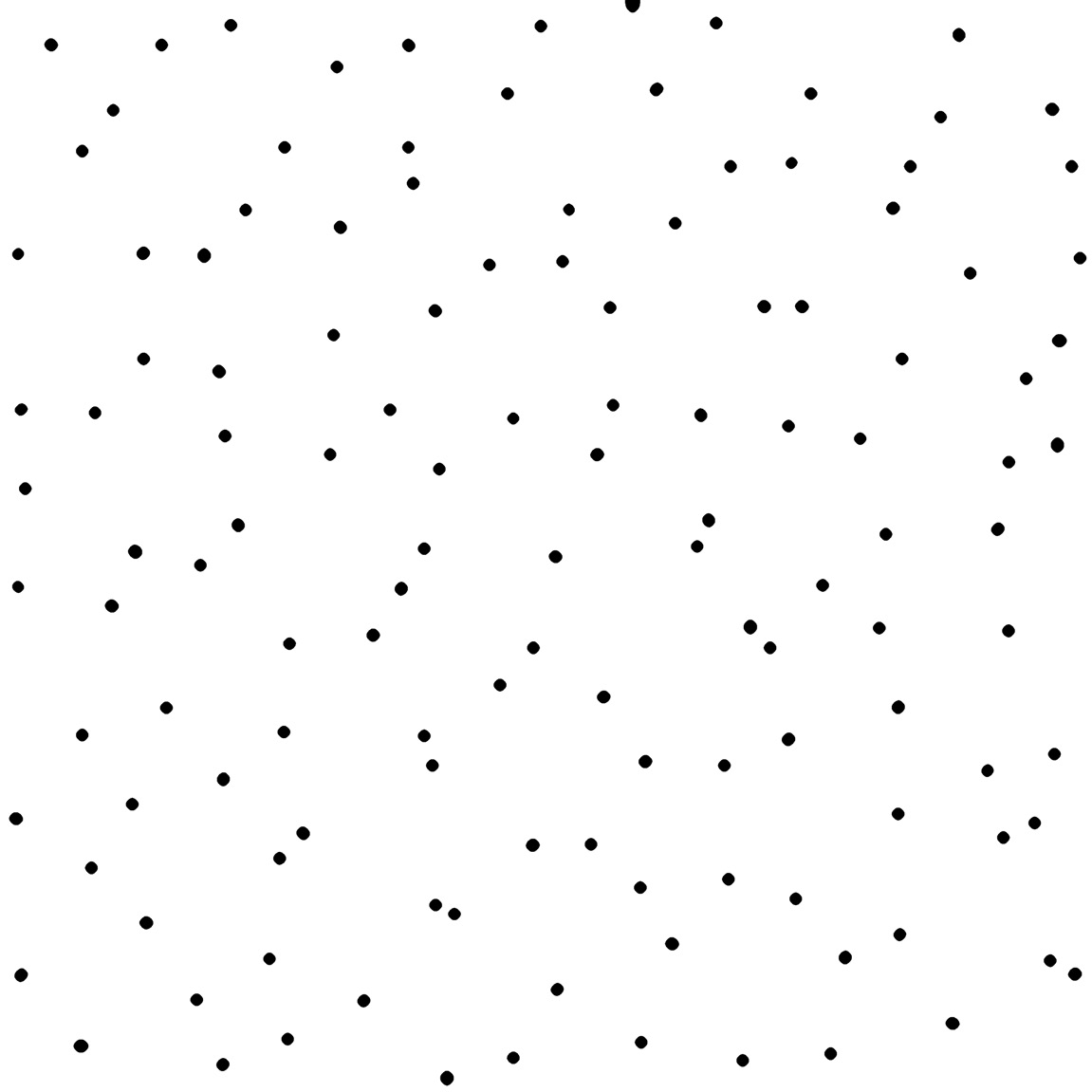
that itself would be evidence that some nonrandom process was at work. The second picture might look “more random” to the naked eye, but it is not; it testifies that the points have a built-in disinclination to crowd.
So the mere appearance of an apparent cluster shouldn’t convince us that the stars in question are actually clumped together in space. On the other hand, a group of stars in the sky might be so tightly packed as to demand that one doubt it could have happened by chance. Michell showed that, were visible stars randomly strewn around in space, the chance that six would array themselves so neatly as to present a Pleiades-like cluster to our eyes was small indeed; about 1 in 500,000, by his computation. But there they are above us, the tightly packed bunch of grapes. Only a fool, Michell concluded, could believe it had happened by chance.
Fisher wrote approvingly of Michell’s work, making explicit the analogy he saw there between Michell’s argument and the classical reductio:
“ The force with which such a conclusion is supported is logically that of a simple disjunction: Either an exceptionally rare chance has occurred, or the theory of random distribution is not true.”
The argument is compelling, and its conclusion correct; the Pleiades are indeed no optical coincidence, but a real cluster—of several hundred adolescent stars, not just the six visible to the eye. The fact that we see many very tight clusters of stars like the Pleiades, much tighter than would be likely to exist by chance, is good evidence that the stars are not placed randomly, but rather are clumped by some real physical phenomenon out there in the void.
But here’s the bad news: the reductio ad unlikely, unlike its Aristotelian ancestor, is not logically sound in general. It leads us into its own absurdities. Joseph Berkson, the longtime head of the medical statistics division at the Mayo Clinic, who cultivated (and loudly broadcast) a vigorous skepticism about methodology he thought shaky, offered a famous example demonstrating the pitfalls of the method. Suppose you have a group of fifty experimental subjects, who you hypothesize (H) are human beings. You observe (O) that one of them is an albino. Now, albinism is extremely rare, affecting no more than one in twenty thousand people. So given that H is correct, the chance you’d find an albino among your fifty subjects is quite small, less than 1 in 400,* or 0.0025. So the p-value, the probability of observing O given H, is much lower than .05.
We are inexorably led to conclude, with a high degree of statistical confidence, that H is incorrect: the subjects in the sample are not human beings.
It’s tempting to think of “very improbable” as meaning “essentially impossible,” and, from there, to utter the word “essentially” more and more quietly in our mind’s voice until we stop paying attention to it.* But impossible and improbable are not the same—not even close. Impossible things never happen. But improbable things happen a lot. That means we’re on quivery logical footing when we try to make inferences from an improbable observation, as reductio ad unlikely asks us to. That time in North Carolina when the lottery combo 4, 21, 23, 34, 39 came up twice in a week raised a lot of questions; was something wrong with the game? But each combination of numbers is exactly as likely to come up as any other. For the numbers to show 4, 21, 23, 34, 39 on Tuesday and 16, 17, 18, 22, 39 on Thursday is precisely as improbable as what actually took place—there’s just 1 chance in 300 billion or so of getting those two draws on those two days. In fact, any particular outcome of the Tuesday and Thursday lottery draws is a 1 in 300 billion shot. If you’re committed to the view that a highly improbable outcome should lead you to question the fairness of the game, you’re going to be the person shooting off an angry e-mail to the lottery commissioner every Thursday of your life, no matter which numbered balls drop out of the cage.
Don’t be that person.
When to use it
Determining whether a pattern in scientific data is statistically significant or due to chance.
Evaluating claims of psychic phenomena based on seemingly improbable predictions.
Assessing whether a series of successes in sports or business is evidence of skill beyond random variation.
Interpreting coincidences in everyday life, such as meeting a friend in a foreign city, as non-random.
FROM THEORY TO EVERYDAY LIFE
In practice
The Pleiades Cluster
John Michell argued that the probability of six stars appearing as tightly packed as the Pleiades by random chance is about 1 in 500,000, leading to the conclusion that the stars are physically clustered. This is a classic application of the reductio ad unlikely.
The Albino Subject
Joseph Berkson's counterexample: If one out of fifty subjects is an albino (albinism occurs in ~1 in 20,000), the p-value is 0.0025, which would lead to rejecting the null hypothesis that the subjects are human. Treating improbable as impossible is the fallacy.
Lottery Numbers
A specific lottery combination appearing twice in a week is extremely improbable, but any combination is equally improbable. Using improbability as evidence of unfairness leads to false conclusions.
A MOMENT TO REFLECT
Put it to work.
Can you recall a situation where you interpreted a rare event as evidence that something unusual was happening, when it might have been just randomness? How does the reductio ad unlikely apply?
How can we avoid the mistake of thinking that a highly improbable observation automatically disproves the null hypothesis?
In what ways does the classical reductio ad absurdum differ from the probabilistic version, and why is the latter not logically sound?
Often confused with
CONTINUE THE CONVERSATION
Source texts
- How Not to Be Wrong The Power of Mathematical Thinking (Ellenberg, Jordan)