Red Behavior Type (DISA System)
In Thomas Erikson’s DISA typology, Red describes a bold, competitive, task-focused style. His examples explore how drive and quick decisions can help someone take charge, and how the same behavior can feel domineering to others.
THE IDEA
How Do Others Really Perceive Me?
The people around you most often see your moderated behavior. You interpret a specific situation and make a choice about how to act based on that evaluation—this is the behavior that others around you experience. It’s all about the mask you wear to fit into a given situation. We all have several different masks. Having one at work and one at home isn’t that unusual. And another one for visiting the in-laws, perhaps. This book is not an advanced course in psychology—but I am content to establish that we interpret situations differently and act accordingly.
Consciously or subconsciously, surrounding factors cause me to choose a particular course of action.
And this is how we act. Look at this formula:
BEHAVIOR = f (P × Sf)
Behavior is a function of Personality and Surrounding factors.
Behavior is that which we can observe.
Personality is what we try to figure out.
Surrounding factors are things that we have an influence on.
Conclusion: We continually affect one another in some form or other. The trick is to try to figure out what’s there, under the surface. And this book is all about behavior.
3
An Introduction to the System
Erikson discusses the background of the DISA system on page 228 of his book. This introduction focuses on how he describes the behavior types.
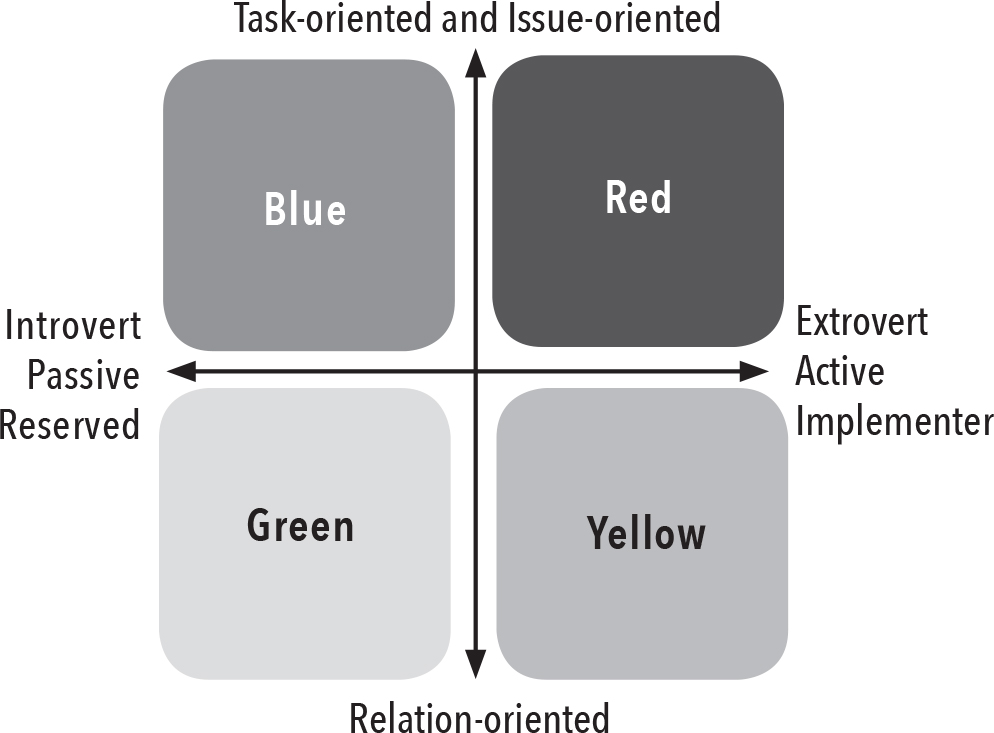
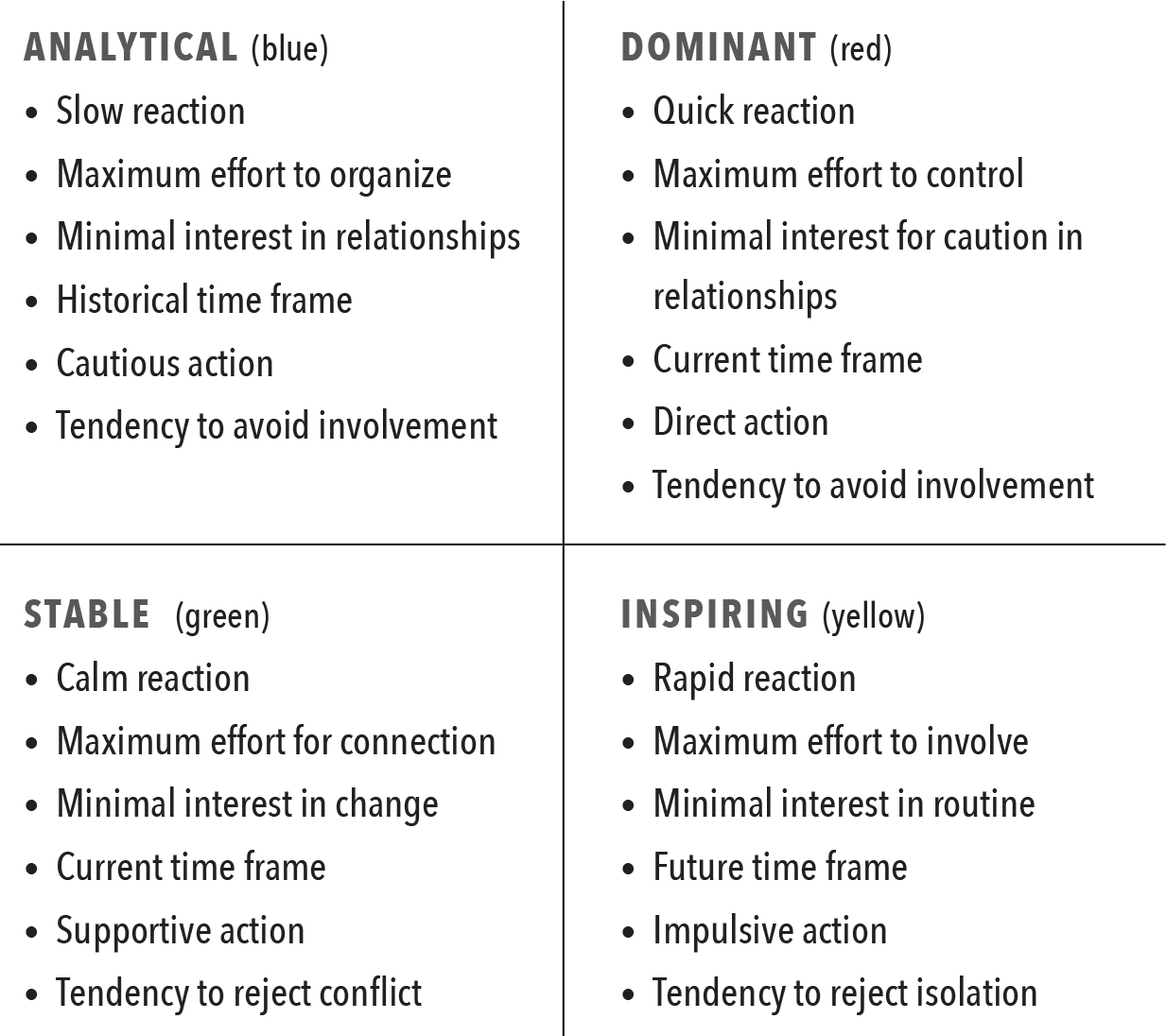
As you can see, there are four main categories of behavior types, each of which is associated with a color. This book is about how you can recognize them. Quite soon, as you start reading about the different colors, various faces will come to mind. Sometimes, maybe, even your own.
In Erikson’s account, about 80 percent of people have a combination of two colors that dominate their behavior. He estimates that approximately 5 percent have only one dominant color. The others are dominated by three colors. Throughout the book I focus on the single colors individually because they are the fundamental components of a person’s behavior. It’s like a recipe—we need to understand all the ingredients before we bake the cake. Entirely Green behavior, or Green in combination with one other color, is the most common. The least common is entirely Red behavior, or Red behavior in combination with one other color.
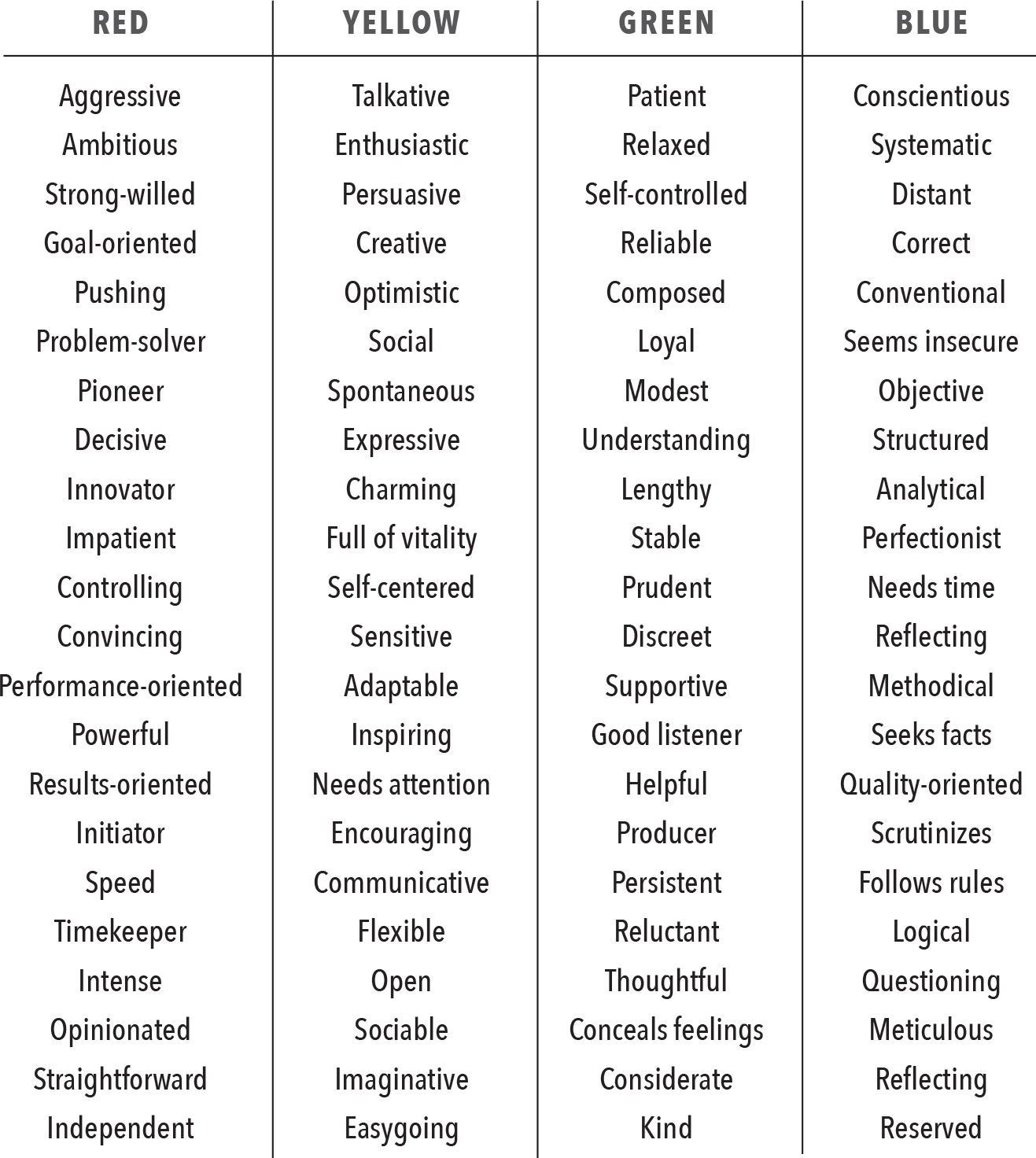
Many people you meet possess qualities that you sometimes wish you had—you may even feel jealous of these people. They easily master things that you struggle with. Maybe you’d like to be more decisive like Reds, or maybe you wish it were easier for you to interact with strangers, like Yellows. Possibly, you wish that you didn’t stress so much, that you could just take it easy like Greens do, and perhaps you wish that you could keep your schedule in better order, something that’s natural for Blues.
Naturally, it works the other way as well. You are going to read things that will help you realize that you too boss others around a bit too much, just like Reds tend to do. Or that you talk way too much, something that Yellows do. It might be that you take things way too easy, not getting involved in anything, the Greens’ weakness. Or you’re always suspicious of everything, seeing risks everywhere, just like Blues. Here you can learn to see your own pitfalls and how you can take appropriate measures to get around them.
No matter what you learn about yourself and others, take notes, underline things, and engage with the material.
4
Red Behavior
How to Recognize a Real Alpha and Avoid Getting in His Way
What should we do? We’ll do it my way. Now!
This is the behavior type that Hippocrates in his theory of human temperament called choleric. Nowadays you might call a Red person bold, ambitious, driven, but also potentially hot-tempered, rash, or dominant. You quickly notice a Red person because he doesn’t make the slightest effort to conceal who he is.
A Red person is a dynamic and driven individual. He has goals in life that others may find difficult to even imagine. Since his goals are so highly ambitious, achieving them seems to be impossible. Reds strive forward, always pushing themselves harder, and they almost never give up. Their belief in their own ability is unsurpassed. They carry inside them the firm belief that they can achieve anything—if they just work hard enough.
People who have lots of Red in their behavior are task-oriented extroverts and they enjoy challenges. They make quick decisions and are often comfortable taking the lead and taking risks. A common perception is that Reds are natural leaders. These are people who willingly take command and go to the fore. They are so driven that they will get through despite any obstacle in their path. Their disposition is ideal in competitive situations. It’s not unusual for a CEO or a president to have lots of Red in his behavior.
This form of competition is present in everything Reds do. To say that they constantly want to challenge and compete is probably not entirely true, but if a chance of winning something arises—why not? The exact nature of the competition is unimportant; it’s the competitive element that keeps Reds running on all cylinders.
Pelle, one of my former neighbors, liked competing so much that he developed entirely new interests just to compete. I like working in the garden, and so I spend quite some time doing so. Pelle didn’t like gardening, but when he had heard people commenting on my beautiful garden often enough he finally had enough. He started one project after another, always with a single but very clear objective: to outdo me. He confounded his wife by digging new flower beds, planting a rainbow of unbelievably fabulous plants, and cultivating the lawn to golf-course standard. The only thing I needed to do to keep him going was to merely suggest that I would purchase more plants. Then he would go to the local garden center quicker than you could say “bad loser.”
You can also recognize Reds by other behavior patterns. Who talks the loudest? Reds. Who goes all out when explaining something? Reds. Who’s always the first to answer a question? Reds again. Who, during an otherwise pleasant dinner, makes categorical comments on just about any topic? And who will judge an entire country based on something he saw on television? Reds!
Something is always happening in the lives of Red people. They can’t sit still. Idle time is wasted time. Life is short; better get going immediately. Do you recognize the type? Always on the go. So step aside; let’s get cracking!
When to use it
When a project needs quick decisions, discuss how a forceful style can help the team act and how to keep it from silencing relevant objections.
Competitive sales environment where closing deals is key
Starting a new business venture with high risk and ambition
In crisis management, assess a person’s judgment and experience alongside their willingness to act; assertiveness alone does not establish who should lead.
FROM THEORY TO EVERYDAY LIFE
In practice
Pelle the Competitive Gardener
Erikson describes his neighbor Pelle taking up gardening after hearing praise for Erikson’s garden. Pelle dug flower beds and improved his lawn in an effort to outdo him. The anecdote illustrates the competitiveness Erikson associates with Red behavior.
A MOMENT TO REFLECT
Put it to work.
Can you think of a situation where a Red person’s competitiveness helped achieve a goal?
How might a Red person's dominance be perceived by others in a team setting?
What are potential pitfalls of Red behavior in collaborative environments?
CONTINUE THE CONVERSATION
Source texts
- Surrounded By Idiots (Thomas Erikson)