Reconnaissance: mapping the future
Reconnaissance involves mapping out possible future scenarios and their probabilities before making decisions, similar to military intelligence-gathering or poker strategy, to improve decision quality and reduce surprise.
THE IDEA
Reconnaissance: mapping the future
Operation Overlord, the Allied forces operation to retake German-occupied France starting in Normandy, was the largest seaborne invasion in military history. It involved planning and logistics on an unprecedented scale. What if the forces were delayed at the start by bad weather? What if the airborne landing force had trouble communicating by radio due to the terrain? What if significant numbers of paratroopers were blown off course? What if currents interfered with the beach landings? What if the forces on the different beaches remained separated? Countless things could go wrong, with tens of thousands of lives at stake and, potentially, the outcome of the war.
All those things did go wrong, along with many other challenges encountered on D-Day and immediately thereafter. Preparation for potential problems helped the Normandy landings succeed despite those setbacks. Reconnaissance has been part of advance military planning for as long as horses have been used in battle. The modern military, of course, has evolved from sending scouts by horse and reporting back to the main forces to planes, drones, satellites, and other high-tech equipment gathering information about what to expect in battle.
The Navy SEAL team that killed Osama bin Laden gathered information about the compound and prepared for what they might encounter beyond its walls. What buildings were there? What was their layout and purpose? What differences might it make if they conducted the raid in different kinds of weather or different times of day? What other people would be present and what risks would they pose? What would they do if bin Laden wasn’t there? What was the team trying to commit to, given what they knew about each of those things (and, of course, numerous others)? Just as they relied on reconnaissance, we shouldn’t plan our future without doing advance work on the range of futures that could result from any given decision and the probabilities of those futures occurring.
For us to make better decisions, we need to perform reconnaissance on the future. If a decision is a bet on a particular future based on our beliefs, then before we place a bet we should consider in detail what those possible futures might look like. Any decision can result in a set of possible outcomes.
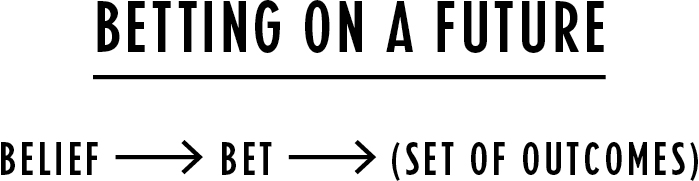
Thinking about what futures are contained in that set (which we do by putting memories together in a novel way to imagine how things might turn out) helps us figure out which decisions to make.
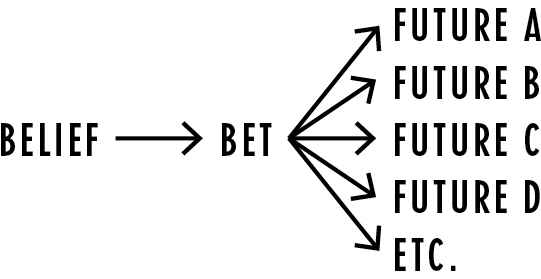
Figure out the possibilities, then take a stab at the probabilities. To start, we imagine the range of potential futures. This is also known as scenario planning. Nate Silver, who compiles and interprets data from the perspective of getting the best strategic use of it, frequently takes a scenario-planning approach. Instead of using data to make a particular conclusion, he sometimes takes the approach of discussing all the scenarios the data could support. In early February 2017, he described the merits of scenario planning: “When faced with highly uncertain conditions, military units and major corporations sometimes use an exercise called scenario planning. The idea is to consider a broad range of possibilities for how the future might unfold to help guide long-term planning and preparation.”
After identifying as many of the possible outcomes as we can, we want to make our best guess at the probability of each of those futures occurring. When I consult with enterprises on building decision trees and determining probabilities of different futures, people frequently resist having to make a guess at the probability of future events mainly because they feel like they can’t be certain of what the likelihood of any scenario is. But that’s the point.
The reason why we do reconnaissance is because we are uncertain. We don’t (and likely can’t) know how often things will turn out a certain way with exact precision. It’s not about approaching our future predictions from a point of perfection. It’s about acknowledging that we’re already making a prediction about the future every time we make a decision, so we’re better off if we make that explicit. If we’re worried about guessing, we’re already guessing. We are already guessing that the decision we execute will result in the highest likelihood of a good outcome given the options we have available to us. By at least trying to assign probabilities, we will naturally move away from the default of 0% or 100%, away from being sure it will turn out one way and not another. Moving away from unjustified certainty can expose assumptions, but a number is not more accurate just because we assign it. Even a wide range, like a chance between 20% and 80%, can help communicate how uncertain an estimate is, provided we explain its basis and revise it when evidence changes.
This kind of reconnaissance of the future is something that experienced poker players are very familiar with. Before making a bet, poker players consider each of their opponents’ possible responses (fold, call, raise), and the likelihood and desirability of each. They also think about what they will do in response (if some or all of the opponents don’t fold). Even if you don’t know much about poker, it should make sense that a player is better off considering these things before they bet. The more expert the player, the further into the future they plan. Before making that decision to bet, the expert player is anticipating what they’ll do following each response, as well as how the action they take now affects their future decisions on the hand. The best players think beyond the current hand into subsequent hands: how do the actions of this hand affect how they and their opponents make decisions on future hands? Poker players really live in this probabilistic world of, “What are the possible futures? What are the probabilities of those possible futures?” And they get very comfortable with the fact that they don’t know exactly because they can’t see their opponent’s cards.
This is true of most strategic thinking. Whether it involves sales strategies, business strategies, or courtroom strategies, the best strategists are considering a fuller range of possible scenarios, anticipating and considering the strategic responses to each, and so on deep into the decision tree.
This kind of scenario planning is a form of mental time travel we can do on our own. It works even better when we do it as part of a scenario-planning group, particularly one that is open-minded to dissent and diverse points of view. Diverse viewpoints allow for the identification of a wider variety of scenarios deeper into the tree, and for better estimates of their probability. In fact, if two people in the group are really far off on an estimate of the likelihood of an outcome, that is a great time to have them switch sides and argue the other’s position. The point is to examine the reasons for disagreement, not to assume the answer lies halfway between the estimates. One person may have considered a key factor the other missed, and tolerating dissent gives the group a chance to uncover it.
In addition to increasing decision quality, scouting various futures has numerous additional benefits. First, scenario planning reminds us that the future is inherently uncertain. By making that explicit in our decision-making process, we have a more realistic view of the world. Second, we are better prepared for how we are going to respond to different outcomes that might result from our initial decision. We can anticipate positive or negative developments and plan our strategy, rather than being reactive. Preparing responses can help even when events still surprise us. Scenario planning makes us nimbler because we’ve considered and are prepared for a wider variety of possible futures. And if our reconnaissance has identified situations where we are susceptible to irrationality, we can try to bind our hands with a Ulysses contract. Third, anticipating the range of outcomes also keeps us from unproductive regret (or undeserved euphoria) when a particular future happens. Finally, by mapping out the potential futures and probabilities, we are less likely to fall prey to resulting or hindsight bias, in which we gloss over the futures that did not occur and behave as if the one that did occur must have been inevitable, because we have recorded the alternatives we considered before the result was known.
When to use it
Planning a business strategy: identify market scenarios (e.g., competitor actions, regulatory changes) and assign probabilities to each.
Preparing for a job interview: anticipate different questions, interviewer reactions, and plan responses for each.
Making a major purchase: consider possible future scenarios (e.g., product performance, price changes, personal needs) and their likelihoods.
Designing a product launch: map out potential user adoption rates, technical issues, and competitive responses to decide on launch timing and features.
FROM THEORY TO EVERYDAY LIFE
In practice
Operation Overlord D-Day Preparations
The Allies planned for disruptions to the Normandy landings, including weather, communication failures, and paratroopers landing off course. The example shows how preparation can help people respond when a plan meets difficulties; it was one contributor to the operation’s success.
Operation Neptune Spear (bin Laden Raid)
The raid on bin Laden’s compound illustrates reconnaissance and contingency planning: gather information about the layout and likely occupants, then prepare for conditions that could differ from expectations. Reconnaissance reduces uncertainty without removing it.
Poker Player Decision-Making
Expert poker players consider opponents' possible responses (fold, call, raise) and their likelihoods before betting, and they anticipate future hands. This probabilistic thinking improves their long-term results.
A MOMENT TO REFLECT
Put it to work.
What are the possible outcomes of a decision I'm currently facing, and what are their probabilities?
How can I anticipate and prepare for multiple scenarios in my project or plan?
Looking back at a decision, which alternative outcomes did you consider in advance? How did that preparation affect your response to what happened?
Often confused with
References
- Scenario planning quote — Nate Silver (2017)
CONTINUE THE CONVERSATION
Source texts
- Thinking in Bets Making Smarter Decisions When You Dont Have All the Facts (Annie Duke)