R2A2 (Roles, Responsibilities, Accountabilities, Authorities)
Unclear R2A2 (Roles, Responsibilities, Accountabilities, Authorities) is a common root cause of organizational failures, leading to gaps and overlaps that create conditions for significant setbacks and problems.
THE IDEA
Surely It Was Someone Else's Job?
Even when organisations define senior leadership roles, the practical division of roles, responsibilities, accountabilities and authorities (R2A2) can remain unclear. That ambiguity can contribute to failures. Illustration 6.1 sums up the challenge.8
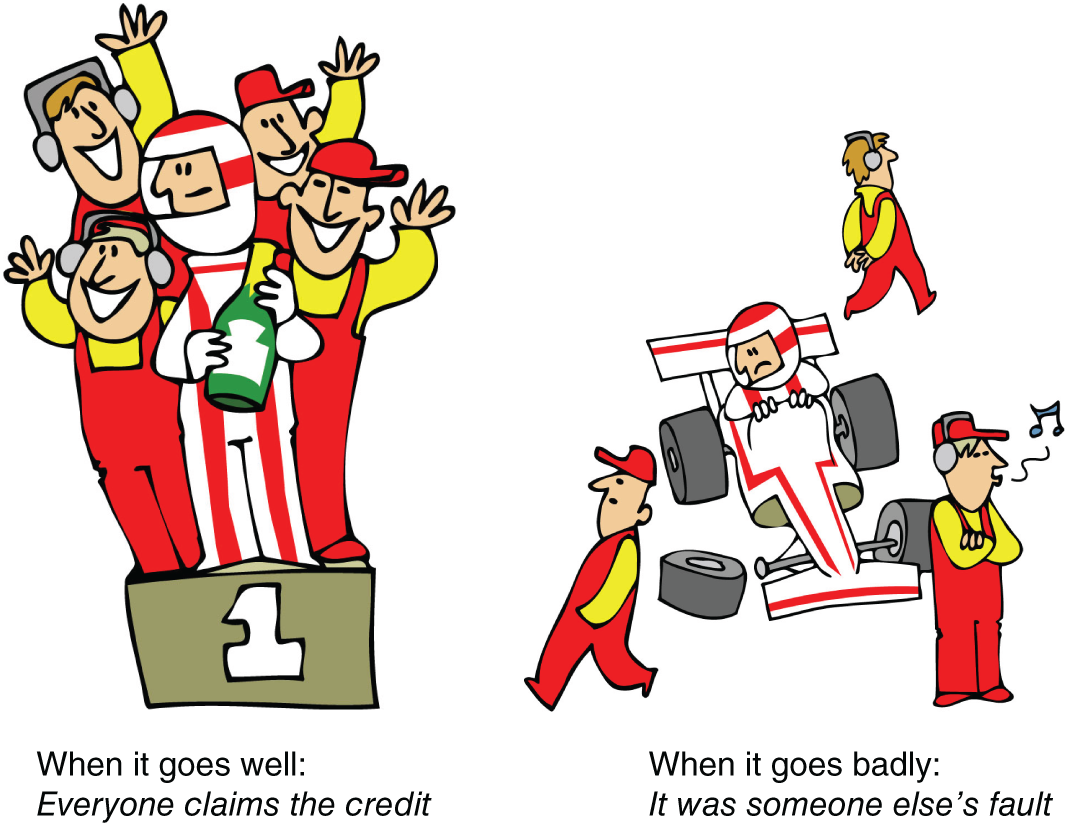
Illustration 6.1 Accountability
Here are some examples of problems that I have seen, where unclear R2A2 has featured:
- A cyber security breach occurs because a business system owner and their local IT support did not execute the latest software update.
The central IT department blames the system owner, but the system owner explains that the software upgrade had been scheduled for later in the month because they were in the process of making other changes to the system that customers had asked for and they didn't want to do anything to interfere with that upgrade. They felt they had the authority to make a pragmatic decision to delay the security upgrade for a few weeks, whereas the central IT department did not. 2. In a large business project for a new line of business, a considerable cost overspend arose that wiped out all the hoped‐for profit of the venture.
A review found that three finance managers had been involved, but their oversight was poorly coordinated. Each finance lead assumed someone else was looking at expenditure commitments being made by various business managers. They said they had got an incomplete understanding of everything that was happening in the business while they were often busy with other matters.
On the other hand, the business managers explained that they were working ‘flat out’ to deliver the project to a timeline, and they didn't have the time to keep track of everything they had discussed and check all the paperwork they had received. They assumed colleagues in legal and finance were keeping track of things. 3. A warehouse has a fire, and stock is damaged because of a lack of sprinklers in a new section of the warehouse.
A health and safety audit before the fire recommended sprinklers should be installed in a new section of the warehouse. However, the warehouse manager said the installation of sprinklers would need to wait until funds were available in the next year.
The head of health and safety explained, ‘I did my best to raise the issue, but I have no authority to make the logistics director and warehouse manager install fire sprinklers since that was a business decision’.
The logistics director and warehouse managers said, ‘If health and safety were not happy with our plan to do it in a year, they should have told us and escalated their concerns upwards so that we could get funding sooner, with their help’. 4. As part of a regional expansion project, a new production plant is built but cannot be used for exports until a crucial approval is obtained (which comes many months later than planned).
The project takes several years; land is acquired, a building contractor is engaged, various permissions are granted to build the facility and get authorisations to produce products (involving an overseas lawyer), etc.
Millions of pounds were spent, and the plant started the commissioning phase to go ‘online’ in the region. As detailed logistics planning begins, it becomes clear that no export licence has yet been issued from the authorities, which is essential if it is going to be used as a regional supply centre.
So, fingers start pointing: Can we get a licence to export in time? Who chose the external lawyer? Who should have supervised what they were doing? How long should we have waited for the ‘pending’ approval before escalating the matter?
There were arguments between various business managers and within the legal function (in the headquarters, regionally and locally). 5. An Internal audit team examines an area and only finds a few minor problems. But six months later, there was a serious fraud.
Senior management and the Audit Committee ask the Chief Audit Executive (CAE): ‘Where were you? You said that area was mostly fine, and now we have a fraud!’ The CAE replies: ‘We did a high‐level review of the area and found some problems, but it would have taken a lot more time and effort to dig into details to find the fraud’. As the discussion ensued, the CAE explained: ‘Anyway, it's not the role of internal audit to provide absolute assurance on everything, we only provide “reasonable assurance”. The procurement and finance departments should have stopped the fraud, not internal audit’.9
I trust the pattern is clear; on the ground, it's easy to encounter situations where roles and responsibilities, etc., are unclear. And for months or years, this may not matter. But R2A2 gaps and overlaps can lie around like landmines, creating the conditions for significant setbacks and problems later when the question of exactly who does what will matter.10
When to use it
Setting up a new cross-functional project team to ensure everyone knows their role and decision-making authority.
Reviewing security incident responses to identify gaps between IT and business owners.
Planning a large capital investment with multiple approval stages to avoid delays from missing permits or licences.
Conducting a post-mortem on a failed initiative to uncover hidden accountability overlaps.
FROM THEORY TO EVERYDAY LIFE
In practice
Cyber security breach due to delayed software update
A system owner delays a security update to avoid interfering with customer-requested changes. After a breach, central IT disputes the owner’s authority to make that tradeoff. The incident exposes an unresolved question about who can accept the risk of delaying an update.
Cost overspend from uncoordinated finance oversight
In a large business project for a new line of business, a considerable cost overspend arose that wiped out all the hoped‐for profit of the venture. A review established that rather than insufficient finance oversight, three finance managers were involved but their efforts were not 'joined up'. Each finance lead assumed someone else was looking at expenditure commitments. Business managers assumed legal and finance were keeping track.
Warehouse fire due to lack of sprinkler installation authority
A fire damages stock in a warehouse section without sprinklers. Health and safety had recommended installation, but the warehouse manager delayed it for lack of funds. Health and safety said it lacked authority to enforce installation; logistics management said the concern should have been escalated. The disagreement exposes uncertainty about who could require action and who should seek funding.
New plant unusable for exports due to missing export licence
As part of a regional expansion project, a new production plant is built but cannot be used for exports until a crucial approval is obtained, which comes many months later than planned. Arguments erupt over who chose the external lawyer, who should have supervised them, and when to escalate the pending approval.
Internal audit misses fraud due to limited scope
An Internal audit team examines an area and only finds a few minor problems. Six months later, a serious fraud occurs. The Chief Audit Executive defends the audit by saying it provided only reasonable assurance and that procurement and finance departments should have stopped the fraud.
A MOMENT TO REFLECT
Put it to work.
In your current project or team, are there any areas where R2A2 is unclear? How could you identify and resolve these gaps?
Think of a recent organizational failure or near-miss. Was unclear R2A2 a contributing factor? How could clearer accountabilities have changed the outcome?
How can you proactively clarify accountabilities and authorities in your own role to prevent future problems?
CONTINUE THE CONVERSATION
Source texts
- Beyond the Five Whys Root Cause Analysis and Systems Thinking (James C. Paterson)