Questioning Concepts
Concepts are mental categories that shape our understanding and expectations. Questioning concepts involves analyzing and clarifying the ideas we use to define situations and events.
THE IDEA
Questioning Concepts
Concepts are ideas we use in thinking. They enable us to group things in our experience in different categories, classes, or divisions. They are the basis of the labels we give things in our minds. They represent our mental map of the world telling us how things operate and what to expect of them. Through our concepts we define situations, events, relationships, and objects of our experience. Very important issues depend on how we conceptualize things. For example, if we conceptualize “animals” as having no rights, we may not consider it a matter of ethics when they are made to suffer pain. We may take them to be nothing more than “our property,” to destroy or maintain as we please. Yet we have the concept of “humane treatment” of animals. What concepts or ideas does it depend upon? What does it presuppose? What does it imply? These are conceptual questions.
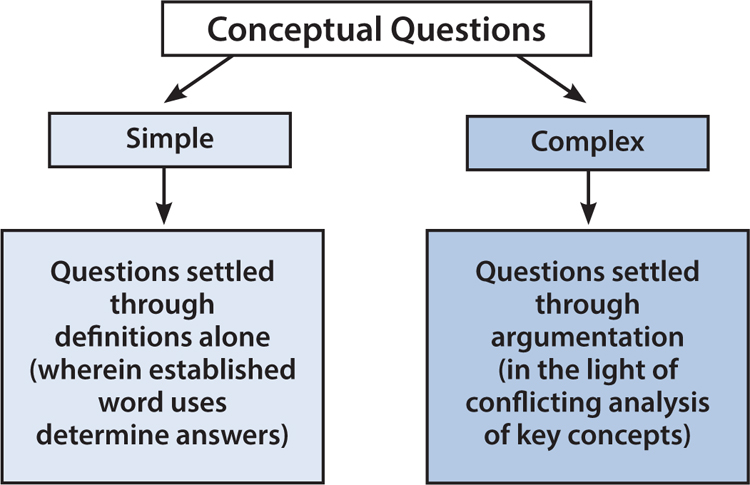
Conceptual questions are questions settled through analysis of and/or clarification of one or more concepts within a question. Conceptual questions can be divided into at least two categories: simple and complex.
When to use it
In a business negotiation, questioning the concept of 'value' can lead to better outcomes.
In education, questioning the concept of 'learning' can improve teaching methods.
In personal relationships, questioning the concept of 'respect' can resolve conflicts.
In public policy, questioning the concept of 'privacy' can influence legislation.
FROM THEORY TO EVERYDAY LIFE
In practice
Animals and Rights
If we conceptualize animals as having no rights, we may not consider their suffering an ethical issue. The concept of 'humane treatment' of animals raises questions about what concepts it depends upon, what it presupposes, and what it implies.
A MOMENT TO REFLECT
Put it to work.
Think of a concept you use daily. What assumptions does it carry? How does it affect your decisions?
Consider a debate you've had. What underlying concepts were being argued?
How might changing a concept change a situation or your perspective?
CONTINUE THE CONVERSATION
Source texts
- The Art of Asking Essential Questions Based on Critical Thinking Concepts and Socratic Principles (Linda Elder, Richard Paul)