Proportion Dominance
Proportion dominance refers to the tendency for judgments to be heavily influenced by proportions or probabilities rather than absolute quantities, because proportions are more evaluable due to their clear bounds (0 to 1). This bias affects decisions in gambling, lifesaving interventions, and consumer choices.
THE IDEA
Proportion Dominance
Proportions and probabilities can be easier to evaluate than an isolated amount because their bounds provide a reference point. They can therefore carry considerable weight in a judgment. At Chris Hsee’s suggestion (personal communication), we call this effect proportion dominance.
Proportion (or probability) dominance was evident in the studies of gambles discussed here. Ratings of a gamble’s attractiveness tend to be determined far more strongly by the probabilities of winning and losing than by the monetary payoffs. The curious finding that adding a small loss to a gamble increases its rated attractiveness, explained originally as a compatibility effect, can now be seen to fit well with the notions of affective mapping and evaluability.
According to this view, a probability maps relatively precisely onto the attractiveness scale because probability has a lower and upper bound (0 and 1) and a midpoint below which a probability is “poor” or “bad” (i.e., has worse than an even chance) and above which it is “good” (i.e., has a better than even chance). People know where a given value, such as 7/36, falls within the bounds, and exactly what it means – “I’m probably not going to win.” In contrast, the mapping of a dollar outcome (e.g., $9) onto the attractiveness scale is diffuse, reflecting a failure to know how good or bad or how attractive or unattractive $9 is. Thus, the impression formed by the gamble offering $9 to win with no losing payoff is dominated by the relatively precise and unattractive impression produced by the 7/36 probability of winning. However, adding a very small loss to the payoff dimension brings the $9 payoff into focus and thus gives it meaning. The combination of a possible $9 gain and a 5¢ loss is a very attractive win/loss ratio, leading to a relatively precise mapping onto the upper end of the scale. Whereas the imprecise mapping of the $9 carries little weight in the averaging process, the more precise and now favorable impression of ($9, −5¢) carries more weight, thus leading to an increase in the overall favorability of the gamble.
The effect of adding a small loss to the gamble can also be explained by norm theory (Kahneman & Miller, 1986; Kahneman & Miller, Chapter 20, this volume). However, a norm-theoretical explanation is consistent with an affective account. It asserts that the gamble with no loss is a relatively mediocre representative of the set of all positive gambles, whereas the gamble with a small loss is a relatively attractive member of the class of mixed (win/loss) gambles.
Proportion dominance surfaces in a powerful way in a very different context, the life-saving interventions studied by Fetherstonhaugh, Slovic, Johnson, and Friedrich (1997), Baron (1997), Jenni and Loewenstein (1997), and Friedrich et al. (1999). For example, Fetherstonhaugh et al. found that people’s willingness to intervene to save a stated number of lives was determined more by the proportion of lives saved than by the actual number of lives that would be saved. However, when two or more interventions were directly compared, number of lives saved became more important than proportion saved. Thus, number of lives saved, standing alone, appears to be poorly evaluable. With a side-by-side comparison, the number of lives became clearly evaluable and important.
Slovic (unpublished), drawing on proportion dominance and the limited evaluability of numbers of lives, predicted (and found) that people, in a between-groups design, would more strongly support an airport-safety measure expected to save 98% of 150 lives at risk than a measure expected to save 150 lives. Saving 150 lives is diffusely good, and therefore only weakly evaluable, whereas saving 98% of something is clearly very good because it is so close to the upper bound on the percentage scale, and hence is readily evaluable and highly weighted in the support judgment. Subsequent reduction of the percentage of 150 lives that would be saved to 95%, 90%, and 85% led to reduced support for the safety measure but each of these percentage conditions still garnered a higher mean level of support than did the Save 150 Lives Condition (Table 23.4).
Table 23.4. Proportion Dominance and Airport Safety: Saving a Percentage of 150 Lives Receives Higher Support Ratings Than Does Saving 150 Lives.
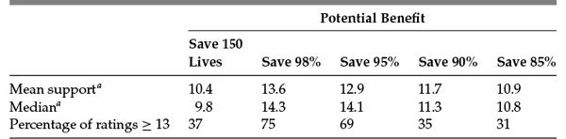
a Cell entries in these rows describe mean and median responses to the question, “How much would you support this proposed measure to purchase the new equipment?” (Critics argue that the money spent on this system could be better spent enhancing other aspects of airport safety.) The response scale ranged from 0 (would not support at all) to 20 (very strong support). An overall ANOVA resulted in F4,200 = 3.36, p = .01. The Save 98% and Save 95% conditions were both significantly different from the Save 150 Lives condition at p *< .*05, Tukey HSD test.
Turning to a more mundane form of proportion dominance, Hsee (1998) found that an overfilled ice cream container with 7 oz of ice cream was valued more highly (measured by willingness to pay) than an underfilled container with 8 oz of ice cream (Fig. 23.1). This “less is better effect” reversed itself when the options were juxtaposed and evaluated together. Thus, the proportion of the serving cup that was filled appeared to be more evaluable (in separate judgments) than the absolute amount of ice cream.
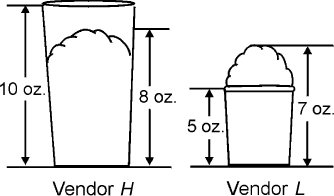
Figure 23.1. Stimuli in ice cream study by Hsee (1998). Participants were given the sizes of the cups and the amounts of ice cream.
When to use it
Assessing a vaccination campaign by comparing coverage rates with the numbers reached and the intended health outcome.
Choosing between two products: a filled-to-the-top container with less product versus a partially filled container with more product.
Comparing safety proposals using both the proportion of people protected and the number of lives expected to be saved.
When comparing job offers, the percentage increase in salary might be more impactful than the actual dollar difference.
FROM THEORY TO EVERYDAY LIFE
In practice
Gamble with Small Loss
With the chance of winning held fixed, a gamble offering a $9 gain and a 5¢ loss was rated more attractive than one offering a $9 gain or nothing. The authors explain that comparing the gain with a small loss made the payoff easier to evaluate.
Airport Safety Measures
In a study, an airport-safety measure expected to save 98% of 150 lives received higher support than a measure expected to save 150 lives outright. The percentage format made the benefit highly evaluable.
Ice Cream Portions
Hsee (1998) found that participants valued an overfilled cup with 7 oz of ice cream more than an underfilled cup with 8 oz when evaluated separately, due to the proportion of the cup filled being more evaluable than absolute amount.
A MOMENT TO REFLECT
Put it to work.
How might proportion dominance affect your evaluation of investment returns presented as percentages versus absolute dollar amounts?
Assume costs and other effects are equal. A measure saves 90% of 100 patients, while another saves 100 patients. How does expressing both benefits as numbers of lives change the comparison?
Think of a time you were swayed by a percentage rather than the actual number. How did that influence your decision?
References
- Norm theory: Comparing reality to its alternatives — Kahneman, D., & Miller, D. T. (1986)
- Insensitivity to the value of human life: A study of psychophysical numbing — Fetherstonhaugh, D., Slovic, P., Johnson, S., & Friedrich, J. (1997)
- Confusion of relative and absolute risk in valuation — Baron, J. (1997)
- Explaining the 'identifiable victim effect' — Jenni, K. E., & Loewenstein, G. (1997)
- Psychophysical numbing: When lives are valued less as the number at risk increases — Friedrich, J., Barnes, P., Chapin, K., Dawson, I., Garst, V., & Kerr, D. (1999)
- Less is better: When low-value options are valued more highly than high-value options — Hsee, C. K. (1998)
- Slovic, P. (unpublished). Airport safety study. — Slovic, P.
CONTINUE THE CONVERSATION
Source texts
- Heuristics and Biases The Psychology of Intuitive Judgment (Thomas Gilovich, Dale Griffin, Daniel Kahneman)