Project Portfolio Matrix
A 2x2 matrix to classify projects by cost and time (or other parameters like learning and vision alignment) to maintain an overview and decide which to pursue, delegate, or reject.
THE IDEA
THE PROJECT PORTFOLIO MATRIX
HOW TO MAINTAIN AN OVERVIEW
Are you juggling several projects simultaneously? Then you are a “slasher” (/). The term was coined by the New York author Marci Alboher and describes people who cannot give a single answer to the question “And what do you do for a living?”
Suppose you are a teacher/musician/web designer. The variety may be appealing, but how can you balance all these projects? And how do you ensure a regular income?
To get an overview, you can classify your current projects, both work-related and private, with the help of the project portfolio matrix according to cost and time (see model on pp. 18–19). Think of costs not only in terms of money but also in terms of resources such as friends involved, energy and psychological stress.
Cost and time are just two examples. You can use whatever parameters are relevant to your situation: for example, the x-axis could be “How much my project is helping me achieve my overriding objective,” and the y-axis “How much I am learning from this project.” Now position your projects in the matrix in relation to the two axes “objectives achieved” and “amount learned.”
HOW TO INTERPRET THE RESULTS
• Reject projects if there is nothing you can learn from them and if they do not correspond to your overriding vision.
• Projects that you can learn from but do not correspond to your vision are interesting but will not help you achieve your objective. Try to change the project so that it serves your vision.
• If a project corresponds to your vision, but you are learning nothing new, look for somebody else to do it for you.
• If you are learning something and achieving your vision, you have hit the jackpot!
Make sure you complete your projects properly. Even those that aren’t successful.
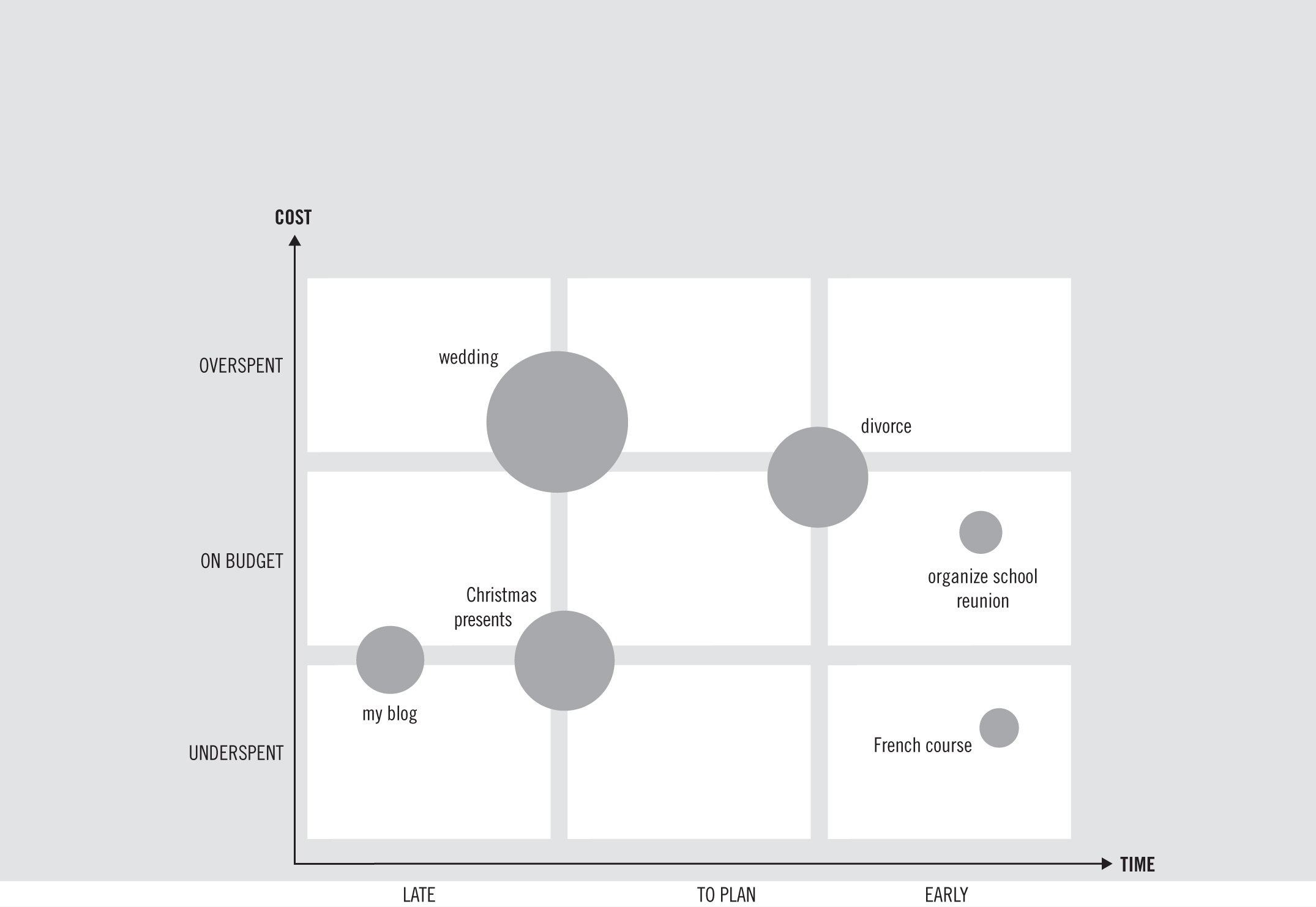
Arrange your current projects in the matrix: are you on budget and on time?
When to use it
A freelancer balancing multiple gigs to decide which to prioritize or drop.
A manager evaluating a department’s project portfolio to align with company strategy.
An entrepreneur assessing new business ideas against personal learning and vision.
A student choosing extracurricular activities based on time investment and career relevance.
FROM THEORY TO EVERYDAY LIFE
In practice
Teacher/Musician/Web Designer
A teacher/musician/web designer compares projects on learning and alignment with long-term goals. Music work offers learning but needs a clearer connection to those goals. A familiar web-design assignment fits the goals but teaches little, so the person considers delegating parts of it. The ratings make those tradeoffs explicit before a decision.
Corporate Project Portfolio Review
A project manager plots initiatives by expected profit and strategic fit. Low ratings on both axes prompt a review of whether to stop a project. High strategic fit but low expected profit prompts a discussion of whether its other benefits justify the cost. The matrix organizes the review; the team still needs reasons for each funding decision.
A MOMENT TO REFLECT
Put it to work.
What parameters other than cost and time could you use to evaluate your current projects?
List your current projects and plot them on the matrix. Which quadrant has the majority? What does that tell you about your focus?
How can you modify a project that is learning-rich but not aligned with your vision to better serve your overarching goals?
CONTINUE THE CONVERSATION
Source texts
- The Decision Book Fifty Models for Strategic Thinking