Privilege
Privilege is analyzed as a hierarchy of intersecting attributes (e.g., rich, white, male), revealing a tension between the number of privilege types a person holds and their absolute societal advantage. This tension helps explain animosity between groups. Discussions of disadvantage need to account for context.
THE IDEA
PRIVILEGE
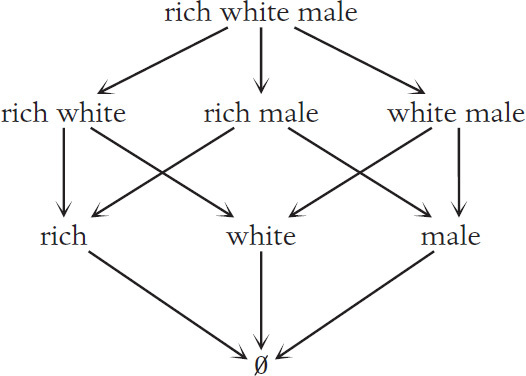
Consider three types of privilege: rich, white and male. Then, following the previous diagram of subsets, we get this diagram of relationships:
We can now add back in the full descriptions, for emphasis: contrasting male with non-male, white with non-white, and (for concision) rich with poor. We get the following picture:
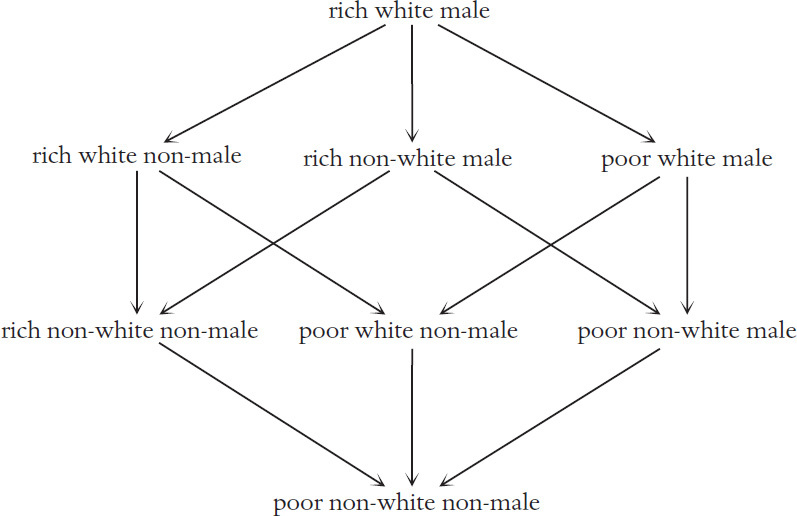
The first thing to observe is that this is a hierarchy where the layers show the number of types of privilege, rather than the actual amount of privilege. Thus of the types of privilege in question, the people in the top row have all three, the people in the next row down have two, the people in the next row down have just one, and those at the bottom have none.
Another thing to note is that the arrows show a direct loss of a type of privilege, with each direction representing one type of privilege. So the vertical arrows indicate the loss of privilege moving from white people to non-white people who have the same other attributes. This is an important aspect of privilege: it doesn’t mean that all white people are more privileged than all non-white people, as can be seen from the fact that rich non-white males are, in this diagram, higher up than poor white non-males. Indeed, as we discussed in Chapter 4, some people point to the existence of super-rich black sports stars in the US and claim that this shows that “white privilege doesn’t exist”. However, the notion of white privilege doesn’t mean that anyone is claiming that those super-rich sports stars are worse off than poor white homeless women. It just means that if those sports stars had all the same success but were also white, we’d expect them to have even higher status in society. This is also relevant to our previous example of police brutality against black people. Some people argue that the tragic deaths occur because the victim was doing something wrong, not because they were black. But if white people doing the same thing (or worse things) are not shot, then it is evidence of white privilege at play: where outcomes are improved if all circumstances are the same except for the person being white instead of black.
There is more we can learn from this diagram. Just as in the factors of 42, there is a tension between the hierarchy in this diagram and the hierarchy of absolute amounts of privilege. If we examine the second row in the diagram we might notice that the three groups of people on that second row do not have equal status in society. Many people would argue that rich white women have higher status than rich black men, for example, and that rich black men in turn are better off in society than poor white men (not just in terms of wealth). It turns out that money goes a long way towards mitigating other problems. Also, although women still suffer disadvantages compared with men, white women were granted some status in society long before black people, certainly in the US, and that history has left an ongoing legacy on society.
Anyway it is not our purpose to examine the historical causes of inequality, but to look at the logic of the situation. We could skew the diagram to show that the three groups in the second row are not level, and likewise the third row. But we can take this further. Instead of just comparing absolute privilege within each row, we can even compare between the rows. Arguably, wealth can outweigh being non-white and being non-male. If we think about rich black women, for example, we might well conclude that they are probably better off than poor white men. Consider Oprah Winfrey or Michelle Obama, for some extreme examples, and compare them with poor white unemployed men. So, in fact, the diagram is even more skewed, like this perhaps:
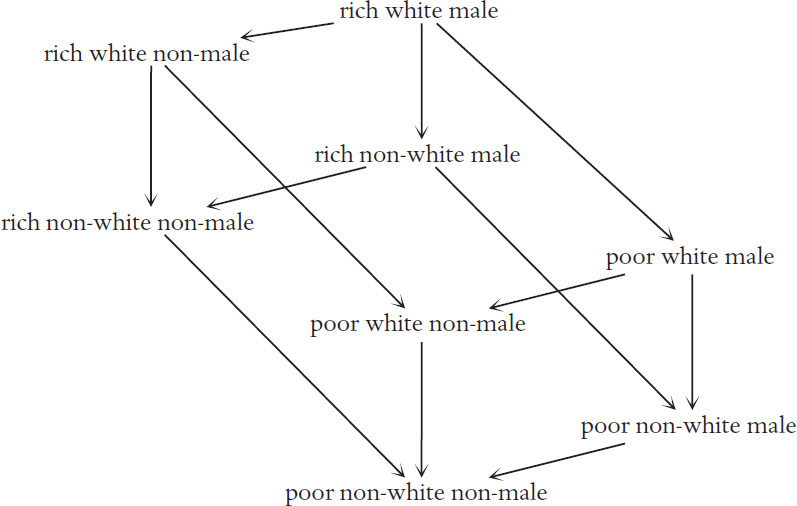
This diagram shows the tension between two different ways of measuring relative privilege: the number of types of privilege, which is shown by the arrows, and the absolute amount of overall privilege, which is shown by the height on the page. The disagreement between these two points of view causes animosity. In particular, this provides a logic-based account of why some poor white men are so angry in the current socio-political climate – because they are considered to be privileged from the point of view of number of types of privilege (white and male), but they are in reality less advantaged than many people who count as having fewer types of privilege than them. Understanding the root of this complaint is more productive than simply being angry with them in return. The same is true for other underprivileged groups within white men: any who are not rich, cis, straight, able-bodied, and any other types of privilege we can think of.
Diagrams of inter-relationships also help us to focus on the context we’re thinking about, and in doing so, can help us switch context and be clear of how switching context affects inter-relationships. For example, instead of considering “rich, white, male” as three attributes, we could change our context to women, and consider “rich, white, cis” as three types of privilege. Leaving aside questions of absolute privilege for the moment, this produces an analogous cube of privilege as shown:
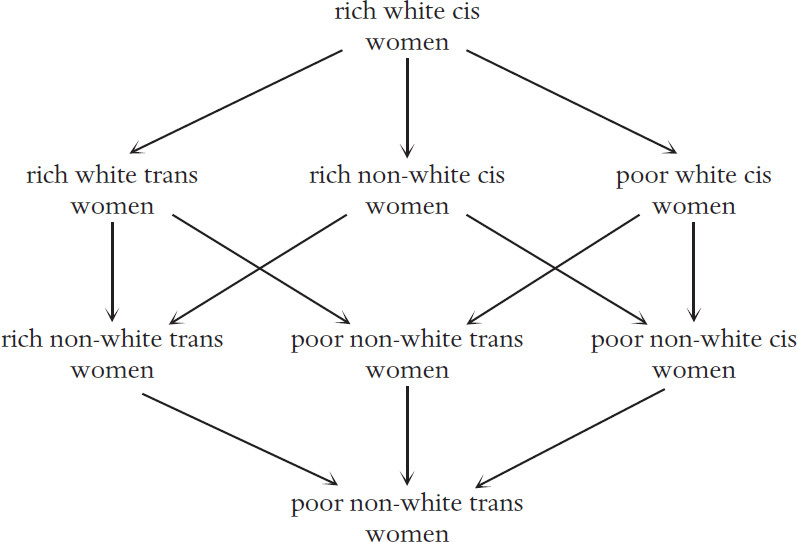
Here we see that rich white cis women now occupy the top position, analogous to rich white men in the previous cube of privilege. This helps us understand why there is a lot of anger towards rich white cis women, among women activitists who feel excluded by mainstream feminism. Rich white cis women may perceive themselves as being underprivileged, especially if they mostly inhabit a world that consists entirely of rich white people. At the same time they are viewed as maximally privileged in the context of women, or feminism.
These questions can become an argument about whether women standing together in unity amounts to erasing the experiences of the most disadvantaged women. From the other point of view, it can become an argument about whether taking into account the greater disadvantages of some women amounts to women fighting each other rather than the true opposition.
Category theory tells us it is always important to be clear what context we’re thinking about. Everyone is privileged relative to some contexts and underprivileged relative to some others. Animosity tends to occur when someone is prone to thinking of themelves in a context that makes them underprivileged (a “victim”) while others tend to view them in a context that makes them overprivileged. We need to find ways to attribute one type of privilege to someone without invalidating their feeling of disadvantage with respect to another type, as that invalidation causes anger, animosity, divisiveness and resistance to change. Rather, this possibility of flipping context should be put to productive ends. We will discuss this in more depth in Chapter 13 on analogies. If we all become more adept at seeing things from both a privileged and a non-privileged point of view, we will achieve greater understanding of disadvantaged people’s struggles but also of the actions, whether malicious or ignorant, that cause bigotry and oppression.
1 The symbol  is a standard one for the empty set. There are technical reasons that 1 is considered to be the “product of no prime factors”.
When to use it
Analyzing social hierarchies in a workplace to understand why certain groups may feel marginalized despite having some privileges.
Facilitating discussions on privilege in a diversity training session by acknowledging that everyone has some privilege in certain contexts.
Resolving conflicts in activist groups (e.g., within feminism) where members feel their specific disadvantages are overlooked by more privileged members.
FROM THEORY TO EVERYDAY LIFE
In practice
Super-rich black sports stars vs. poor white homeless women
Some claim super-rich black sports stars disprove white privilege, but the concept of white privilege means that if those sports stars were also white, they would likely have even higher societal status, not that they are worse off than poor white people.
Police brutality and race
When black people are shot by police for actions that white people committing similar or worse actions are not shot for, this is evidence of white privilege: equal circumstances except for race lead to worse outcomes for black individuals.
Oprah Winfrey and Michelle Obama vs. poor white unemployed men
Rich black women like Oprah or Michelle Obama are likely better off than poor white men, illustrating that wealth can outweigh other disadvantages and create tension between different measures of privilege.
A MOMENT TO REFLECT
Put it to work.
Think of a situation where you or someone you know might be seen as privileged in one context but underprivileged in another. How does that affect interactions?
How can understanding the tension between number of privilege types and absolute privilege help reduce animosity between groups?
When discussing privilege, why is it important to specify the context (e.g., within feminism, within society as a whole)?
CONTINUE THE CONVERSATION
Source texts
- The Art of Logic How to Make Sense in a World that Doesn’t (Eugenia Cheng)