Principle of Probabilistic Sustainability
Taleb’s principle evaluates a risk as if it would be repeated at a specified frequency over the unit’s remaining lifespan. With a fixed positive independent ruin probability, cumulative ruin risk approaches 1 as the number of exposures grows without bound; a finite horizon requires its own assessment.
THE IDEA
Adaptation of Theorem 1 to Brownian Motion
The simplified model referred to here is not included. Taleb argues that its implications extend to richer models, such as a stochastic process subjected to an absorbing barrier. And of course in a natural setting the eradication of all previous life can happen (i.e., X t can take extreme negative value), not just a stopping condition. The Peters and Gell-Mann argument also cancels the so-called equity premium puzzle if you add fat tails (hence outcomes vastly more severe pushing some level equivalent to ruin) and absence of the fungibility of temporal and ensemble. There is no puzzle.
The problem is invariant in real life if one uses a Brownian-motion-style stochastic process subjected to an absorbing barrier. In place of the simplified representation we would have, for a process subjected to L, an absorbing barrier from below, in the arithmetic version:

or, for a geometric process:

where Z is a random variable.
Going to continuous time, and considering the geometric case, let  be the stopping time. The idea is to have the simple expectation of the stopping time match the remaining lifespan—or remain in the same order.
We switched the focus from probability to the mismatch between stopping time T for ruin and the remaining lifespan.
C. PRINCIPLE OF PROBABILISTIC SUSTAINABILITY
Principle: A unit needs to take any risk as if it were going to take it repeatedly—at a specified frequency—over its remaining lifespan.
The principle of sustainability is necessary for the following argument. While experiments are static (we saw the confusion between the state-space and the temporal), life is continuous. If you incur a tiny probability of ruin as a “one-off” risk, survive it, then do it again (another “one-off” deal), the probability of eventual ruin approaches 1 under a model with a fixed positive independent chance of ruin on each exposure, continued without bound. Confusion arises because it may seem that the “one-off” risk is reasonable, but that also means that an additional one is reasonable. (See Figure 9). The good news is that some classes of risk can be deemed to be practically of probability zero: the earth survived trillions of natural variations daily over three billion years, otherwise we would not be here. We can use conditional probability arguments (adjusting for the survivorship bias) to back-out the ruin probability in a system.
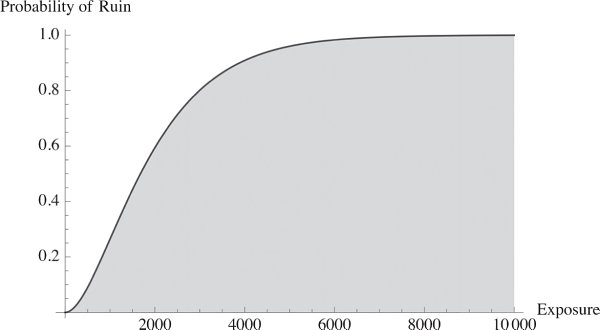
FIGURE 9. Why ruin is not a renewable resource. No matter how small the probability, in time, something bound to hit the ruin barrier is about guaranteed to hit it. No risk should be considered a “one-off” event.
Now, we do not have to take  nor is permanent sustainability necessary. We can just extend shelf time. The longer the t, the more the expectation operators diverge.
Consider the unconditional expected stopping time to ruin in a discrete and simplified model:  where
 is the number of exposures per time period, T is the overall remaining lifespan, and p is the ruin probability, both over that same time period for fixing p. Since
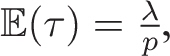 we can calibrate the risk under repetition. The longer the life expectancy T (expressed in time periods), the more serious the ruin problem. Humans and plants have a short shelf life, nature doesn’t—at least for t of the order of 108 years—hence annual ruin probabilities of O(10−8) and (for tighter increments) local ruin probabilities of at most O(10−50). The higher up in the hierarchy individual-species-ecosystem, the more serious the ruin problem. This duality hinges on ; hence requirement is not necessary for items that are not permanent, that have a finite shelf life.
The fat tails argument: The more a system is capable of delivering large deviations, the worse the ruin problem.
The variance of the process matters, but for ruin the critical question is whether a deviation crosses the absorbing threshold.
When to use it
Investment strategies with tail risk that can lead to ruin if repeated over long horizons.
Insurance companies pricing policies for rare but catastrophic events, considering the cumulative risk over many policies.
Space exploration missions where the probability of failure per launch is low but repeated launches increase overall risk of mission failure.
When considering a repeated personal risk, assess cumulative exposure over the relevant period instead of evaluating each occasion in isolation.
FROM THEORY TO EVERYDAY LIFE
In practice
Repeated Gambling
A gambler takes independent bets, each with a fixed 1% chance of total ruin. As the number of bets increases without bound, the cumulative probability of ruin approaches 1. Over a finite series, the risk depends on how many bets are made.
Corporate Risk Taking
A company assesses a project’s chance of catastrophic failure, then considers how often it expects to take comparable risks. The accumulated exposure can be much greater than the risk of one project; its size depends on the horizon and the dependence between failures.
A MOMENT TO REFLECT
Put it to work.
How does your organization assess long-term risks in light of repeated exposure?
Consider a risk you take daily; what is the cumulative probability of ruin over your lifetime?
Why is it misleading to evaluate a risk as a 'one-off' event when you plan to engage in it multiple times?
CONTINUE THE CONVERSATION
Source texts
- Skin In The Game Hidden Asymmetries In Daily Life (Nassim Nicholas Taleb)