Present Bias and Hyperbolic Discounting
Present bias gives immediate rewards extra weight relative to future benefits. Hyperbolic discounting describes a related pattern: the discount rate declines as the delay grows. Specific commitments and useful defaults can help people follow through on long-term goals.
THE IDEA
GET OUT OF YOUR OWN WAY
Gabriel Weinberg and Lauren McCann discuss procrastination and project decisions in this excerpt from Super Thinking.
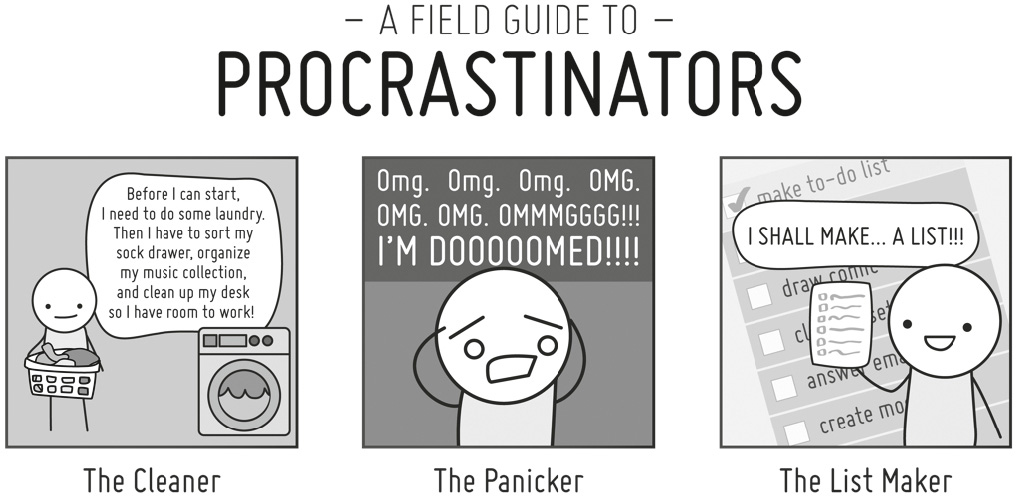
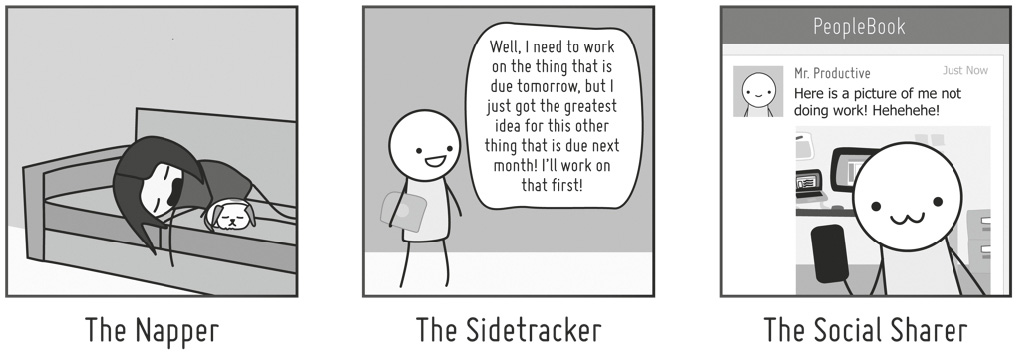
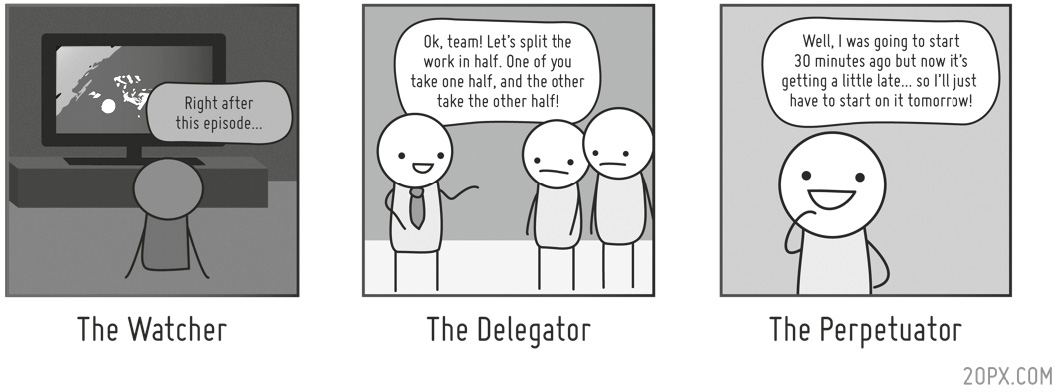
Applying leverage and related mental models will help you spend time on the right activities. The next step is getting those activities done in a timely manner. The path to doing this is fraught with traps. The first trap: procrastination.
Our kids are expert procrastinators, and if this is a genetically transferred trait, Lauren must take responsibility. Around the time we first met in 1999, Gabriel wrote an article in The Tech, MIT’s student newspaper, recommending that everyone stop procrastinating. While Lauren was not an expert procrastinator, she typically finished Friday’s problem sets sometime late Thursday night. Gabriel was the only person Lauren knew at MIT who finished his weekly work by Tuesday; in fact, he procrastinated so little that he finished MIT in three years.
One reason why people procrastinate so much is present bias, which is the tendency to overvalue near-term rewards in the present over making incremental progress on long-term goals (see short-termism in Chapter 2). It’s really easy to find reasons on any given day to skip going to the gym (too much work, bad sleep, feeling sick/sore, etc.), but if you do this too often, you’ll never reach your long-term fitness goals.

Everyone discounts the future as compared with the present to some degree. For instance, given a choice between getting $100 today and $100 in a year, most everyone would choose to get it today. Suppose, though, you’re offered $100 in a year, but you can pay a fee to get the $100 today (minus the fee). How much would you be willing to pay? Would you pay $20 to get the $100 right now (netting $80) versus getting $100 in a year?
When you cast this fee as a percentage, it effectively becomes an “interest rate,” called the discount rate (in the example above, it would be 25 percent, since $80 × 125% = $100). To calculate present value, divide the future payment by the growth factor for the waiting period. At a fixed positive discount rate, a payment’s present value decreases as the delay grows.
The discount rate is the cornerstone of the discounted cash flow method of valuing assets, investments, and offers. This model can help you properly determine the worth of arrangements that involve future payments, such as investment properties, stocks, and bonds. For example, let’s say you win the lottery and are offered a choice between getting one million dollars each year, forever, or a lump-sum payment today. How high does that lump-sum payment need to be before you will accept it? You might think initially it should be exceptionally high because the payments go out forever; but because of the compounding discount rate, the expected earnings far in the future aren’t actually worth that much to you today.
At the discount rate of 5 percent per year, for example, the million dollars in cash flow from next year would be discounted to only $952,381 of value today ($1M/1.05). Two years out, because of compounding, the million that year becomes just $907,029 of value today ($1M/1.05²). This continues with earnings further out being discounted more and more until they get discounted closer and closer to zero in today’s dollars. Fifty years out, at the 5 percent discount rate, the million dollars that year is worth only $87,204 to you today ($1M/1.05⁵⁰).
When you add the discounted earnings together from all future years, you get the net present value, or NPV, of the lottery payments. In this case, the total comes to twenty million dollars. That is, if a 5 percent discount rate is appropriate, you would value this stream of cash flows of one million dollars a year forever at only twenty million dollars today, assuming you could get that twenty million dollars right now in the lump-sum payment. The 5 percent rate is an assumption for this hypothetical perpetual payment stream.
Of course, this method is very sensitive to the discount rate (e.g., 5 percent versus 20 percent). At a 20 percent discount rate applied yearly, the NPV of this cash flow stream becomes valued at $5 million in today’s dollars instead of $20 million at the 5 percent discount rate.
| Payment date | Undiscounted payment | 0% Discount Rate | 5% Discount Rate | 10% Discount Rate | 20% Discount Rate |
|---|---|---|---|---|---|
| All future years | — | Infinite | $20,000,000 | $10,000,000 | $5,000,000 |
| Year 1 | $1,000,000 | $952,381 | $909,091 | $833,333 | |
| Year 2 | $1,000,000 | $907,029 | $826,446 | $694,444 | |
| Year 3 | $1,000,000 | $863,838 | $751,315 | $578,704 | |
| Year 4 | $1,000,000 | $822,702 | $683,013 | $482,253 | |
| ... | ... | ... | ... | ... | |
| Year 50 | $1,000,000 | $87,204 | $8,519 | $110 |
The right discount rate to apply in a business and investing context is something we will explore a bit more in Chapter 6. Here, though, one thing to consider is what you could do with that money if you had it now. From a purely financial point of view, if you could guarantee investing at a rate greater than the discount rate, then you would be better off getting the lump-sum payment and investing it. For example, if you think you can invest at a 6 percent rate, then you’d be okay with a 5 percent discount rate. The 5 percent figure remains an illustrative assumption; an actual offer requires comparing its payment schedule, risks, and terms.
Of course, you wouldn’t consider just the financial point of view. If you had the lump-sum payment today, you might better enjoy your winnings because having more money now gives you more options in terms of spending. On the other hand, many actual lottery winners regret taking the lump-sum payment because they end up spending too much initially.
In personal situations, most people discount the future implicitly at relatively high discount rates. Often the implied annual discount rate is higher for short delays than for long ones, a pattern described by hyperbolic discounting. In other words, people really, really value instant gratification over delayed gratification, and this preference plays a central role in procrastination, along with other areas of life where people struggle with self-control, such as dieting, addiction, etc.
When you’re on a diet, it’s hard to avoid the pull of that donut in the office. That’s because you get the short-term donut payoff right now, whereas the long-term dieting payoff, being so far in the future, is discounted in your mind close to zero (like company earnings fifty years in the future).
In studies, this preference is often revealed through asking people variations of the $100 question, finding points at which people are willing to get a lesser amount of money sooner rather than a greater amount later. One such study, “Some Empirical Evidence on Dynamic Inconsistency” by economist Richard Thaler, found that people on average were equally willing to receive $15 immediately, $30 after three months, $60 after one year, or $100 after three years. These values imply decreasing annual discount rates, declining from 277 percent to 139 percent to 63 percent as the delays get longer.
Once you are old enough (like us) to have plenty of regrets about procrastination, you can more easily appreciate that your future self is going to have even greater struggles if you continue to put things off. You must strive to keep these feelings of regret in mind as motivation to stay focused on the long-term benefits of your actions, viewing your present efforts as incremental progress toward your goals. In that way you can attempt to counteract your inherent present bias and resulting procrastination tendencies.
A mental model that can help you further combat your present bias is commitment, where you actively commit in some way to your desired future. Commitments can be formal or informal, but they are usually most effective when they have some sort of penalty attached to breaking the commitment.
For example, if you are trying to lose weight, you could sign up for a gym membership or make a bet with a friend. In these cases you are making a financial commitment and suffering a loss if you don’t stick with it. Or you and a friend could agree to exercise and diet together or make some sort of public pronouncement about how much weight you both want to lose. In these cases, you are holding yourself accountable through social pressure.
Choosing to put money into a 401(k) program is another example, where you are committing to save for your retirement. The penalties for withdrawing from these accounts early are notoriously harsh, making it more likely that you will stick with your commitment.
Since many people take the path of least resistance, 401(k) programs also showcase the default effect, the effect stemming from the fact that many people just accept default options. Participation in a 401(k) or in programs such as organ donation or voter registration varies dramatically depending on whether the programs are default opt-in versus default opt-out.
Default Effect
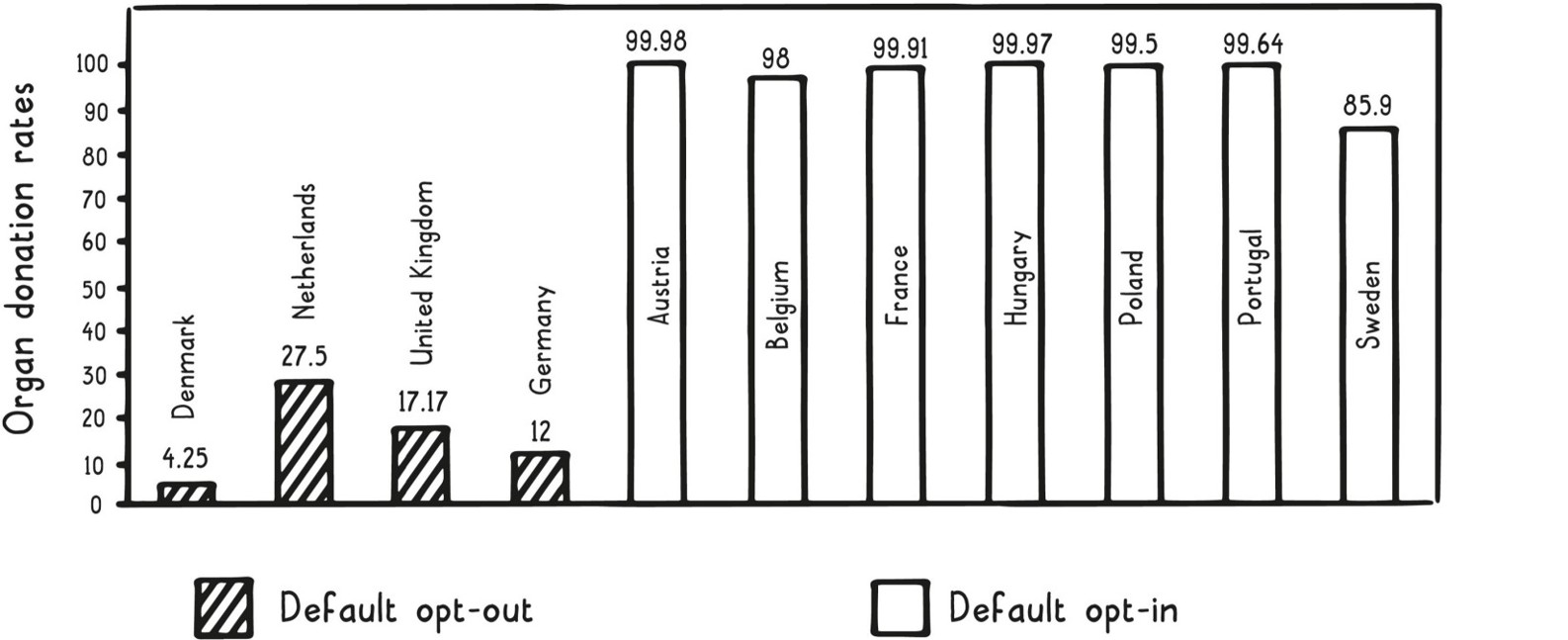
You can use the default effect to your personal advantage by making default commitments toward your long-term goals. A simple example is scheduling recurring time right into your calendar, such as an hour a week to look for a new job, deep-clean your living space, or work on a side project. Thereafter, by default your time is allocated to whichever long-term goal you choose. This same technique also works well for scheduling deep work. By putting deep-work blocks of time into your calendar, you can prevent yourself by default from booking this time with meetings since it is already committed.
Commitments have shortcomings, however. First, it is easy to put off making the commitment itself. Second, if the penalty isn’t large, as in many social contracts or calendar commitments, you may decide it is worth it just to break it, defeating its purpose. Third, there are many ways to formulate an ineffective commitment, including making it unrealistic (“I will work out at the gym every day”), not specifying a clear timeline (“I will go to the gym more often”), and being too vague (“I will try to exercise more”). By contrast, a realistic, time-bound, and specific gym commitment might be: “I will go to the gym Wednesday and Sunday mornings with my friend for the next three months, doing twenty minutes of running and twenty minutes of weight training, and I will give my friend twenty dollars each time I miss a date.”
Once you overcome procrastination and are actually making consistent progress toward a goal, the next trap you can fall into is failing to plan your time effectively. Parkinson’s law (yes, another law by the same Parkinson of Parkinson’s law of triviality) states that “work expands so as to fill the time available for its completion.” Does that ring true for you? It certainly does for us.
When your top priority has a deadline far in the future, it doesn’t mean that you need to spend all your time on it until the deadline. The sooner you finish, the sooner you can move on to the next item on your list. You also never know when finishing early might help you—for instance, when something important and urgent pops up in your Eisenhower Decision Matrix.
A couple of whimsical models capture the feelings surrounding end-of-project work. In his book Gödel, Escher, Bach, cognitive scientist Douglas Hofstadter coined Hofstadter’s law: It always takes longer than you expect, even when you take into account Hofstadter’s Law.
In other words, things take longer than you expect, even when you consider that they take longer than you expect! Tom Cargill was credited (in the September 1985 Communications of the ACM) for the similar ninety-ninety rule from his time programming at Bell Labs in the 1980s: The first 90 percent of the code accounts for the first 90 percent of the development time. The remaining 10 percent of the code accounts for the other 90 percent of the development time.
Both concepts highlight the fact that you’re generally bad at estimating when things will get done, because, unless you put a lot of effort into continuous project planning, you don’t realize all the little things that need to be completed to really button up a project. This has certainly proved true in writing this book!
The deeper point, however, is that you often have a choice of when to call the project “done.” This choice can dramatically affect the project’s time requirements, and periodically questioning what constitutes “done” can save you from wasted effort. In the case of the clinical study reports mentioned in the previous section, there could have been a step after each draft, comparing it with a predefined set of objectives for the project, and evaluating whether the group should move on.
Recall from Chapter 2 that perfect is the enemy of good. If you deliver that faultless and definitive report to your organization, you’ve probably waited too long. A less-than-perfect solution is often good enough to keep optimally moving forward. This model applies in other contexts as well: waiting until you are sure you are making the perfect decision, until you have crafted the flawless product, and so on. The best time to call something done is much earlier than it usually happens.
Of course, there are times when the circumstances call for getting things closer to perfect. However, those times are rarer than you think, and so it is worth considering ahead of time and again during a project what final quality level is acceptable, that is, what done means in this context (see reversible decisions versus irreversible decisions in Chapter 2).
Another often-overlooked option is to abandon the project altogether before it is done. Sometimes you need to acknowledge that you are just not on the path to success. Other times you may find that what it would take to get where you originally wanted to go is just not worth the effort anymore. Unfortunately, psychologically, your mind is working hard against you here, and loss aversion is the model that explains why. You are more inclined to avoid losses, to be averse to them, than you are to want to make similar gains.
Quite simply, you get more displeasure from losing fifty dollars than pleasure from gaining fifty dollars. Since you hate losing, loss aversion can cause you harm under many circumstances. You may hold losing stocks way too long, hoping they will recover back to the value they had when you bought them. You may stay in a house despite wanting to move, because you are waiting until its selling price exceeds your purchase price. These purchase prices are arbitrary numbers, independent of the current value of the assets, but they are meaningful to you because they represent losses or gains. Similarly, you may avoid killing a project because that would mean admitting the loss of your efforts up to that point.
Daniel Kahneman and Amos Tversky’s work on this topic, detailed in the October 1992 issue of the Journal of Risk and Uncertainty, reported that across many risky situations, such as winning or losing money based on a coin toss, people tend to want the potential payoff to be around double the potential loss before they are willing to take the gamble. That is, people want to have a fifty-fifty chance of winning one hundred dollars if they have to put fifty dollars on the line.
Loss aversion can be better understood using the frame of reference model (see Chapter 1). When you already have a win on your hands, you tend to want to lock in your gains. From this frame of reference, you tend to act more conservatively and are more likely to pass up a chance at a bigger gain if it means risking your current winnings.
Conversely, when you have a loss on your hands, you’d rather take a chance at breaking even than accept the sure loss. From this frame of reference, you tend to act more aggressively, not wanting to end with the loss.
From an objective frame of reference, however, you should approach both situations from the same standpoint of opportunity cost. By holding on to a loss too long, you are misallocating time or money that could be better used on another opportunity. Similarly, by walking away after a sure but small gain, you may be missing out on a potentially better opportunity.
When it comes to losses in particular, you need to acknowledge that they’ve already happened: you’ve already spent the resources on the project to date. When you allow these irrecoverable costs to cloud your decision making, you are falling victim to the sunk-cost fallacy. The costs of the project so far, including your time spent, have already been sunk. You can’t get them back.
This can be a problem (fallacy) when these previous losses influence you to make a bad decision. An instance where sunk costs lead to an escalation of commitment is sometimes called the Concorde fallacy, named after the supersonic jet whose development program was plagued with prohibitive cost overruns and never came close to making a profit. Ask yourself: Is my project like the Concorde? Am I throwing good money after bad when it is better to just walk away?
Everyday sunk cost fallacy examples can run from less consequential decisions, such as finishing a movie or book that you don’t like, to larger ones, such as investing more money into a failing business or staying in a career or relationship that is turning sour. You need to avoid thinking, We’ve come too far to stop now. Instead, take a realistic look at your chances of success and evaluate from an opportunity cost perspective whether your limited resources are best used continuing what you are doing or pursuing another opportunity. You may have made a commitment, but given all you know now, this may be one of those situations where you should break it.
Evaluating your chances honestly can be difficult because you want so badly to believe that you can succeed. In a 1968 paper in the Journal of Personality and Social Psychology, Robert E. Knox and James A. Inkster described two experiments they conducted at two different horse tracks. They asked as many people as possible to rate the chances of their horses’ winning. Some of the people were interviewed right before their bets were placed, and others right after. The group questioned after they made their bets rated their horses’ chances significantly higher. This supported the scientists’ prediction that, post-bet, bettors were more confident in their choices. The difference is consistent with commitment increasing confidence, although comparing different bettors does not show how each person’s confidence changed (see cognitive dissonance in Chapter 1). Remaining data-driven can help you avoid this mistake. The “power of positive thinking” can only get you so far.
Some economists argue that considering sunk costs is okay when taking a loss may damage your reputation. However, you should also consider that holding on to something for too long because of pride can also damage how you’re seen by those who are let down by your failure or stuck bailing you out. Reassess whether continuing is worthwhile given what you now know.
Sometimes, though, you can indeed right the ship. In these situations, admitting you are not on the right track is the best way to save a project. This admission can push you to change strategies and tactics and possibly call in reinforcements.
In Chapter 1, we discussed postmortems, where you analyze project failures so that you can do better next time. But you don’t have to wait until the end of a project—you can also conduct mid-mortems, and occasionally even pre-mortems, where you predict ahead of time where things could go off track.
In Chapter 1, we also discussed the third story, where you look at conflicts from an objective point of view. You need to use the same point of view when evaluating your own projects. If you recognize that you cannot do that, then bring someone else in to help you get out of your own way.
When to use it
Retirement savings: Using automatic enrollment in a 401(k) program to make participation the default.
Personal finance: Noticing when the appeal of an immediate payment changes a comparison with delayed payments.
Project management: Use pre-mortems to anticipate obstacles and avoid escalation of commitment due to loss aversion.
Health and fitness: Making an exercise commitment specific enough to schedule and check.
FROM THEORY TO EVERYDAY LIFE
In practice
Lottery Net Present Value
The hypothetical lottery example compares receiving $1 million each year forever vs. a lump sum today. Using a 5% discount rate, the NPV of the perpetual annuity is $20 million, showing how future payments are heavily discounted.
Dieting and the Donut
When on a diet, the immediate pleasure of a donut is valued highly compared to the distant goal of weight loss, illustrating present bias and hyperbolic discounting.
Horse Track Bettors' Confidence
A 1968 study found that bettors who had already placed their bets rated their horses’ chances higher than bettors who were about to place them. The result is consistent with increased confidence after commitment, but it compares different people rather than measuring each bettor before and after.
A MOMENT TO REFLECT
Put it to work.
Identify a current goal you are procrastinating on. How might present bias be affecting your daily choices?
What commitment device could you put in place to help you stick to a long-term objective?
Recall a time you continued a project or relationship due to sunk costs. In hindsight, what would have been the rational decision?
References
- Some Empirical Evidence on Dynamic Inconsistency — Richard Thaler
- Prospect Theory: An Analysis of Decision under Risk — Daniel Kahneman and Amos Tversky (1992)
- Postdecision Dissonance at Post Time — Robert E. Knox and James A. Inkster (1968)
- Gödel, Escher, Bach — Douglas Hofstadter (1979)
- The ninety-ninety rule — Tom Cargill (1985)
CONTINUE THE CONVERSATION
Source texts
- Super Thinking (Gabriel Weinberg, Lauren McCann)